Strong Wings

My neighbor stops by while I’m weeding my kale seedlings, asking what’s this? and this? and then stands where mulched blueberry plants edge up against a wild spread of field, heading down the back hill. Bind weed, ripped relentlessly from my garden beds, twines around milkweed.

Monarch banquet, I answer.

Through our domestic life – a teenager in and out of love, trampoline jumping – these ancient migrations make their way around us, munching, fluttering, procreating, moving on.

What it takes on this planet,
to make love to each other in peace….

– Pablo Neruda

Mason-Dixon

The summer my nephew was 10, my daughters and I spent a long piece of the summer with his family in Charlottesville, Virginia. We were visiting because of family illness, and so it was me and the kids and a palpable uncertainty and unhappiness, and sweltering days and nights – and, since we are this kind of family, we laughed a lot, even at things that may not have been hugely funny. The four kids and myself explored the surrounding woods and the downtown, and my nephew – a boy hungry for history and stories – offered a near nonstop commentary about his hometown’s past. My own daughters, who’ve lived in woodsy Vermont all their lives, were mystified by the sprawling historic mansions, the prolific Civil War statues, the presence of the past.

In one long ramble, my nephew mentioned the War of Northern Aggression –  a name never mentioned in my New Hampshire public schooling. He was stunned I’d never heard the term.

Really? he asked.

Really. Like that, I was ashamed, suddenly seeing this sticky and different place more foreign and infinitely more complex than I’d imagined. The statues, the big houses, my nephew’s intricate stories were but keyholes, tiny slits into a titanic past.

And one day we must ask the question, “Why are there forty million poor people in America?” And when you begin to ask that question, you are raising questions about the economic system, about a broader distribution of wealth. When you ask that question, you begin to question the capitalistic economy.

– Martin Luther King, Letter From Birmingham Jail, 1963

FullSizeRender.jpg

First Star I See Tonight

Dislike of burning fossil fuels notwithstanding, I love driving through the White Mountains, this journey from my brother’s house to mine. Last night in the crepuscular light, my feet wet in sandals from kayaking, my 12-year-old daughter quiet beside me, we wound through the granite mountains as dusk fattened into dark.

Just before we left, my brother and I walked through his house, talking, feeding his dogs leftover bits of dinner. My brother remarked how much he remembered this one particular hike we took as kids on countless Saturdays: in black-fly spring, humid summer, autumn’s splendor. We saw a snowy owl, an opossum in a tree hanging by its tail, scads of wildflowers, a few other hikers.

Driving through that gorgeous sprawl of granite and forest, white-clapboard towns and curvaceous river, with the sky morphing from blue to onyx by our evening’s end, my daughter and I talked about little things, her hands around glass my brother had given her from his brewery. Playing music from her teenage sister, she asked if I knew a particular song she didn’t: AC/DC’s Highway to Hell. Sure, I knew that one.

Through all the other junk in my head, I realized about the time we saw the first single star poised over a St. Johnsbury steeple that the infinity of childhood hiking – through days laughingly glorious and those heartless ones when we bickered and were terribly out of sorts – braided in one long inseparable whole, as sacred as I’d ever get in this earthly realm.

Will my daughters, looking back on their childhoods filled with both love and grief – as we all come to, in some variation of measure or another – see the same? Perhaps that actually may not matter. Maybe the journey together will be sufficient.

that midsummer night…
the cold moon
fills my whiskey glass

– Chenou Liu

FullSizeRender

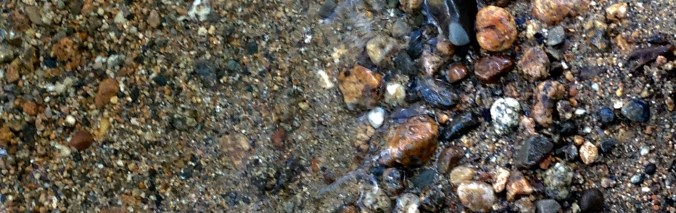
Sacco River, New Hampshire


Hey, Kid!

The other evening I walked by a kid in shorts and a t-shirt crouched down in the mess of road construction on Main Street. What the heck? He was about seven-years-old or so, his hands on a thick stake with a blue triangle flag hammered into the bulldozed dirt.

The little boy was so serious that I stopped and looked back at him. Evening, the workers had long since quit, and no one was around except for cars and pickups on the road. The boy snapped off the stake, immediately put it over his shoulder, and walked down the road quickly.

Slow-thinking perhaps, I didn’t realize what the child was up to, until I saw his yet-serious face glance over his shoulder at the blue flag, and then his fingers came back and brushed the triangle, lightly, without lessening his speed.

The kid was working, doing serious stuff, holding up the veritable imaginative life of the village. So intent he never smiled, he hurried across the street and disappeared around a building, out of my sight.

When we are mired in the relative world, never lifting our gaze to the mystery, our life is stunted, incomplete; we are filled with yearning for that paradise that is lost when, as young children, we replace it with words and ideas and abstractions – such as merit, such as past, present, and future – our direct, spontaneous experience of the thing itself, in the beauty and precision of this present moment.

– Peter Matthiessen

FullSizeRender.jpg

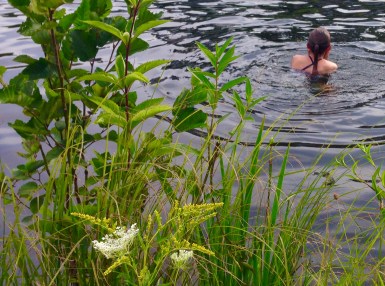
Summer girl

Far Travels

Here’s something I never told my daughters: the summer I was 19, the hitchhiking tour of New England my then-boyfriend and I took ended in a convertible ride from Springfield, MA, up I-91 to Brattleboro. The car was an enormous old beauty from the 1950s, and the boyfriend sat up front and talked nonstop with the driver, an ebullient pilot of his darn cool car. I sprawled in the back, the wind wildly noisy, holding my hair out of my face with both hands.

I was 19, in lust but not in love with the boyfriend, and I knew I wouldn’t marry him, as he doubtlessly knew he would never marry me. But we were both at that age of no longer child but not really adult, and we were madly in love with the world, with just the sheer possibility of living.

Every now and then, I think back to my younger self, flying up that interstate in a stranger’s car, my legs stretched out on the red leather seat, with no seatbelt tethering me in, admiring all that sky gradually darkening into a bloody July sunset.

I wear seatbelts now. I never hitchhike. My daughters sleep under a solid roof, in a well-built and deeply insulated house. My older daughter is 18, and I think of this story sometimes when she’s headed off with her friends. I say the same things my parents said intently to me, Drive safely. Keep your eyes open. Come home.

I stand in the doorway, watching her leave. What are you doing? she asks. And when I say, humor me, humor me, she’s gracious enough to do so.

It’s lovely to live on a raft. We had the sky, up there, all speckled with stars, and we used to lay on our backs and look up at them, and discuss about whether they was made, or only just happened…

– Mark Twain, The Adventures of Huckleberry Finn
FullSizeRender.jpg

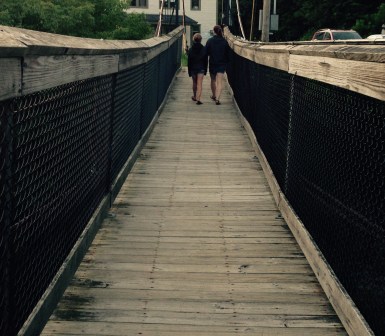
Sisters.


Between

Standing in our open kitchen doorway this morning, waiting for coffee to brew, I watched a turkey vulture sweep silently over the barn, wings outstretched, so near I saw its feathertips fluttering in the air currents. Hours before, walking in the evening’s mist-soaked gloaming, my 12-year-old daughter counted 40 vultures dropping and ascending over an empty ballfield. Gradually, their drifting and layered circles widened, so we appeared to be in the center of their vortex.

Carrion eaters.

I looked at my daughter, wondering if she was afraid. The vultures – black against a gray sky – dipped especially low, reminding me of Andrew Wyeth’s stunning painting of a single vulture. I had seen it for the first time in a museum’s basement room, beautiful and ominous, imbued with human emotion. But my daughter kept walking beneath these circling birds, face tipped up, curious.

Under our feet, earthworms, grubs, centipedes, work in the soil in my evolving garden, in the forest behind our house, beneath the stream hidden in the thickets of August’s greenery. Between the earth and the sky, human life unspools busily all day, sometimes into the night in our small town. Then, these birds. Silent, skilled. How could she not admire them, as I was again, this early morning?

I light
a small fire in the rain.

– Galway Kinnell, from “Under the Maud Moon”

FullSizeRender.jpg

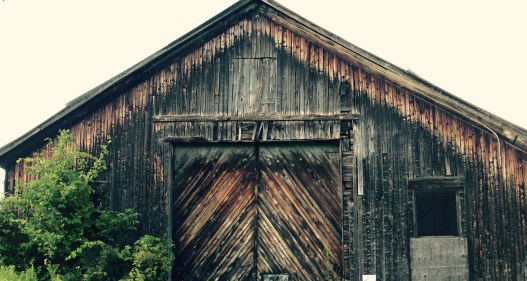
Abandoned granite shed. Hardwick, Vermont.