Knitting Circle

Note this: a Vermont November day in the fifties. My girls toss text notes to me from Hardwick to my windowless desk in Burlington: Who did you loan the pie pans to? When will you be home?

The teenager and her friend are hatching a plan to pick up an old friend at the airport which requires, first, that ancient human activity: waiting.

The friend, nervous, taps her phone.

I take out the hat I’m knitting, and – like that – the girls ask for needles and yarn. My teenager, former Waldorf student, knits quickly, weaving in a second color. The kittens leap from one ball of yarn to another. Our needles, fingers, and voices work, in this other old activity: women at handwork.

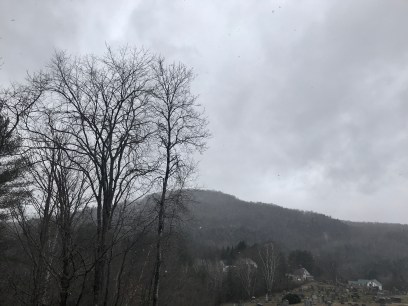
Twilight comes to the little farm
At winter’s end. The snowbanks
High as the eaves, which melted
And became pitted during the day,
Are freezing again, and crunch
Under the dog’s foot. The mountains
From their place behind our shoulders
Lean close a moment, as if for a
Final inspection, but with kindness,
A benediction as the darkness
Falls….

From Hayden Carruth’s “Twilight Comes”

IMG_0370.jpg

Thread of Thanks

Before I turned off the lights and went home from the library the other day, I checked out a ‘thanksgiving’ tree a child had made and left behind, maybe to dry, maybe because the project was forgotten. Branches were stuck in a mason jar, with colored leaves tied on with white yarn, handwritten with the child’s thanks.

Whoever this child is, she or he had painted the jar a brilliant turquoise blue, and the branches were so large, they nearly tipped the jar over.

I read a few written in purple marker in a child’s handwriting: mom, my bike, the sky, chocolate.

These November days, the dark is ubiquitous. I rise in the dark with the mewling kittens. Before I begin dinner, the dark has already wrapped us again, familiar, like a long-term visitor we must endure. The heady days of an evening swim in the lake, of splashing while the late sunset descends, will return.

Here’s my own offering, from Julie Cadwallader-Staub’s Milk:

… and it was all too much then –
the endless stream of groceries meals
bills illnesses laundry jobs no sleep –
so to sit in the rocking chair was sweet respite,
to do just one thing:
watch the baby
drain the profusion of milk out of me
watch the baby
become so contented that nursing faded into sleep…

IMG_0375.jpg


Pre-Thanksgiving

When my daughter was four, she went through a period when she wanted the same handful of books read aloud each night. One of these books was Peter Spier’s ornately drawn picture book without words about Noah’s ark. The book was a hand-me-down from her cousins, and it was the only Bible story I think we ever read to her. The Old Testament’s grief and struggle doesn’t seem the cheeriest childhood bedtime reading.

But she loved the two-by-two of the animals, the dove with the olive branch, and Noah patting the soil around his vineyard at the end.

Yesterday, I picked up a gardening book at the library and read parts of it aloud to my daughters. The yard at our new-to-us house is fairly flat, blank slate. Envisioning growth, the three of us all agree on this common point: grapes.

Dreaming of a small vineyard, years in the tending: November. Thanksgiving.

images

Librarians Rock

5 hours of interlibrary loan training? Really, the best thing about library conferences is the decency of fellow librarians. Smart, witty – definitely quirky – exuding a capability far beyond the circulation desk. Usually women, many of these librarians are likely equally handy shoveling a roof or driving a tractor.

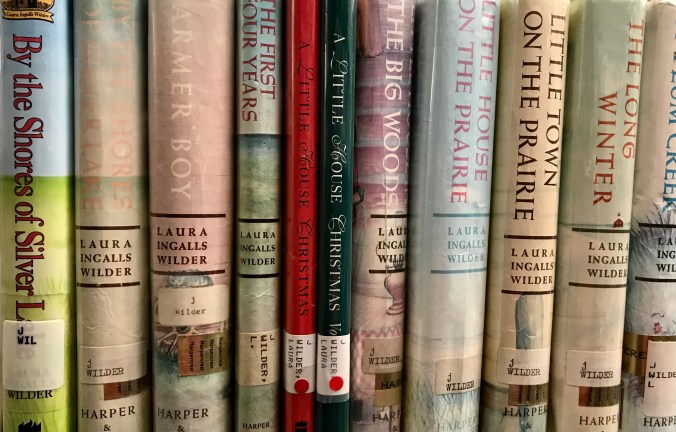
Better yet, wandering deep in the state library stacks, I found a row of the Little House books, and remembered when I first discovered these in second grade. Shelved in the Ws, the books were on the bottom shelf. Even now, I remember my intense happiness at finding so many of these novels.

The real things haven’t changed. It is still best to be honest and truthful; to make the most of what we have; to be happy with simple pleasures; and have courage when things go wrong.

– Laura Ingalls Wilder

IMG_0361.jpg

Vermont Currency

My neighbor offers to pay me to stack her wood. I reply she can’t pay me, but I would stack it anyway.

The woman and I stand in her yard, looking eye to eye. I am inches below five feet. In her seventies, the woman seems both tough and fragile. She asks what she’s going to have to do for me – cook, is that it?

Without thinking, I say something that surprises me: Maybe you should just be happy with this? Why not do me a favor and allow me to do this?

She thinks this over – there’s an actual pause – before she agrees.

It’s an interesting and largely unspoken contract. She’s an attorney; I’m a writer. We’re each divorced. Both small and scrappy, accepting help is a reluctant relief.

The next morning, while I’m cooking noodles to pack for my daughter’s lunch, my neighbor appears at our double glass kitchen doors. I’m in trouble, she says.

I ask her in, cautioning her not step on a kitten.

She’s closing on her house at noon, and behind in packing. When my daughter heads to school, leaping the cemetery fence, I walk over to the neighbor’s and take a look. Then I walk back to my house and shout for my teenager to wake up. Your help is needed! In a bit, my long-legged girl walks over drinking a can of this orange juice she keeps buying, takes a good around, says, Hmm, and then, Where’s the packing tape?

A skilled packer, when we run out of cardboard boxes, she goes out to the woodpile, empties plastic milk crates, and loads those with the iron skillets. We pass a fat black marker back and forth between us, to label the boxes.

Written on my summer fan
torn in half
in autumn.

– Bashō

IMG_0352

Specificity in Writing

Like many people I know, I cut my early reading teeth on Little House on the Prairie, and reading the new fictionalized version of Ma (er… Caroline) brings back the days when reading a chapter in a real, fat book was a very big deal.

The book is an interesting take beyond the troupes linked with each character – blue calico and blonde hair with Mary, a red dress and brown braids with Laura, Ma and the china shepherdess, Pa with the gun, baby Carrie and her beads, even loyal Jack warning his growl – into the grownup terrain of a woman in labor.

At the end, I remembered Jacqueline Woodson saying that she insists her writing students know all stories have a specific place and a time. Not long after the Osage left their land, here’s sometimes naughty, sometimes sweet little Laura taking one last final look at the cabin her father built in a sea of virgin grass, as their wagon rolled away.

The wagon lurched as Charles jumped down, then shuddered with the loosening of the rope at the back so that Laura and Mary could peep out through the wagon cover. For a long moment it was still. The Caroline heard Charles’s footsteps, receding instead of approaching. She did not trust herself to look forward again if she looked back, but she turned. Laura and Mary crowded the small keyhole Charles had made in the canvas. Past their heads, a narrow swath of the cabin was visible.

– Caroline, Little House, Revisited, by Sarah Miller