Hardwick Postcard #9 1/2: General & Particular

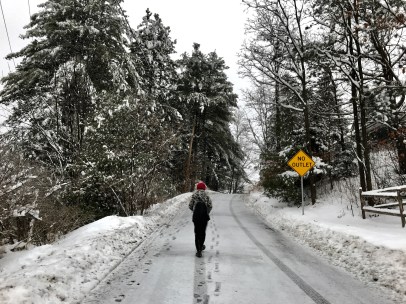
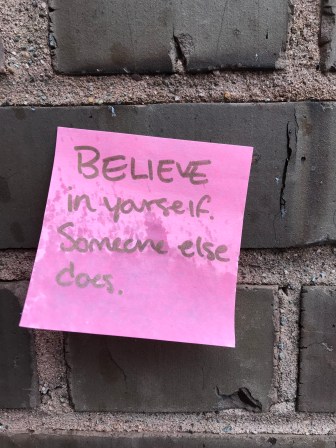
On this eve, two photos: one of generalness of American life, the sludge of hurrying here and there, fueled by the genericness of roadside gas and plastic-wrapped convenience food.

Within all this, the utter uniqueness of my older neighbor opening her storm door for a long-haired feral cat, the loud boys across the street pummeling each other with snowballs, my daughter walking home, eggnog and a gift for her friend on her back.

I do not understand the mystery of grace — only that it meets us where we are and does not leave us where it found us.

— Anne Lamott

IMG_0668.jpg

Hardwick, Vermont

IMG_0665.jpg

Hardwick, Vermont

Hardwick Postcard #9: The Close and Holy Snow

I’ve never lived in the tropics, but my friend has, and she’s remarked on the suddenness of nightfall in that region of the globe. A crepuscular walk in autumn’s lengthy twilight is a boon of Vermont living. The first solid snowfall of the year is another.

Now just a few days before Christmas, the other night my daughter and I were in Montpelier, in the frantic traffic, the rush of after-work shopping, and so this morning, when the snow began falling, one silent flake after another, the dawning day seemed filled with a particularly brilliant kind of light.

Whether we want the snow or not, it will come, and a snowstorm always sheds a certain silent grace. When my children were very small, more than anything, I wanted Christmas to be full of joy. Like so much else in my life, I’ve half succeeded and half utterly failed. We’ve had plenty of joy and lavish laughter, but the older I get, the more I understand joy travels hand-in-hand with sadness and grief, too — that the exquisite beauty of that snow carries a killing cold as well.

I think it’s taken me all these Christmases to understand the spirit of this season is so perfectly illustrated by Dylan Thomas’s “close and holy darkness,” and that the most miraculous aspects of this season are the profound mysteries upon mysteries unfolding despite (and perhaps in spite of) my own blind ignorance.

Today, watching the snow fall, my face upturned to the clouds, I remembered being ten-years-old and speculating with my sister about the origin of all those millions of snowflakes, drifting and twirling down. What did it look like, so high above our heads in those clouds?

Awesome.

And when the firemen turned off the hose and were standing in the wet, smoky room, Jim’s Aunt, Miss Prothero, came downstairs and peered in at them. Jim and I waited, very quietly, to hear what she would say to them. She said the right thing, always. She looked at the three tall firemen in their shining helmets, standing among the smoke and cinders and dissolving snowballs, and she said, “Would you like anything to read?”

— Dylan Thomas, “A Child’s Christmas in Wales”
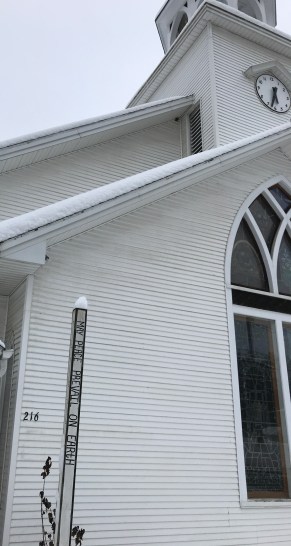
IMG_0644.jpg

Jeudevine Library, Hardwick, Vermont

Hardwick Postcard #8: Talk, Talk

There’s not a bland way to write this: gossip is part of the human condition. Gossip in a small town? Can be funny. Or scorching.

Arriving at a library meeting, someone walks in and says, I’ve been to the post office. I’ve got gossip.

I come out from the stacks where I’ve been shelving books and say, Do tell….

I spend a lot of time at the post office, and I frequently have the odd sense the post office folks know me intimately. While my email inbox may have more details, a whole landscape of my life channels through that slender box. Like gossip, sometimes the mail’s good, sometimes bad, and sometimes rather dull.

From the post office gossip unravels laughter, but then much seriousness, too. The story is about one person, one family, but really about our community. In a multifaceted way, it’s a variation of the contemporary disfunction of our greater society, about emptiness and loneliness, and the natural lust to fill those caverns in our souls, and how badly awry human nature can go.

Then we stop talking for a moment. We just stop.

Later, my daughter sends me a photo of a post-it she found on a classroom building at Johnson State. She snapped the photo and left the note for another passerby to read.

Reading fiction not only develops our imagination and creativity, it gives us the skills to be alone. It gives us the ability to feel empathy for people we’ve never met, living lives we couldn’t possibly experience for ourselves, because the book puts us inside the character’s skin.

– Ann Patchett

IMG_1900.jpg


Hardwick Postcard #7: Middle School

At the middle school concert’s intermission, my merry-eyed daughter sat behind me with a girl I didn’t know, so I turned around and introduced myself. Being 12, the girls laughed at this weirdly formal introduction, and then the couple beside me began laughing, too. I had been sitting beside the girl’s parents.

It’s a little world we live in.

I chatted with the new friend’s parents. Quickly, the girl’s mother and I realized we had both served on an elementary school board. The lights dimmed just as we started a conversation that could have launched into a very long conversation about school consolidation.

For all its myriad faults, public education — at least in Vermont — is still all about the local community. Chances are, at a middle school concert, you’ll sit beside people you like, and, equally possibly, besides people you don’t.

But you’re all still there.

My father sent me this Wendell Berry essay. Read it.

In 1936, moreover, only a handful of people were thinking about sustainability. Now, reasonably, many of us are thinking about it. The problem of sustainability is simple enough to state. It requires that the fertility cycle of birth, growth, maturity, death, and decay—what Albert Howard called “the Wheel of Life”—should turn continuously in place, so that the law of return is kept and nothing is wasted. For this to happen in the stewardship of humans, there must be a cultural cycle, in harmony with the fertility cycle, also continuously turning in place. The cultural cycle is an unending conversation between old people and young people, assuring the survival of local memory, which has, as long as it remains local, the greatest practical urgency and value. This is what is meant, and is all that is meant, by “sustainability.” The fertility cycle turns by the law of nature. The cultural cycle turns on affection.

Wendell Berry

IMG_0622.jpg

Main Street, Hardwick, Vermont

Hardwick Postcard #6: Young Men

Without much discussion in the hardware store’s parking lot, the girls picked out a tree from the high school’s forestry program, then looked at my small car, the tree, and the car again.

The young man who had sold us the tree said, If you’re not going far, I’ll take your tree home for you. He had been selling trees all day in the cold, and his cheeks were red. Like most of the young men who work in the woods and know how to use tools and their hands, he was polite. He was a young man who would insist on taking off his boots rather than track mud on your kitchen floor.

He put the tree in the back of his truck, followed us home, and carried it to our back porch. I gave him a handful of chocolate chip cookies the girls had made that morning.

Barter economy? Perhaps an illustration. Or maybe just young man decency.

The two great aims of industrialism – replacement of people by technology and concentration of wealth into the hands of a small plutocracy – seem close to fulfillment.

– Wendell Berry

IMG_0592.JPG