Good Humor

My dad had this phrase when I was a kid — a high-entropy day — a confluence of crazy, falling-apartness. All those years we sugared, March was high-entropy: we endured ice storms, broken machinery, illness, unexpected expenses.

In snowy and muddy Vermont March days, I always fooled myself into believing June was nothing but sweetness.

June, yesterday, green and gorgeous, and around us: chaos — all the factors of work and extended family, wound through with the golden chicken who got into the neighbors’ garden. At the end of the day, I stood in our upstairs glassed-in porch, threading through a work problem on the phone, watching birds dart around our house. Little tiny birds I didn’t know dove into an enormous, flowering mock orange tree.

When I came downstairs, where my girls were at the dinner table, they showed me a three-line text from their MIA parent, the one who hasn’t so much as given his girls a piece of bread in years — travels with father — and I laughed. Here’s the epitome of family life, maybe of human life: a baffling and incredibly painful mystery. What the heck does any of this mean?

I write this not so much because it’s my story, but because I see this reflected over and over in the families around me: that the harder years of parenting through adolescence, through parental desires met and unmet, bring to the forefront those tensions between what’s best for the one, and what’s best for the family.

My girls and I kept eating and talking. I fed our cat a bit of bacon from my fingers. The windows were all open, and the scent of the roses drifted in. We kept talking about the day’s chaos, and then we kept laughing and laughing. It’s the only antidote I know — laughter — to the hardness of family life, to just the plain-out strangeness of what might seem so simple.

Then we went out to talk to the chickens, too.

IMG_2273.jpg

Antidote

A photograph of my daughter and her friend is on a Good Citizen poster.

What the heck does that mean, she asks? Who’s a good citizen?

I drag up my standard answers: that history matters, that good fortune doesn’t equate with good character, that our actions affect others, whether we see — or want to see — this or not.

Later, I realize I should add this in: read and write poetry.

Poems build our capacity for imaginative thinking, create a tolerance for ambiguity, and foster an appreciation for the role of the unknown in human life. From such compact structures of language, from so few poems, so much can be reinforced that is currently at risk in our culture.

— Tony Hoagland, Twenty Poems That Could Save America

IMG_2241


Age 13

My 13-year-old returns from her travels slightly shifted, changed in a perceptible way. She’s tasted a bit of the world cracked open. The younger sister, she’s now taking steps — err, leaps — into her own life. Who am I, and what do I want to do?

These early summer mornings remind me of my own wanderlust at that age, how as a child our family was happiest on the road. A number of summers, my parents packed up the Jeep, and we drove west from New Hampshire with a vague itinerary and nothing more. Maybe Wyoming, maybe Mexico. Always Colorado.

13 — such an age, such a year. While adult years all blend together — that was my wild twenties, the childbearing thirties, the hard forties — there’s age 13, the year my daughter is a child and began stretching toward not-a-child.

Chicken tending chores, her best friend, ice cream for lunch.

How we spend our days is, of course, how we spend our lives.

— Annie Dillard

IMG_2245

Hardwick, Vermont

Summer, Again

On this first day of summer, mock orange blooms beneath our bedroom windows — an enormous bush that nearly reaches to the second floor — its scent so sweet it’s nearly liquid.

Yesterday, a day that perhaps reflects our summer world: chaos combined with a languid beauty winding through. The chickens fly over their fence. My two jobs clamber for my attention. My oldest daughter coughs. My bank account teeters on dipping into the red.

And yet, a small dog named Dammit wanders through the library. The little children play in the sandbox for hours, digging with bent spoons and old trucks. That evening, I return to the library for a novelist to read. Four kids whose mother is at the food shelf follow me in. They check out books. I give them handfuls of bookmarks and Reading Rocks! tattoos. The youngest plays on the floor with the dollhouse, eating potato chips, sharing her life story with me.

Each summer I bring friends out
to note and share the (garden) display and produce.
Here is life’s habit on grand exhibit
and the hard work hidden.

— Leland Kinsey

IMG_2239.jpg

White Mountains, New Hampshire

Age 19

Oh, ode to June in all her lovely greenery.

Remember being 19-years-old? Remember desire, desire, desire?

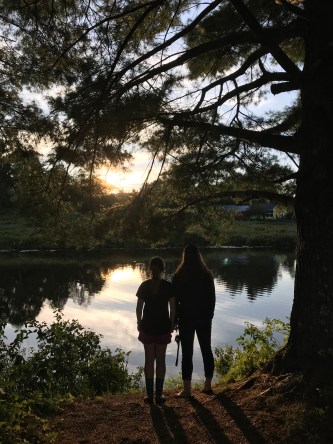
The summer river.
It’s happy to walk across it.
My hands with zori sandal.

—Buson

IMG_2215

Dog River, Berlin, Vermont

Female House

The summer my second daughter was an infant, the season was particularly hot and sticky — at least in my memory it was. That summer I just didn’t do certain things — I washed clothes and probably even folded them, but I rarely put them away.

Domestic chaos? Maybe. But I knew I would never have another baby, the  irreplaceable sweetness of a nursing infant in arms.

We were at Dartmouth Hitchcock Medical Center that summer with our 6-year-old for a very minor procedure, and my then-husband and I took turns walking up and down the hospital hallways with an infant. At one point, I stood swaying with my sleeping baby from foot to foot, reading the posters on the wall.

One watercolor was a purple hyacinth blossom with the words beneath: Choose joy.

When I drove away from the hospital, with all four of us, and crossed the river back into Vermont, I was so light-hearted, so happy. It was such a minor thing that had occurred, and we were all together and well.

Now that infant daughter is a teenager, the oldest daughter a young woman. Like all families, we’ve lived through the gamut of happiness and grief and rage. Every now and then, I remind myself, slow down, breathe deep, and finger the strand of life that’s joy.

You might as well answer the door, my child,
the truth is furiously knocking.

— Lucille Clifton, Good Woman: Poems and a Memoir 1969-1980

IMG_2193.jpg