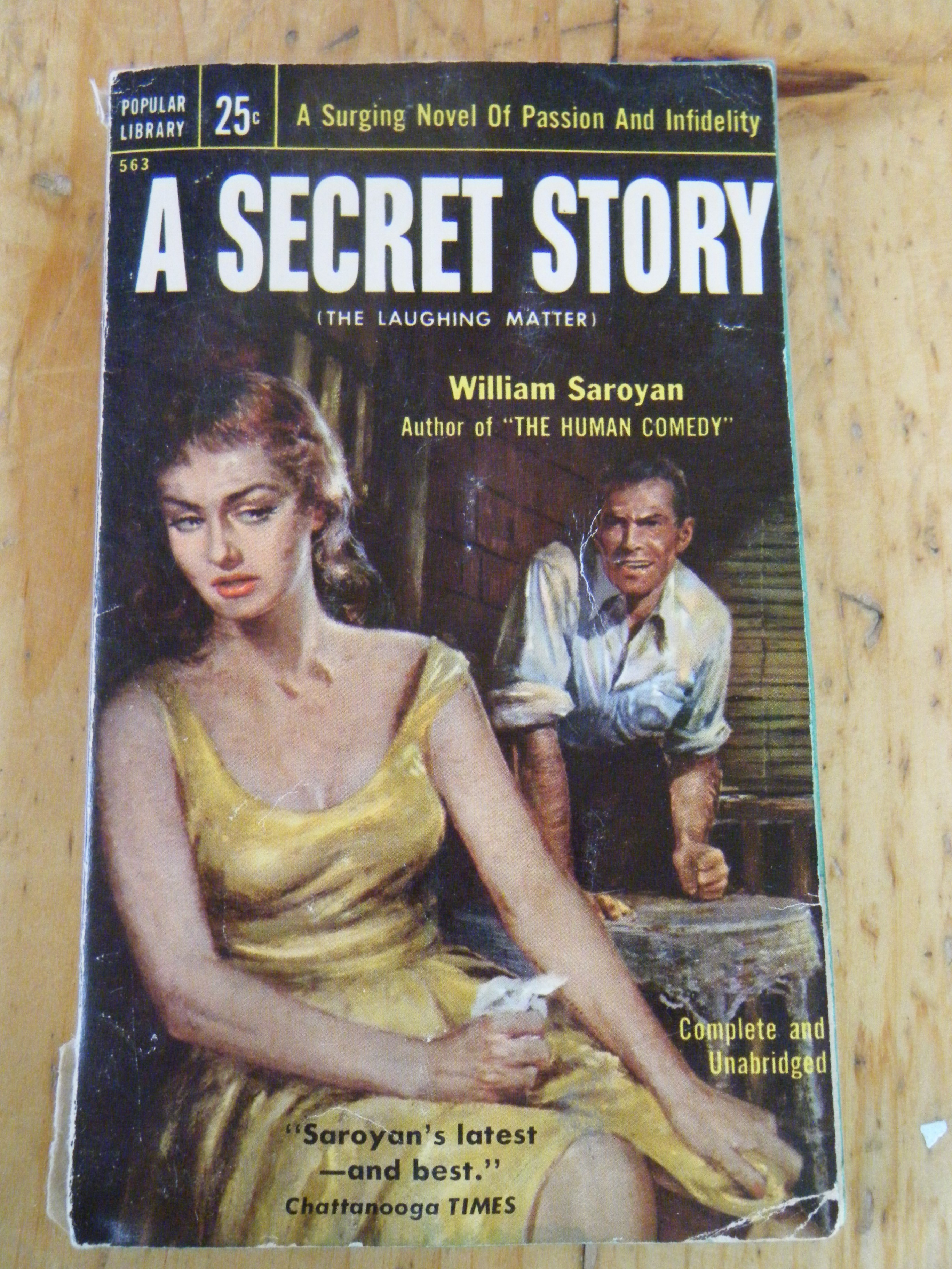
I picked up a copy of William Saroyan’s The Secret Story for fifty cents. No doubt out of print now, this copy must have been sold on a drugstore rack. I paid double the original book cost: one whole quarter. Check out the garish cover below. It’s so slutty I’m a little embarrassed to be seen reading it on the elementary school playground.
The novel, however, is classic Saroyan, and for anyone who loves Saroyan that means exquisite. The story has a tender appreciation for its characters, particularly its children, who often figure prominently in Saroyan stories and are never trivialized or portrayed as naive. The underlying adult relationships, however, are rife with sin — greed and lust and unfulfilled desire — often cataclysmically playing out.
When I learned to knit sweaters, every time I saw someone in a handknit sweater who was amenable to undressing a bit, I asked to have that sweater handed over. Then I turned the garment inside out and ran my hands and eyes over the knitting and seaming, to figure out how the sweater was created. Likewise, with writing, I can’t help but turn a novel inside out. How is this piece of writing put together? In this Saroyan novel, I immediately noticed the vocabulary is simple, just a handful of words really. A well-placed image of weeds in an irrigation ditch comes and goes with the characters: nothing flashy or show-offy, merely a ditch one-fifth full of water, and remarking whether or not to dredge weeds from the ditch. The writing relies heavily on characters revealing themselves through their own dialogue, distinctive and natural to each character.
Yet, reading this novel is like journeying down into a very deep pond, clear and transparent at the surface, increasingly murky and filled with microscopic, teeming life as the journey progresses.
David Budbill’s advice to himself is:
Never be deliberately obscure.
Life is difficult enough.
Don’t add to the confusion.
I’d add here that might mean: rely on your material. Rely on the craft of your material.
A word again on that cover. How I wish novels were still a quarter a book. Wouldn’t we all read more? The Secret Story is a racy story, filled with illicit desire, a scandalous pregnancy, a husband’s rage. But aren’t we drawn to those elements because wild desire is part of our human world? Isn’t plot — story — one of the most engrossing elements of who we are? Why not revel in story? Why not seek our own redemption through story? Why not love reading?
 Stony Soil Vermont
Love that advice from David Budbill. And also the image of you reading this on the playground. Ha! Did you read that article in the New Yorker a while back about the rise of the paperback?