For no other reason except sheer pleasure, magnetic poetry reemerged in our lives…. And sometimes one sentence is enough.

For no other reason except sheer pleasure, magnetic poetry reemerged in our lives…. And sometimes one sentence is enough.
Just on the other side of my garden lies a town cemetery, wisely placed far above Hardwick’s flood plain, with a rooftop view of the village, built on a sandy hillside and along a river. Interestingly, the villagers frequently use the cemetery as a public green space, and older women with little dogs or couples holding hands frequently pass by my elderberries.
New to this house, my daughters and I leap the fence and are beginning to know these stones – names and dates and what little local lore we’ve garnered.
Our favorite is the couple with a pithy phrase on one side – She always did her best – and on the other end – He did not. Our visitors usually pause, blinking, and then laugh out loud.
By the dates, I notice he died twenty years before his wife.
Revenge or love? It must be love. My daughters and I – we’re sticking with that theory.
We could have some arrangementBy which I’d bind myself to keep hands offAnything special you’re a-mind to name.Though I don’t like such things ’twixt those that love.Two that don’t love can’t live together without them.But two that do can’t live together with them.
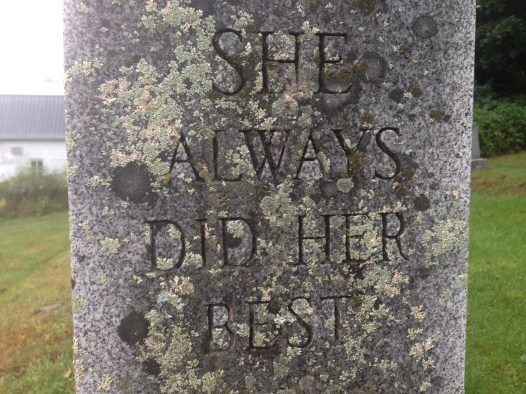
Hardwick, Vermont
Like this cold September (what? covering gardens already?), reading Knausgaard is both exasperating and mesmerizing. Does he really live in a house with small children and can write about minutiae?
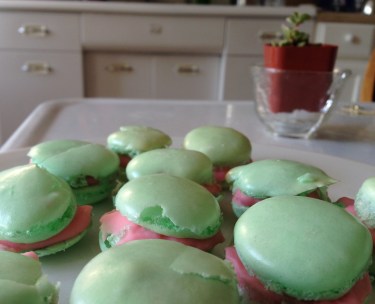
Reading at the kitchen table, my bare toes rub over the sugary effluvia of lime-green macaroon making on the floor. I keep reading.
The children wander in for more macaroons, my daughter’s afternoon vision yielding these quarter-sized airy sandwiches with a pink sweet filling. While I was in the other room, trying not to listen while tediously working on a paid project, the girls, left to themselves, experimented with baking whipped egg whites (Wow, that’s weird), periodically carrying in a baking sheet of baked samples, the hot sugar still bubbling from the oven, asking my unskilled opinion. In the end, they assembled two dozen uneven tiny cakes, dripping filling. Extremely satisfied, they stand back. Look.
Writing this, I realize (again) our life is all minutiae. Maybe that’s the gem of having children – tiny things mixed in with cosmologically-sized love – Blake’s world in a grain of sand.
Check out this sentence about ancient triceratops and reading to children at bedtime.
That petrol (in a puddle) was extracted from crude oil, which was brought up from reservoirs deep under the ground and consisted of transformed organic matter from a time when human beings didn’t exist, only dinosaurs, those gigantic but simple creatures, and when trees and plants too were larger and simpler, and that it was the prehistoric force of that zoological and biological matter which now unfolded around us, all this made sense – the kinship between the bulldozer and the dinosaur was obvious to any child – but not the connection between the power of petrol and the mysterious beauty of the small trembling rainbow swirls in the many puddles of the 1970s.
Karl Ove Knausgaard, Autumn
By chance, I’ve discovered a reprint of The Farm in the Green Mountains by Alice Herdan-Zuckmayer, published originally in 1968, about a German family who sought succor in my state during the terrible years of World War II. Herdan-Zuckmayer’s writing flows clear as water, pragmatic and thoughtful. How I wished she lived down my road today, and I might ask her to take a walk.
Among the states they (Vermonters) are a relatively poor state, but they are not afraid of their poverty; they don’t love wealth, they have little to gain and not much to lose. This modesty and moderation give them an independence from uncertain times and arm them with pride and fearlessness.

As little girls, my sister and I played pretend in a pink polyester dress and musty-smelling man’s dinner jacket and clomped around the house in my mother’s high heeled wedding shoes, with the implicit expectation someday our small feet would fit into those shiny and coveted heels.
For my feet, not so. My grown-up women’s feet are size five, my older daughter’s size eleven.
Growing up in the ’70s and ’80s, I believed in a 1950s-framework of a long marriage, two or three children primarily reared by myself as mother, a college education, and a stable and possibly sedate life. It was a vision of life I was doomed to abysmally fail.
While those values lay deeply in my culture, they weren’t particularly in my own childhood home. Unlike every other family in the small New Hampshire town I grew up in, my parents were happiest packing up our old green Jeep and camping all summer on the cheap in national parks west of the Mississippi River. We spent our best hours cooking on a Coleman stove with our kitchen stuff in cardboard boxes, playing Hearts by lantern light and reading used books at the picnic table. “Leave It to Beaver” is a concept I culturally grasp, but I’ve never watched an episode, and I’m willing to bet my siblings haven’t, either.
So when my daughters discovered my wedding dress while cleaning a closet the other day, marveling that its size will never fit either of them, I laughed and told them it was just as well. Each of them can stitch or discover their own attire.
It may be that when we no longer know what to do we have come to our real work and that when we no longer know which way to go we have begun our real journey. The mind that is not baffled is not employed. The impeded stream is one that sings.
– Wendell Berry, “Poetry and Marriage”
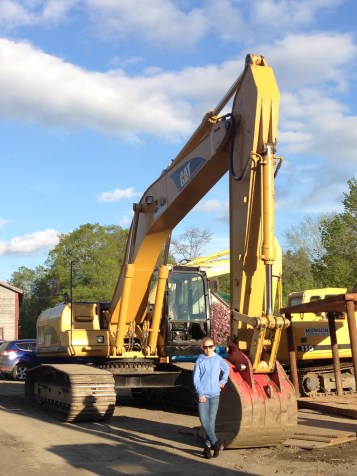
On our way to a performance of “Little Women,” we took a detour. Hardwick, Vermont
 Stony Soil Vermont