… send what you will, I will listen.

This winter, I joined a Dartmouth Writing Circle for cancer patients. At that time, my waking hours were pretty much confined to the couch, endeavoring to stay alive, and I thought why not? I’ve kept on with this Circle. Compulsively, I keep writing about disease, but others write about aging parents, children and memories, picking strawberries — the necessary pieces of our everyday lives. Their poems and short essays amaze me. Maybe the lesson is this: suffer from a disease, pay attention, unfold your heart.

So yesterday, another trip to Dartmouth, but this time not to the door of the ER or 3K — the cancer center. My youngest daughter had signed up to walk in The Prouty, a weekend of fundraising. The four of us drove together, my daughters drinking coffee and laughing in the front seat, the boyfriend and I in the back. In the thousands of participants and volunteers, I met a few of my Writing friends as if kismet.

My family ate doughnuts and drank chocolate milk. We walked and ate watermelon and the sandwiches that appeared on tables as if by magic. At a long table, we lingered beneath a white tent, admiring babies and small dogs. It was at once a family event (my family, who pulled me through this winter) and a community embrace. When my daughter signed up (and a HUGE thanks to those who donated to her team), I didn’t, as I could hardly stand two months ago. Walk a few miles? Forget that. Now, my legs gaining muscle, my body healing, I walked between my daughters, so full of youth and quickness, of wit and curiosity. So profoundly of this world.

We live lives of forgetting, but I have not forgotten those long days in 3K’s infusion center, the chemo drugs dripping into my veins while I stared through the window at cardinals in the snow, or that night in the ER when the MDs in scrubs posed the possibility that I couldn’t finish the chemo treatment, that enough was enough for my body which was now, I noticed, described in my chart as frail. An adjective I immediately hated. Fuck frail. By that time, my flesh and my blood was suffused with zofran and dilaudid, lactated ringer’s, with the mighty rituximab…. But even though my bones and my flesh are my domain, my life is not. There’s a tendency in my circle of leftish rural Vermont to look at the medical world askance — an indulgence that immediately dried up for me when I first arrived in the ER. All along, I’ve asked for the data and facts; what am living through now and what might this mean? Beyond this, I was encouraged to embrace the mysterious complexity of disease, data, determination, the universe’s toss of the dice. When I said, go ahead, make me more frail, I’ll endure, the Good Doctor made that possible.

I have not forgotten that I am alive by the grace of medicine and strangers, by my family, by illusive fate itself. I carry this knowledge as all day long I go about my life of writing and working, of watering the flowering nasturtiums, eating peaches, reading novels and poetry and cancer research beneath the apple tree, as I walk through the sultry July twilights, that this will someday — this year, or 30 years from now — change for me, too, as it changes for everyone.

But for now, luscious watermelon. Later, a family dinner on the back porch, summer sweet.

From Ruth Stone:

… send what you will, I will listen.
All things come to an end.
No, they go on forever.

Living in the Edge.

As part of my heal-from-cancer and keep-the-cancer-from-returning approach, I borrow my daughter’s yoga map on Thursday mornings and walk through the cemetery and along Little League field to the village. The studio is above the town’s coffee shop. The windows frame the town’s main intersection of routes 14 and 15, the Lamoille River, flanked by July’s burgeoning green.

As I lie on the polished maple floor, the sound of the traffic comes and goes. This calmness reminds me of those years I lived in Brattleboro, pre-internet, when the main source of my twenties’ activities was walking to the public library or a favorite bar, hiking, or hanging out with my roommates in the house we rented, running our mouths about the state of the world. There was a lot of laughter, a whole lot of discussion about morals and relativity.

This particular Thursday is the anniversary of the floods in 2023 and 2024, exactly a year apart. The class leader repeats a theme of in the edge, that fertile and sticky place between terrains. I think of this summer’s profuse wildflowers – trefoil and asters and Canada lilies – that spread between the river and the fields. Afterwards, I spread out my notebooks and papers and laptop in the coffee shop, plunge into a hard piece of work. I’ve no illusions that yoga will set me floating down any peaceful river. The edge, that complicated habitat, has long been my domain. Friends appear and tell me they’ve sold their house, are pulling up stakes and heading overseas. Around me, people come and go, talking and eating, figuring out or not figuring out parts of their lives.

Later, at home, the catbirds screech. A robin perches on the porch railing and studies me. The woodchucks scurry under the steps from den to woodpile, or have they slowed to a who-gives-a-damn saunter?

Winter, the edge terrain is a cold beast. July, I’m all in…

“Not so much a game
as a sphere,
a mystery.
Held up to light,
a small hole
into another dimension.” ~ Ruth Stone

“… hard wind and the rain that unsettled the creek…”

Evening, I linger on the porch swing, talking with my siblings as the long July day ebbs down to twilight. My neighbor texts me that a bear’s been seen in our neighborhood. As the gloaming, like a tide, washes in, I water the tomato plants. The white hydrangeas hover like magical pompoms in the dusk.

July, Vermont’s growing month. Walking with my neighbor, she points out the height of the wild grasses and flowers around her house. Already, this summer, taller than she’s ever seen. The heat and the rain have propelled immense growth. The box elders rub my house; I’ll need to ask another favor from someone with a saw.

I have not forgotten this winter when I drifted from one variation of cold to another, my body and mind fiercely bent to the intertwined goal of finishing cancer treatments and remaining alive. On the other side, what remains is what plagued me before, my own variation of hard wind and rain. And yet, a whole July hangs like a promise: sunshine all day, pink cottage roses, laughter with my neighbor about the burgeoning woodchucks.

In the late afternoon, I take a long walk in the town forest to the reservoir’s edge. Deer prints press into the mud. On this walk, I don’t see a soul. In the distance, children call to each other.

“Kitchen Sink”
Today she would change nothing,
not even the wallpaper peeling,
like dead bark. Nor, outside, the shadows
approaching the yard where ants
toil like women in their houses of sand.
Never mind that the sun will be setting.

When she was young she felt afraid
of hard wind and the rain that unsettled the creek.
But the earth never left her,
not once did the floods reach her feet.
The reward of a long life is faith
in what’s left. Dishes stacked on a strong table,
Jars of dried beans. Scraps of cloth,
And the ten thousand things of her own thoughts,
Incessant as creek water. She has been able
to lay up her treasures on earth,
as if heaven were here, worth believing.
In the water her hands reach
like roots grown accustomed to living,the roots of the cat-briar that hold to the hillside
and can never be torn free of this earth completely.

~ Kathryn Stripling Byer

Hunger.

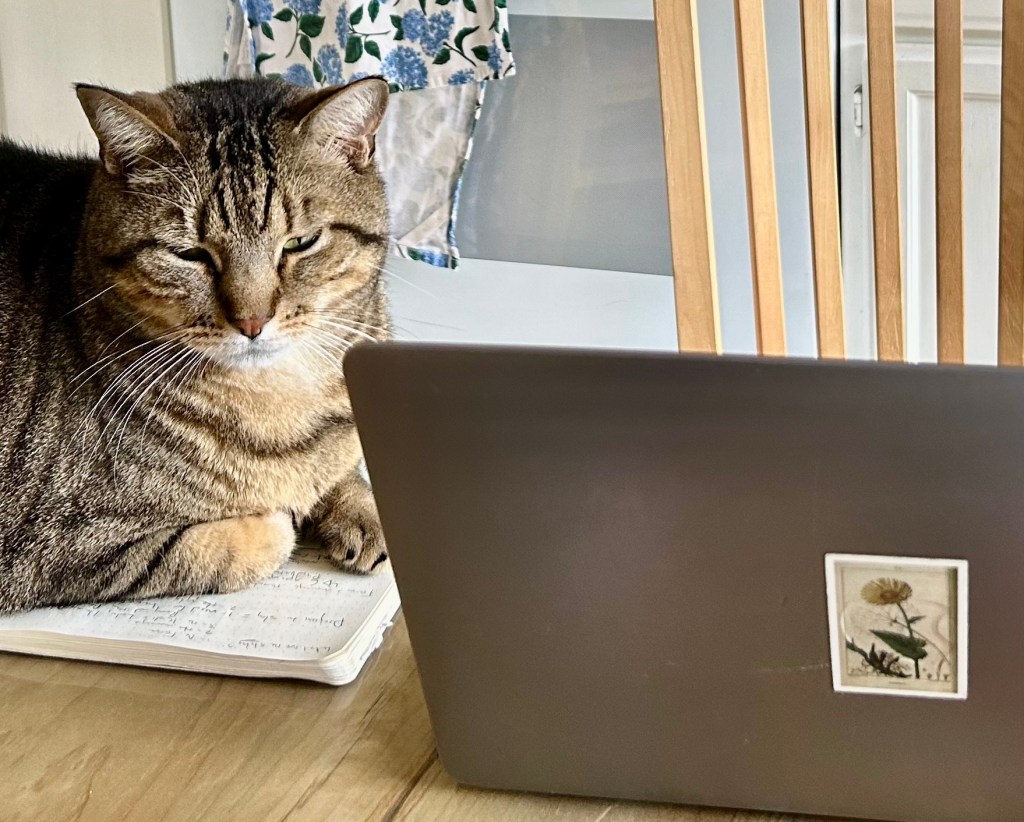
Curious cat named Acer

A few years back when my youngest was doing odd jobs, she came home with four strawberry plants someone had given her from a garden she weeded. Naturally, I planted these in our garden. The plants spread and have produced beautifully this year. I crouch beside these weedy plants and devour red berries. The crop is so small no berries ever make it into the house. Since it’s usually just me here these days, I eat in the garden. I’m famished for this sweet food. I devour the strawberries, juice dripping down my chin.

I’m ravenous for the sharp June sun, for this morning’s cold dumping rain, for my daily midday reading break, for the purring cats who clamor across my keyboard. Healing from cancer, I’m supposed to sleep (get seven to nine hours!) but, come that glimmer of gold at the horizon, I’m finished with bed, hungry for coffee, oatmeal, maple syrup. Eager to finish my novel revisions.

In those months of chemo, I’d worried my mind and imagination might dull, my fierceness lessen. Six weeks out from surgery, I’m diminished in body but a peculiar power blooms in me. A determination to do what I want. An impatience with artifice. Don’t waste my time.

And yet, the old haste that plagued my days and nights has quelled. Stopping by my neighbor’s, I sink into her armchair, set my feet on her footstool, listen, let the day’s exhaustion drape around me. That fatigue is now familiar to me as the blanket a stranger gifted me at the beginning of this cancer journey. We talk and talk, then wander outside and keep on with these conversational matters, the color of paint she’s considering for her house’s clapboards, how to encourage Columbine to grow among the phlox.

This time, I really want to listen…. I’ve spent my life mistaking instinct for fact, subjective experience for reality. What a waste of time here on earth to spend it as a slave to one story, how boring and repetitive, how many of our days are spent in chains.

From Sarah Gilmartin’s Service.

Small Kindnesses.

Writing a novel, you pay attention to action. What are the characters doing? And why? At the midpoint, the action often switches; the protagonist ceases to react and, instead, acts — and not without mishap, without complications.

I’ve long thought of labor as a metaphor. The mother’s cervix dilates (helped, sure, by walking, by receptivity), followed by the uncertainty of transition just before the mother engages in the pushing phase, the brief or lengthy or sometimes stigmied phase of bringing this child into the world.

I’m in the transition phase again in my life, beneficiary of cancer treatments and so much medical care. Mornings this winter when I woke, I began each day with a survival mindset; I would endure my body’s illness. Now, June, the birds wake me, the feathered creatures intend on nest-building, procreation, survival, maybe the joy of communal singing. In the garden, the tithonia abruptly deepen their green, expand their leaves. The hydrangeas sprawl into a fortress.

At my desk, I lean into my day’s work, hours and hours unspooling.

Late afternoon, my friend arrives with her little girl, and the three of us walk in the cool town forest. The child removes her shoes and runs over the pine-needle-spread paths. She buries her bare feet in the shallow stream’s mucky mud. Yes, June…

Mostly, we don’t want to harm each other.

We want to be handed our cup of coffee hot,

and to say thank you to the person handing it… 

We have so little of each other, now. So far 

from tribe and fire. Only these brief moments of exchange.

What if they are the true dwelling of the holy, these

fleeting temples we make together when we say, “Here,

have my seat,” “Go ahead — you first,” “I like your hat.”

~ from “Small Kindnesses” by Danusha Laméris

“Quite Serious”

My neighbor runs out his back door, shouting and waving his arms. I’m working on my upstairs glassed-in porch. He cranks up the volume on VPR’s Morning Edition. I’m guessing he hopes the young woodchucks burrowing beneath his deck aren’t NPR fans.

Like my neighbor, I am a VPR fan. This morning, news of Iran dominates the air. As I labor to join noun to verb, I notice my heart beating at Steve Inskeep’s words. Eventually, I leave my cat sprawled on the windowsill and head downstairs to wash the dishes. I’ve listened to NPR my entire life. Heck, the radio was probably playing when my parents brought newborn me home from Presbyterian Hospital in Abuquerque. Little these days is good news.

This winter, I’ve written in this space about my obsessive struggle to remain among the living on this planet. Only now—two surgeries, six rounds of chemo, 11 hospitalizations later—do I realize the diciness of my determination to live. A few weeks ago, driving with my daughter, she showed me a lawn where she cried on a bench because I believed my mother would die. Every day now, as I begin by feeding my two cats and drinking coffee, I carry this winter, those months of spitting distance from my grave, within me. As at the beginning, my greatest worry was/is my daughters. So many months later, I understand how my life is connected intrinsically to so many others. That what lies before my eyes are the twig tips of stories.

In my younger, brasher years, I might have written about politics and conflict, but the Mideast is a place I’ve never been, with people I’ve never met, for whom I will never speak. Too, I’ve knocked around this planet long enough to know that violence changes the world, irredeemably. That the combination of deceit and anger and hubris wrecks destruction. And that cruelty wrought can never be undone. We hurtle onward. I keep listening.

June, and pink roses bloom against my house, planted by someone I never knew, perhaps the woman known as Grandma Bea buried in the adjacent cemetery’s crest. My daughters climb a mountain with a view of Vermont’s shimmering Lake Champlain and the emerald patchwork of farms stitched together. They return with a gift for me, a thorny rosebush with fragrant blossoms that fill my cupped hand. In the evening, shortly before dark, I walk in my bare feet, the long grass already cool with dew. High heat is predicted, the planet is surely burning up, but this ruby-and-gold sunset drags in a coolness. Lush, so lush this month. The butternut tree I planted stretches towards the apple someone else carefully cultivated and noted in pencil on the barn’s bottom wall. A record someone held dear.

In 1956, Allen Ginsburg wrote: “America this is quite serious.”