Playing Hearts, Writing Books

Last night, my ten-year-old daughter, her grandfather, and I played Hearts. New to this game, she was tentative for a few hands, fearful of losing. The third game in, she dropped a card that caught me entirely by surprise: a king of clubs who gobbled up my sloughed heart. The card was so precisely the right one I gasped aloud. She won this game on her own fine merit.

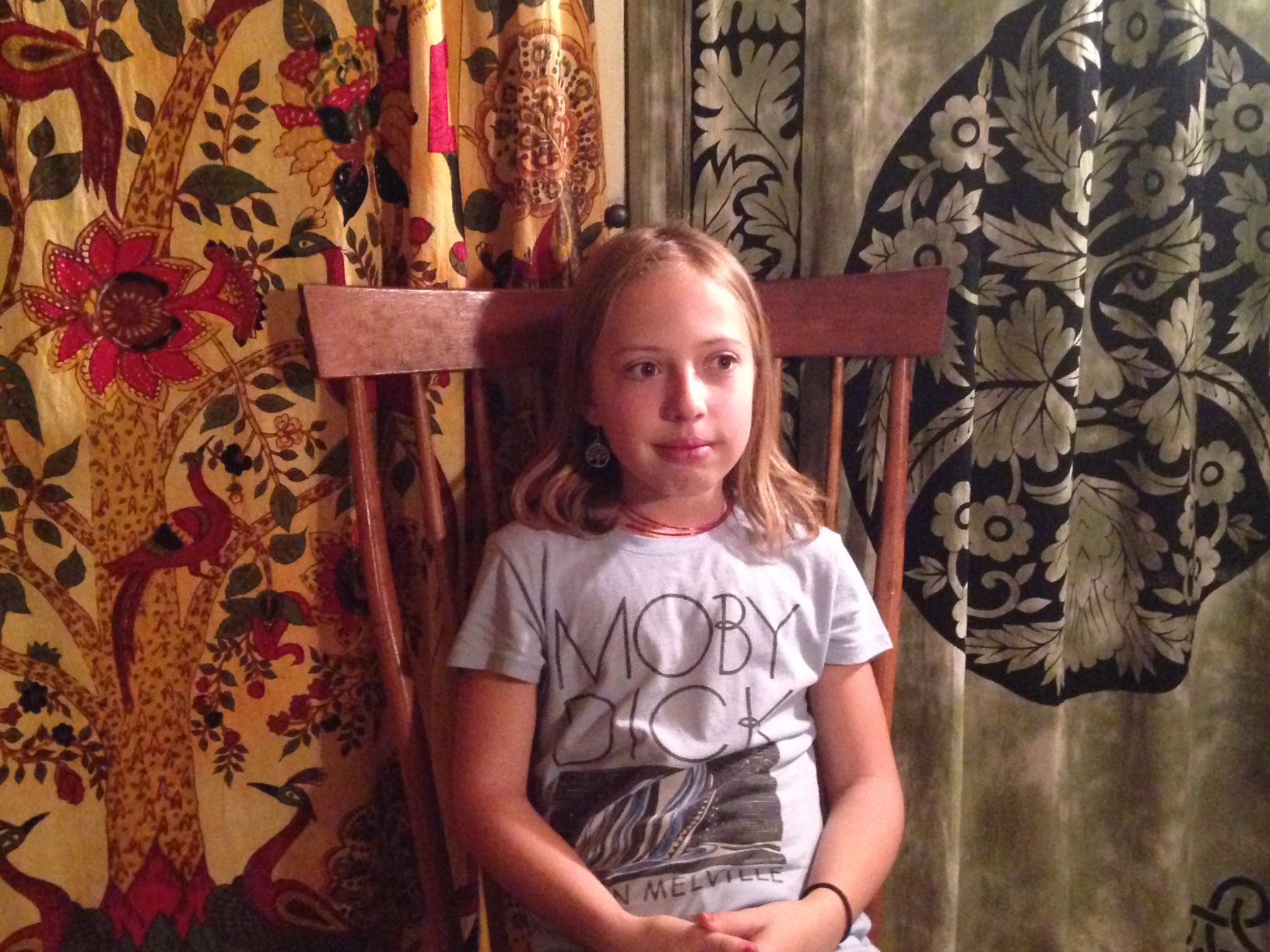
We had this moment, my grinning girl and I, of such sheer ten-year-old kid radiance, such pleasure in her own quickness, her success at navigating a difficult game and counting cards. She wore a shirt with red flowers and tiny lavender rose-blossom earrings. Sure, our life is chock-full of all kinds of things that are difficult and dark, that scrape right down to Eugene O’Neill’s Long Day’s Journey Into Night. When I sit down again tomorrow morning to rewrite my book, yes, I’ll aim to write deeper, and yes, again, even deeper into all the hardest and what appears to me most unknowable things, but our life also brims over with effervesence and joy–an evening of fifty-two cards, a grandfather, a mother, and two granddaughters–and I’ll wind that in, too.

Ann Sexton once remarked in an interview, when asked why she wrote such dark and painful poems, that pain engraves a deeper memory. Pain engraves a deeper memory. Think of a time in your own life when you have experienced a sudden shock, a betrayal, terrible news. Perhaps you remember the weather, the quality of the breeze, a half-full ashtray, a scratch on the wooden floor, the moth-eaten sweater you were wearing, the siren in the distance. Pain carves details into us, yes. I would wager, though, that great joy does as well.

–– Dani Shaprio

Photo by Molly S.

Photo by Molly S.

Summer: Sing Like the Sea

Day by day, this sweet August season winds down. Next week, I’ll walk with my girls down the driveway to the bus stop, where we’ll kick around the fallen apples from the wild trees along the road, looking through the misty fall mornings for the bright yellow bus. Our summer has been packed with all kinds of things: hiking and friends and art camps, not enough swimming, countless s’mores with the cousins.

We spent a lot of miles with my older daughter at the steering wheel, me with my knitting in the front seat, the three younger kids in the backseat, everyone talking sometimes all at the same time. Near the end of the cousins’ stay, late one afternoon we drove up the winding dirt road towards home, everyone hot and hungry, miserable and crabby all the way around. Without thinking, I put both my bare feet out the window and waved my soles at the passing trees. The children shouted, What are you doing? and because I started laughing, they all started laughing, even the teenager in the driver’s seat who does not approve of such undignified behavior, not at all, although she graciously tolerates my foolishness.

Silly? Completely. But in the face of things that are not humorous–words that none of us even want to say, like cancer for instance–why not occasionally throw your feet up and rally to the grubby children in the backseat? Say: I don’t want to hear bickering; just hang with me for a little bit in this golden summer, with all of you so near?

Driving to work today, I thought of these kids of mine and that afternoon, and the last stanza of one of my most beloved poems, “Fern Hill.” I’d always considered the final words tragically bittersweet, but I wonder perhaps now if I misunderstood these lines. Perhaps this poem is about acceptance of our mortality, and simultaneously an exhortation to sing like the sea, rage on against the dying light, laugh in the face of despair. Write beautifully in this good world.

Nothing I cared, in the lamb white days, that time would
take me
Up to the swallow thronged loft by the shadow of my hand,
In the moon that is always rising,
Nor that riding to sleep
I should hear him fly with the high fields
And wake to the farm forever fled from the childless land.
Oh as I was young and easy in the mercy of his means,
Time held me green and dying
Though I sang in my chains like the sea.

–– Dylan Thomas

IMG_7430

Photo by Molly S. Gabriela and Kaz, Sterling Pond

Failure and Writing

One of the real assets to working in a bookstore is the Advance Reader Copies–those paperbacks that appear in a white box shortly before everyone else gets their hands on them. Early this morning I read a little book of Pema Chödrön’s, Fail Fail Again Fail Better but, heads up, the interview at the end is the better part of the book. An eighty-year-old nun now, Chodron is refreshingly honest about her mistakes as a young woman, her two failed marriages, her struggles with parenting.

In this book, she writes about how to live a life in the present–with mindfulness–and yet acknowledge the wrongs we’ve all committed in our lives. In other words, how to reconcile what we’ve screwed up–and we all screw up, badly, one way or another–with a creative and loving and productive life. Isn’t that a fine place to aim for? To hold the past, acknowledge it, hold it before you like the foulest and ugliest of your fears, and yet move on.

Canoeing with my daughters today is a wholly present moment–sunlight and dragonflies, the water almost too warm at the surface, then cooler the deeper down I dove–and yet I carried with me, secreted, as if beneath a middle rib, thoughts of the book I’m rewriting–taking apart and taking apart–and will begin to put back together, better. Finer. Smarter.

“Fail better” means you being to have the ability to hold… “the raw of vulnerability” in your heart, and see it as your connection with other human beings and as a part of your humanness. Failing better means when these things happen in your life, they become a source of growth, a source of forward… If it’s something like writing, just start–don’t not write the book.

–– Pema Chödrön

IMG_8448

Photo by Molly S. Number 10 Pond, Calais, Vermont

Writing Your Life

By this time of year in Vermont, much of what will come to fruition has been sowed and thrives. You’ve either had a crop of blueberries or not. The strawberries have long since gone by, only the verdant green remaining. Carrots, kale, squash, all should be well on their way.

What’s gone is gone. My chard, devoured by the woodchuck, will not grace my kitchen table this year. This digs at the question of poetry. I could turn my gaze and blind myself to how my garden lies at this time, weedy and gnawed in places, the peppers sweet and savory, the green ripening on the ear, the cucumbers proliferate. A metaphor for raising a child, acknowledging where wiser tending could have happened – or not. The elements of rain and cold and disease will thrust in.

But writing, perhaps, is a different endeavor than life. You get a rough draft; with diligence, you can rewrite and rework, burnishing your words. Easier, less risky, less dear.

Isn’t this all a matter of hunger, of desire in one raw form or another, a great maw of longing for satiation? The woodchuck to fill his belly. The carrots to thicken. A writer’s desire to reflect and hold the world’s mysterious complexity and beauty. A child’s yearning for growth and expansion.

A mountain can be a great teacher–not only because it manifests that cosmology of sincerity and restless hunger with such immediacy and drama, but also because it stands apart, at once elusive and magisterial…. (Walking up Hunger Mountain) reminds me yet again that things in and of themselves remain beyond us, even after… the most concise and penetrating poem.

–– David Hinton, HUNGER MOUNTAIN

DSCF0031 1

Wild cucumbers.

Storytelling, or What to Learn From a Ten-Year-Old

Smugglers Notch perches high up in Vermont’s Green Mountains, a haven of enormous, tumbled boulders. We hiked up to pristine Sterling Pond, then the children played in the caves at the trail’s origin. On a lichen-covered boulder, high up above the road, my younger daughter claimed her house. She invited me in, and, like any proud householder, showed me the hemlock stoutly growing in the midst of her living room. Out of the rock, she said, this tree grows.

When it comes to storytelling (and it’s all storytelling) I often tell my students that we need to be dumb like animals. Storytelling itself is primal. It’s the way we’ve always come to understand the world around us–whether recited around a campfire, or read aloud in an East Village bar. And so it stands to reason that in order to tell our stories, we tap into something beyond the intellect–an understanding deeper than anything we can willfully engage. Overthink and our minds scramble…. Our minds obscure the light. We second-guess. We become lost in the morass of our limited consciousness.

– Dani Shapiro, Still Writing

Photo by Molly Blume S.

Photo by Molly Blume S.

August 9, 1945

At a particular juncture this year, although I increasingly make my living from words, I became, quite simply, fed up with talking. I wanted action. Action infused with intentionality, with great thought and empathy, but action.

This summer, with my nephews’ extended visit, I determined to alter – in at least one small degree – the course of our lives by action, to swing the pendulum one minor stroke toward happiness. A raw truth of myself is that the outer dark of despair, of pain’s gnashing teeth, the fiercely cold howling winds of evil, hover perpetually just an arm’s length from my own outstretched fingertips, those turkey vultures I keep writing about silently soaring. There’s not a bit of schizophrenia in this worldview, not one jagged bit of insanity, not one curl of my toes over the edge into any abyss; our world is not a two-dimensional plane where grief can merely be rubbed away for the wishing.

The children are tucked into their beds, sleeping the slumber of children who have played and swam and biked together, all day. Bickered and made up and told each other stories, their faces scrubbed clean, their hair scented with lake water and wood fire smoke, at ease.

To every thing there is a season, and a time to every purpose under the heaven:
A time to be born, and a time to die; a time to plant, and a time to pluck up that which is planted…
A time to rend, and a time to sew; a time to keep silence, and a time to speak;
A time to love, and a time to hate; a time of war, and a time of peace.

— Ecclesiastes 3:2

DSC01125