Shells, Sea Glass, and Stories

My daughters have no school for a few days, so they came to work with me today, around Mt Elmore, around Mt Mansfield, and along the beautiful Winooski River valley. Inevitably, the drive is longer than I think, after a hurried jumble to get out, we need to leave in the morning, then coffee drinking in the car while the girls either laugh or bicker. The clouds all the way along the interstate were shot through with dark gray and glimmering gold, as if the weather itself couldn’t decide whether to shine or cry.

At the very end of my drive, I arrive at a street’s crest and the city suddenly dips down, and there’s the lake, the great expanse of it, white-capped over cold slate, undulating upward as if twisting deep in its marrow.

My daughters walked off on their adventure, while I went into my windowless office and set my mind fiercely to work. Later, finished, my proofs for weekend work tucked into my bag, I stepped out of that building. The parking lot edges up to a railyard where train cars are stored on dead-end lengths of track, besides enormous piles of gravel, and seagulls swoop down over the lot, hungrily screaming. With my face up to October’s meager’s light and the wind gustily blowing, I thought of the college class with aspiring writers I sat in yesterday, where we talked about the story beneath the story. This odd lot was rife with stories, stretching on out to the mighty granite block building at the corner, where commence a hundred years ago must have once teemed at the lake.

My daughters returned from their exploration along the lake’s edge, where they discovered diminutive shells and sea glass, more bits of stories carried out of the lake and into their hands.

Everything that does not migrate
has fattened up, bedded down,
cocooned up, and seeded itself.
Life’s two principles–
reproduce; survive to reproduce again….
And by this process, even beyond
the evident hand of man, the world
slowly changes utterly.

– Leland Kinsey, Winter Ready

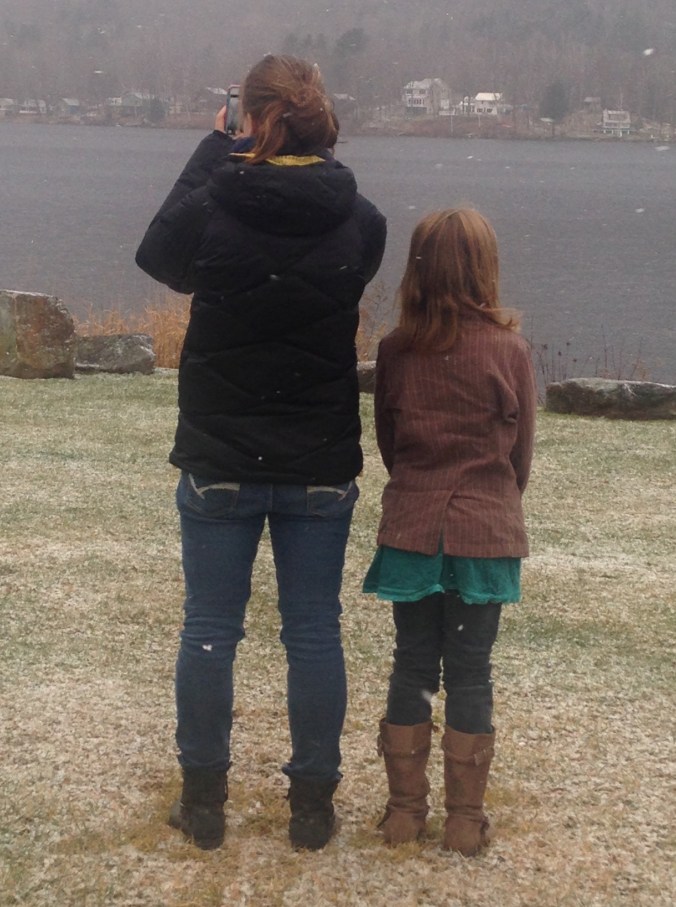
IMG_0140

Beside Lake Champlain, Vermont

Seeds

After a morning’s work, I stepped out on the balcony and saw wild turkeys slowly picking their way through the frost-bent buckwheat around my garden. These birds are amazingly large, with their red and gum-blue heads vibrant colors against the autumn’s gold. By the time I was in the garden, the turkeys had gone on their way, back into the woods.

With my hands, I tore out the pepper plants, the marigolds and nasturtiums, the cosmos, the end of the squash, these beauties finished for this year. The sunflowers and zinnias I left standing, heads bent down, yet rich with seed, for the birds.

Life is not orderly. No matter how we try to make life so, right in the middle of it we die, lose a leg, fall in love, drop a jar of applesauce. In summer, we work hard to make a tidy garden, bordered by pansies with rows or clumps of columbine, petunias, bleeding hearts. Then we find ourselves longing for the forest, where everything has the appearance of disorder; yet we feel peaceful there.

–– Natalie Goldberg

IMG_0131

Garden/West Woodbury, Vermont

Singing and Writing: a Small Blue Book

The other morning, between errands, I stopped in at Bear Pond Books in Montpelier, and found a small novel by Tomas Gonzalez, a Columbian, In the Beginning was the Sea. The book is beautifully crafted and fit just about in the palm of my hand, yet with a real heft and weight. And – it was my favorite color: blue.

These past few days I’ve swum down into the sea of this book. I’m not at all likely to head south to Columbia, and the book itself is not gleaming feel-good read. But it’s writing with a depth that goes down and down, and is as true and real to me as drinking a glass of my own well water.

As a Vermont writer, I’m often asked about sense of place and its importance in my writing. Yes, of course, place-centered geography centers in my writing. But equally, I know, the beauty of  a tropical paradise can also drive an inhabitant over the edge, and to write with a sentiment that place is only holy seems false to me. Surely, the yingyang flip of holy is unholiness. While this short novel holds the beauty of human life and the moonlit sea, the writing also contains the deeper elements of all the vagaries of human existence.

“So WHY does our writing matter again?” (my students) ask.

Because of the spirit, I say. Because of the heart. Writing and reading decrease our sense of isolation. They deepen and widen and expand our sense of life: they feed the soul… We are given a shot at dancing with, or at least clapping along with, the absurdity of life, instead of being squashed by it over and over again. It’s like singing on a boat during a terrible storm at sea. You can’t stop the raging storm, but singing can change the hearts and spirits of the people who are together on that ship.

— Anne Lamott, Bird By Bird

IMG_0124

The Fourth Cottage

Here’s a story from Timothy Snyder’s recent book Black Earth. During World War II, a young Lithuanian woman tumbled into a pit of corpses during a mass execution. When the killing was finished, earth was thrown over the grave. Somehow, buried beneath the dead, she managed to survive. Naked, shot in the hand, covered in her own blood and the blood of others, she managed to claw herself free of the pestilent trench. Terrified beyond what is imaginable, she sought help at a cottage. She was turned away. She found a second cottage, and was turned away again. At a third cottage, she again pleaded for help and was refused. At the fourth cottage, she was given succor, and she survived.

Snyder writers,

Who lives in the fourth cottage?…. When the outside world offered threats but no promises, the few people who acted to rescue Jews often did so because they could imagine how their own lives might be different. The risk to self was compensated by a vision of love, of marriage, of children, of enduring the war into peace and into some more tranquil time.

As a writer, I keep thinking of that fourth cottage, its habitants long-lost in the horrifically bloodied past. And yet:  whose hand opened the door in the fourth cottage? And who dwelled in cottages one, two, and three?

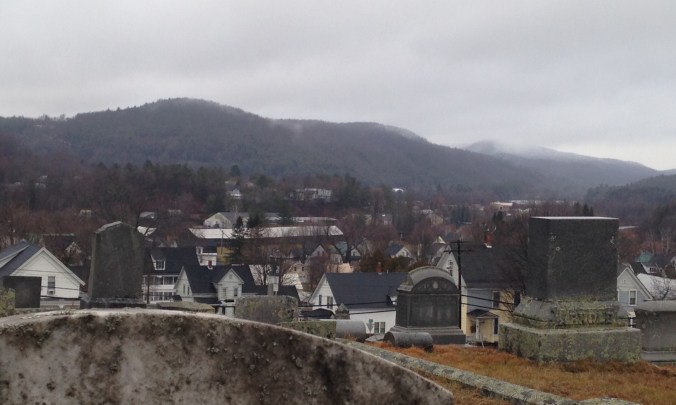
IMG_9341

East Calais, Vermont/Photo by Molly S.

Enjoying the Digital Age

While I frequently rail against the digital age, the nefariousness of video games — while I believe children should play outside in apple trees and ride bikes, and read real books — while I am the champion of the world made by hand and do-it-yourself ad nauseum — the truth is, I find the digital world just plain fun at times.

My dad sent me a power point presentation he made for his class, and I watched it with my older daughter. At one point, she started exclaiming, Did grandpa photoshop that? I had no idea; I was too busy reading the words. God, she said, of a monastery in Bhutan, I’d like to be there.

At the end, she said, Cool beans to grandpa — that’s high accolades from a teenager.

This past day, I’ve been sending text back and forth to my publisher, making the very last changes on my novel before it heads, digitally of course, to the printers. An s was dropped here; I added acknowledgments, a dedication, and permissions. It’s all email, back and forth, with notes and exclamations, and phone calls of course, too. But truly, having read these 278 pages over and over, in the end, it all comes down to the writing. To story, craft, beauty, and meaning.

But the digital realm offers much to us in rural Vermont. I remember some winters standing outside the co-op with a baby on my back, reading the posters as cultural infusion. Here’s a paragraph I filched from that bounty of my dad’s material:

Like anything that one makes well with one’s own hands, writing good nonfiction prose can be profoundly satisfying. Yet after a day of arranging my research, my set of facts, I feel stale and drained, whereas I am energized by fiction. Deep in a novel, one scarcely knows what may surface next, let alone where it comes from. In abandoning oneself to the free creation of something never beheld on earth, one feels almost delirious with a strange joy.

“The Craft of Fiction in Far Tortuga”
Interview of Peter Matthiessen
The Paris Review 60 (winter 1974)

IMG_9111

East Calais, Vermont/Photo by Molly S.

Autumn Light: Painting and Writing

When my sister was at Williams College, I used to take the Greyhound to stay with her, and while she was in class, I walked to the Clark Art Museum. The museum admission was free, and you could walk in and stay as long as you liked. The museum wasn’t enormous, but it was sizable enough that you could begin with the Remingtons and head up to the Impressionists. On the second floor was a large light-filled room filled with Monet and Cassatt and Degas and Pissarro.

Every fall, I remember Monet’s The Duck Pond, and how I could stand in front of that painting, age seventeen, and gaze at all those golden hues of oil paint.

These paintings were portals opening my eyes to looking at the world, just at the time when I discovered James Joyce. Thinking back now, I realize visiting these paintings repeatedly contributed to who I am as a writer. If there’s one thing we need in this country, surely more art would rank near the top, and free art at that, where a girl from a small New Hampshire town can walk through a museum’s open door, over and over, and begin to know a handful of paintings.

(In a Vermeer painting)… scattered flakes of gold…. are strewn lavishly through shadows and luminous areas alike, and the eye simply accepts their presence. Vermeer’s most penetrating critic, Lawrence Gowing, describes this phenomenon as a glittering “commentary of light.”

— Michael White, Travels in Vermeer

IMG_0085

Montpelier, Vermont/Photo by Molly S.