A few garden words…

Calendula, such a pretty word, such a marvelous little flower, still blossoming beneath the frost-killed sunflowers in my garden.

Late Sunday afternoon finds me piling fallen maple leaves around these beauties in my garden, tucking in the soil for a winter’s hibernation. There’s celery, yet, too, among the Brussels sprouts. As I work, I snip off celery leaves, dusting off sandy soil on the hem of my shorts. The leaves are slightly grainy in my teeth, but when push comes to shove (as life inevitably goes), I’d rather have tried my teeth on a little grit than none at all.

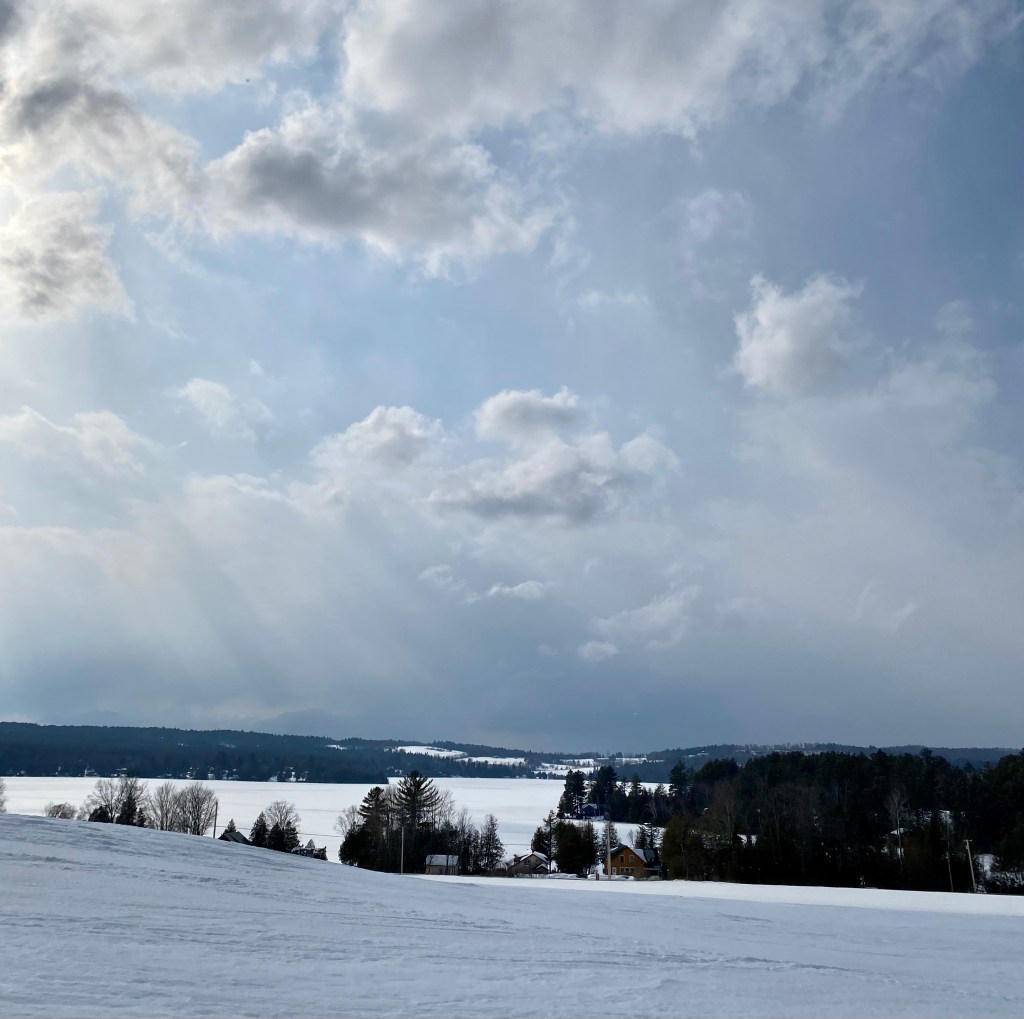
Here’s what happens in New England’s October: the shadows creep in before the day has finished. We all know these shadows are edged with cold, with the intimation of winter and wind, of snow and more snow, and the always surprising dazzlement of winter’s glistening beauty. I bake an apple crisp, listen to election debates on public radio, comb my cat. October.

At no other time (than autumn) does the earth let itself be inhaled in one smell, the ripe earth…

— Rilke

Green Apples.

I flee work early with my daughter and her dog, to watch my younger daughter play soccer. Mid-October, and in my world everyone clamors to be outside as much as possible.

In the parking lot, a rusty white Toyota pickup sports a peeling bumpersticker with Joseph Campbell’s advice: Follow your bliss.

In my young woman days, I wholeheartedly championed this, easy-peasy, of course, I thought. Then I entered what seemed like a labyrinthian period of my life where the notion of bliss seemed facile and sometimes outright stupid. On this sunny afternoon, I chat with parents and strangers on the grass about little things — who’s started their furnace already and the merits of sprinkling cinnamon on hot oatmeal and is that the new superintendent with the coach?

As the sun heads down, the spectators pull on jackets. The wiser among us brought blankets. I find my hat in my car and loan my daughter my jacket. My youngest is a senior. Next year I won’t be here, clustered among the parents and grandparents, and so each game seems a bead on a counting game. On the way home, we stop at the general store for curried dumplings.

All afternoon I kept thinking of Ruth Stone’s achingly lovely poem “Green Apples.”

In August we carried the old horsehair mattress
To the back porch
And slept with our children in a row.
The wind came up the mountain into the orchard
Telling me something:
Saying something urgent.
I was happy.
The green apples fell on the sloping roof
And rattled down.
The wind was shaking me all night long;
Shaking me in my sleep
Like a definition of love,
Saying, this is the moment,
Here, now.

October Afternoon.

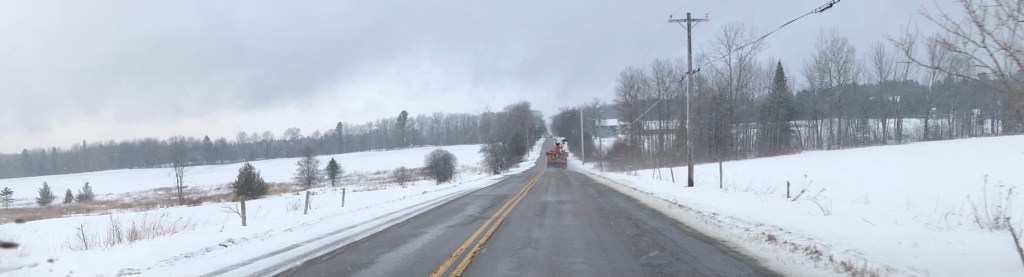
On my way back to Hardwick, I’m stopped in road construction on the County Road. While I wait for the steamroller, I glance at the passenger seat and notice my knitting has slipped from my bag. The project is a simple hat, and the yarn slid from the needles. To save my work, I lift the unfinished hat and slide the stitches back on the needles.

Just before my car hood, the woman in bright yellow holding a STOP sign leans against the pole. I turn off my Subaru engine, thinking of where I’ve come from and the high school soccer game where I’m headed. How quickly cold shadows edge in when the sun slips behind the mountains at this time of year. The mountains around the road dazzle with crimson and gold, but gray is visible in patches, too. Stick season marches in inexorably.

I’m at the town line somewhere between Montpelier and Calais. A few years ago, I sold our arch — the long firebox and pans used for making syrup — to a man who said he’d pick it up in a few months. His address was in this area. I promptly cashed his sizable check. He didn’t return. More than a few months later, I had sold the house, too, and my daughters and I were moving. I wrote list after list with things like pack canning jars and Salvation Army drop-off and get rid of Toyota transmission in shed. On those endlessly reworked lists, I added arch must be moved. While tracking down the buyer, I discovered an unspeakably sad thing had happened to his family a number of years before he wrote me that check.

I found him. He arrived with a friend and loaded the arch on a trailer. He and his friend were older than me, in a different phase of their lives than I was. They spoke kindly to my daughters.

For just a fleeting moment, still waiting for that steamroller to move, I remember that arch precisely. Stainless steel, black metal, the scrape of a shovel on firebrick.

The woman with the STOP sign appears at my open window. I expect her to chide me for daydreaming. Instead, she points to a nearby pond where a flock of geese have landed. The sun hits the sugar maples around the water. There’s so much in that moment — the clamoring and splashing birds, the stunning leaves, that crystalline memory, the sunlight and green yarn in my lap. The woman tells me, “Head on when you’re ready.”

October 1.

I spend the better part of Saturday stacking wood, beginning bundled in a sweatshirt and hat, and quickly stripping to a tank top and shorts. A black cat wanders by and appraises my work which, admittedly, is uneven but certainly sufficient. I breathe in fresh sap, wet earth, dusty bark crumbles.

The month of September — all thirty days — disappeared in a few heartbeats. I’m still pulling in frost-choked parts of my garden, the dead lily stalks, putting away the clay fairy house in the rock garden my daughter made so many years ago.

Friday, I’m at a summit all day that brought together people, who, in one way or another, are enmeshed in healing from addiction. Here’s the thing: a few years ago, I never would have attended a summit like this, let alone speak to a large group. For years, I said nothing about my own struggles with addiction. But publishing Unstitched acknowledged in a very public way my own miserable struggles with drinking. Because I had written the book, I had to answer questions publicly about this, and I needed a surprising amount of time to acknowledge this, to really accept what this meant. But I heard — and I kept hearing — from people I both knew and complete strangers — about their struggles, or a friend or family member’s struggles.

The Rumi line I quote in Unstitched is “the wound is the place where light enters.” When I returned Friday evening, my daughter asked me why I go to these sad things. And it’s true; there’s such grief that’s shared. But now I understand that there’s my own grief — still much of it in a private place in my heart — but grief is our human commonality, too. The wound is what renders the light possible.

When I step out, three hot air balloons are rising.

Nearby the expo where the summit is held is a hair salon named The Rusty Clipper where I dropped off maple syrup wedding favors about twenty years ago. The father of the bride gave me a check. When the bride opened a box, she told me I had given her the wrong bottle — hearts instead of leaves, or leaves instead of hearts. I gave the check back to the father. I put the boxes back in my car. I buckled in my three-year-old and drove home. At home, I redid all the favors and drove back the next day. When I got the check again.

I stand there under the hot air balloons and wonder about that bride whose name I’ve long since forgotten. Then I follow the crescent moon home over the mountains as the light gives way to twilight.

Flight.

In the inky pre-dawn Next Mexico morning, my brother and I head back to the Santa Fe airport. He’s done this thing that somehow never hit my consciousness — rented a car like an Air BNB — which has been incredibly helpful. The sunrise spreads over the horizon, more golden than pink, while the three of us stand talking in the parking lot for just a moment. My brother hands over the keys, and then that’s done. The car’s owner leaves.

My brother and I have time. We can walk through the one-room Santa Fe airport in about three minutes — maybe six, including security. A half moon hangs above us. We kick around words for the phases of the moon, and he teases me, again, about what he claims is my overuse of the word gibbous in my first novel. As the wide Santa Fe sky morphs from black to blue, Orion fades.

On the short flight to Denver, my brother and I are separated by a few rows, each of us peering out the window at the Jemez mountains. We’re back in that enormous flow of airline travel, so many people going so many places, all that fuel and pollution eating up the planet. Not very long ago, people remained on the earth. But for these moments, suspended thousands of miles above the planet, I glimpse my brother and I as separate people but indelibly part of this great human stream, traveling to visit our old parents. Around us, everyone moves through their lives and stories.

The pilot ferries us above the mountains and through the clouds. As I walk into the airport, I say thank you, and I mean it.

Kid Joy.

In a pouring rain, I pack up my car with recycling and trash. The empty cat food tins need to be out of my barn. My oldest stops by with her dog, and we stand in the open door of the barn. The barn’s inside is crammed with firewood in my fairly neat rows. Sometimes I imagine this space will be something else, but we moved here late enough in the childrearing years that the barn never became true kid headquarters.

The rain dumps. We stand drinking coffee and kicking around bits of this and that.

Truly, there are days when I wonder how the heck I’ve ended up at Alpine Heights in Hardwick, Vermont. I drive to the dump/recycling station. Years ago, when my oldest was in a carseat, the old man who ran the place took the time to talk with me. He told me to take my daughter swimming as much as I could, to enjoy summer, to savor her. He’s long dead now, passed on to the next world after a devastating accident. The dump/recycling world is run by savviness — plenty of things and money pass through here. The man asks what I’ve got and asks how I feel about eight dollars? I feel just fine about handing over eight singles.

My neighbors across the street had their water and sewer lines dug up and replaced this week. The contractor’s wife is someone I’ve known for years, off and on. Sometimes I meet her as she walks her tiny dog through town. When the contractor finished with the work, he gave the neighbors’ little boys a ride in his excavator. Such a simple thing, I think, and so much kid happiness.