Losing hair, blue dawn, foreign objects in flesh.

Before dawn, brushing my hair I sing On the road again, just can’t wait to get on the road again, that old Willy Nelson song my mother loved. In the kitchen, making coffee, my daughter calls, Wait? You know that song? We played it everyday on our road trip last summer.

A thing to savor in this cancer: how my daughters and I discover these tiny things about each other.

My youngest cut the snarls from my hair that lingered from that hospital stay, when I couldn’t raise my arm to brush my long hair. Now, hanks of my hair slip out in my brush.

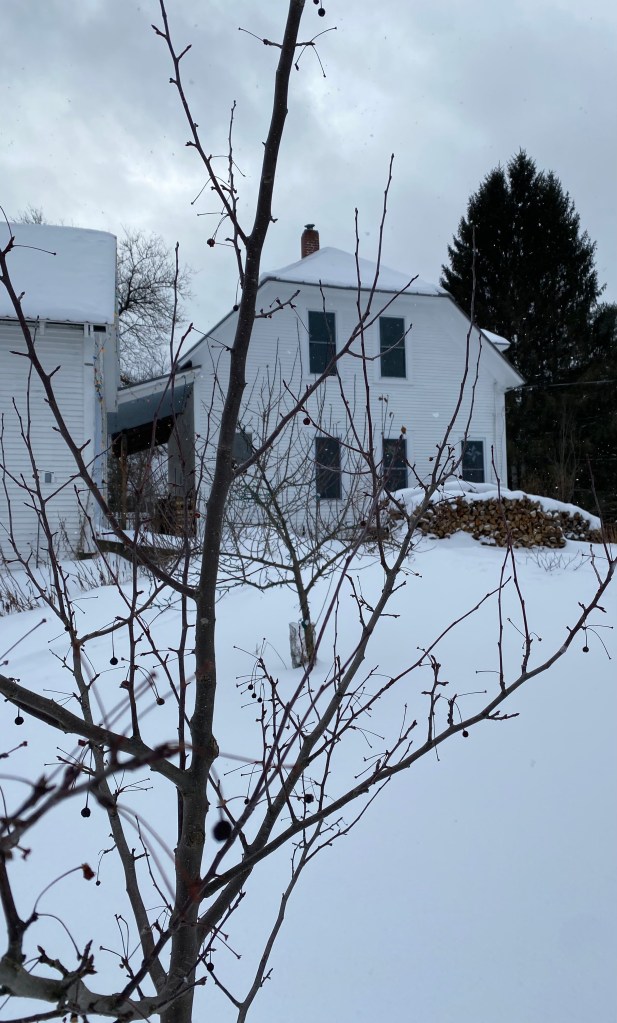
Outside, I stand for a moment, the waning moon hung over the neighbors’ roof, the emerging dawn a river-stone blue. A thaw’s set in, and the air is redolent with melting snow, a hint of loosening compost and soil. Raindrops hang from the three apple trees I planted.

We drive through the village, the coffee shop lit up where I’ve spent so many hours writing and talking, a young woman sweeping at the door. Colored lights string through the trees and over store windows. Out of town, day warms over farm fields and forests.

At the hospital, blood’s drawn for my chemo course this week. In my rudimentary cancer thinking, while doing the darnedest I can to forget about the orange fluids that will enter my body, I reckon that this week’s treatment means one third of the way through. If I can endure a third, I can endure half. If I can endure half, I can persevere to the finish. Talking with my daughter about December monochrome, I silently counsel myself to knock off my silly math. I’ve factored in no variables, and the variables are inviolate.

Before we leave, the nurse shows me a model of a port that may or may not be inserted in my chest. I hold the pad for needles, finger the plastic tube as she explains how it will lie under my chest. At the end, in the shape of a calla lily, is the opening that will drip the chemo beside my heart. The whole apparatus seems enormous to me, that plastic calla lily wider than my small finger. I hand it back to her. In the end, with the Good Doctor, how much of this will be my decision, and how much will be wisest course forward? In this age of truth/untruth, facts are powerful. I thank her, and we leave.

It’s a pleasure to be outside again, on this tiny road trip, my daughter at the wheel, drinking coffee. The fields and mountains and sky are layered quilt batting: blue and pearl and silver. Around the trees, rain’s pushed the snow away from the trunks, opening the earth again.

From Lauren Markham’s A Map of Future Ruins:

We don’t live steadily toward epiphany; our truest stories move back and forth in time, in space, in memory. Life is a mosaic, not a line.

A smidgen of writing.

The clocks cease meaning for me. To gird myself for an appointment, a call, I set an alarm, ask a daughter for a reminder. Counting backwards proves stupidly difficult: what hour to we need to leave? Write this on a sticky, please.

The flip side: I wake early one morning, kibble the cats, open my notebook and begin writing the pieces of this book I’m rewriting in my head. Daunted, I copy my draft into a folder. Someday whole sections might become another book, an essay, trash. Weeks before I heard the cancer diagnosis, I took a class with the remarkable Lauren Markham. All these weeks, these endless hours sleeping and half-dreaming, reading hungrily, much of this solitary but never lonely, much surrounded by skilled strangers who spill snippets of their own remarkable lives in the wee hours of the night, syringe in hand.

Now, aided perhaps by exhaustion, I envision the skeleton of this revised book, the joints that hold these stories together, beginning in a moldy basement, rising to a glass complex, surely, the endless firmament.

Neuropathy comes and goes, reappears in my fingertips. The knobby bones of my wrists and knees expand beyond my dwindling muscle mass. The prednisone prescription reappears for five chemo days, beginning next week. I try not to think of that, of the force these mighty drugs will weld over my body, how I will yield, pray for their power, try to keep to my feet at least marginally, moving my body, keeping in the everyday realm.

Like anyone, I’ve hard used this woman’s body I’ve been gifted, through pregnancies and nursing, decades of sugaring and the countless cords of firewood I lifted and burned each year, churning ice cream to sell with a baby on my back, fourteen years of peddling syrup spring to snowy autumn at farmers markets. The bleeding fissures on my fingers from washing wool filters. But so much pleasure, too, the ineffable joy of cuddling a daughter in my lap, of mountain climbing, intimacy, of lying on the dewy grass under the creamy rising moon. Women my age often complain about the indignity of hot flashes, but the real indignity for me has always been when the flush of my changing body courses through me in a male-centered meeting in my difficult work of budgeting for a town.

A rambly post here….. a variation of my inside-out world where the former rules are revealed as trite. Patience, patience. An hour of work. Half a cup of tea. Another half hour. December sunlight.

Pig farm, glass buildings, moss.

Photo by Molly S.

The man who swept and cleaned my room at Dartmouth-Hitchcock lives in a nearby farmhouse where he grew up. All this complex here, all these buildings, he says, unrolling trash bags, was once a pig farm. Marooned in bed, IV-ed with multiple lines, I ask questions. His family raised beef, milked, had sheep, their own pigs, a chicken-and-egg empire run by the family women.

We talk food – garden canning, slaughtering and freezing, how his mother’s cookstove had a can of grease they used for eggs, steaks, day-old biscuits. That stuff in a box we eat now, with too many ingredients, that’s not food.

We get to gravy recipes, boiling water and how much flour to paste in. Then we wish each other well. Done for the day, he trundles his cart down the hall.

Home, I’m less cloudy for a few morning hours. By afternoon, the cats and I retreat to lying down, reading, slipping in and out of sleep, where I dream of an enormous pig farm where those tall glass buildings now tower over the surrounding woods. I dream myself back to early girlhood, sick, sick, playing paper dolls in bed. I weld my paring knife, skinning a Chioggia beet. For one long piercing moment, I ache to pull on my jacket and boots, slip wordlessly out the door and along the brambly path – a solitary walk to clear my mind. How I’d relish stepping from frosty twilight into my warm house. Patience, patience: my lesson now.

Friends text photos of sunsets, lakes, moss, running streams. Cell phone photos once so common to me, I study these, proof of a winter day. Mail arrives. Half insurance bills, half gorgeous cards – flowers, a paper wreath, snowy mountains – and so many welcome words. Late afternoon, I cook a pot of rice, my first contribution to a meal in weeks, save setting out forks and spoons like a toddler.

I like the juicy stem of grass that grows

within the coarser leaf folded round,

and the butteryellow glow

in the narrow flute from which the morning-glory   

opens blue and cool on a hot morning.

– Denise Levertov

Snow geese and cancer and macaroni and cheese.

My friend walks into my kitchen. The windows are shrouded in the remains of last night’s darkness. She bends down and looks at my face, reminding me of those enervating conversations in ERs with doctors. After a careful moment, she pronounces, You look good. My house is warm; her sentence warms me more.

In the St. Johnsbury hospital, she drops me at the laboratory door. A receptionist sends me down the hall, in search of elevators. A woman in the waiting room follows rickety me in my winter boots, and repeats the directions. I wander down halls empty of people, interspersed with lit Christmas trees in what seem to me random corners and notches. Someone calls my name. I turn and look, and of course this is my friend, who for a fleeting moment I don’t recognize in her bundled coat, surgical mask.

Not far from the Canadian border, St.Johnsbury has a faded charm from its former heyday of logging and Fairbanks scales. This December morning, the day sputters, promising no sunlight, maybe a few rosy strands in the opening daybreak. In my strange fog, I wonder if the light mirrors Siberia. My blood is drawn and spun. Waiting for the verdict, I stare out the window, the layers of coal and washed-thin blue and last night’s pale snow. Beside me, a man introduces himself says he owns a garage and towing business. I pull down my mask and offer my name. My voice is so muted he can hardly hear me, but I ask him to tell me about his plowing so far this winter. While we wait, he obliges me. My hands, he says, will never be clean enough for hospitals.

Siberia, I think, Siberia, as the garage owner pinpoints roads. The daylight notches up a bit. Save for my friend, waiting elsewhere, I know no one here, but this winter landscape of snow and pale mountain, the livelihood of working with hands and backs and people, is familiar to me as my thumb knuckles, the loneliness of lingering over the morning’s last cup of cooling black coffee, pondering some decision that’s wormed itself in the day.

So disease, cancer, that forbidding word, burrows in. The disease is me; the blood is mine; the nurse explains numbers, says hematocrit, hemoglobin. Less than a handful of weeks into this journey, I know my blood courses with immutable facts, ragingly powerful chemistry. The blessing to leave is laid upon me.

Home again from distant Siberia — is it midmorning? afternoon’s mire? — my friend sweeps ashes from my wood stove and nourishes gleaming coals with birchbark and splinters, odd pieces of end wood. This day unfurls, somber and patient, settling into winter’s long haul. I offer a piece of my daughter’s gingerbread. For hours now, we’ve talked about migrating snow geese and cancer and macaroni and cheese. She asks if I would take her on a nighttime walk — I envision the throb of spring peepers, the redolent rotting slop of thawing earth — indeed, a pleasure I might give back, to one of my shepherds holding me steady as I wobble down my back steps.

Small Soup Bowls. Quarantine. Icicles.

My brother returns home, and I immediately slip up, ignore a morphine dose, am unable to eat. A lesson in my own laziness or foolishness learned: keep to the path.

For days, he sets small bowls of heated soup on my kitchen table – chicken and dumplings, our childhood favorite of pea soup, lentils with savory carrots. One night, my daughter bakes biscuits, opens a gift jar of raspberry jam (July!), and we revel at a nameless soup from a woman we’ve never met. Potatoes with the skins left on, chicken and maybe tarragon, celery, onion. There is nothing we could imagine adding.

Like these soup bowls, my physical life has narrowed to these warm rooms with cats, hours unfurling patiently as I stop counting days and treatments. Each day unfolds. On Saturday, I sit on the couch and return a friend’s call. Sunday, I return another call, listening to my laughter, their laughter, these friends who have been down their own stony journeys.

Quarantined, I’m connected to the world in ways I didn’t anticipate – emails and calls, books, prayers– a rosy swaddling aura. An acquaintance phones me with her cancer story and describes her year so straightforwardly she buoys me with courage. A friend offers to plow our driveway all winter; perpetually on the skimp, I’ve shoveled for years, but it’s a great gift to my people who are anyways busily feeding my wood stove and picking up morphine and antibiotics and driving me to bloodwork and The Good Doctor — not to mention, working their own jobs and walking their dogs and generally going about their lives.

So much kindness has come my way. The night the sainted nurse sat with me for an hour and a half while the final chemo infusion ebbed, ebbed, into my chest beside my heart, she counseled me to cultivate patience, that I will be able to give again, that the world spins and shifts.

In a wind gust, the robins’ nest falls from our porch beam. Icicles hang from the roof, radiant swords of sunlight.

…. A few lines from Louise Dickinson Rich, courtesy of my sister-in-law:

“All ordinary people like us, everywhere, are trying to find the same things. It makes no difference whether they are New Englanders or Texans or Malayans or Finns. They all want to be left alone to conduct their own private search for a personal peace, a reasonable security, a little love, a chance to attain happiness through achievement.”

Brutal and Brilliant Lights.

My brother drives us out of the Dartmouth-Hitchcock conglomeration of soaring windows. Somewhere in the afternoon, the gloaming sifts down through the interstate traffic. The stream of trucks bends south. We head north. Evergreen and gray, a pale blue of mountains ahead. Midwinter, I mutter, but it’s yet late fall, the solstice ahead.

All the way back home, up and down the ribboned swell of interstate, coal night tapping down, I’m jumbled in an unbroken stream of searing hospital lights, the sparklingness of The Good Doctor who sits beside me and then phones me with good news, that the lymphoma and I are parting ways, disease shedding from my unseen flesh.

Now home again, drifting in and out of this perpetual river — of appointments and results, in an unfamiliar body swollen with water that, trickle by trickle, the chemo poisons are doing their fierce work to keep me alive, thrust me towards full health — the strangeness of not being able to lift a piece of birch to feed my stove, kindle my own hearth.

Grave illness is the void. The void is always with us. I know this even as I write with my tabby purring at my knee, epitome of domestic bliss. Maybe that’s why I was compelled to write so savagely in this place about terror. Late summer, as I’d descended into this cancer, without knowing that I was sickening, I could feel myself gyrating in a sucking whirlpool of negativity — from my own particular life and in this unusual time we inhabit. On the eve of the election, the cancer word smashed into my life. A levee burst in me. For me, a woman with cancer (this is no flip joke), these are fraught days, months, more months. But even in illness I’m part of the whirling flux of this time. As we drove out of that glass complex for the first of what will certainly be many times, I was imbued with a sense of magnitude, the mightiness of the tension between life and death and the mightiness of our collective lives, each dear, each interwoven.

I left Dartmouth with a bright red card in my hand from a kind stranger. At home, the sky was overcast. The stars were shrouded. Our dear white clapboard house twinkled with colored and white lights. I stumbled on the top step and fell. My daughter lifted me up and helped me in.

“You have come to the shore. There are no instructions.”
― Denise Levertov