Picking at the salty remains of roast beef…

Shortly before the November election, I’d heard word of a friend’s illness, and I determined to fly West and see this couple. At that time, I thought I was poisoned by mold and struggling myself, but I really wanted to visit. I decided to hold off buying the ticket for a few days until just after the election, because, well, what if? What if the grid crashed or something? I’ve lost money on airline tickets before.

What happened, instead, is I ended up in the ER the night before the election and discovered the mold was a red herring. I had cancer — although I hold, yet, that the mold was an element of a complicated equation that may, or may not, have added to turning on that cancer gene. By then, flying was impossible for me. Now, news comes to me of her final passage from this life. My friend has lived a long, loving — a good, very good — life, and yet…

All afternoon, another friend and I text back and forth. Remember the nights we ate in their dining room where the walls were painted light blue above a cream headboard? On the wall thermometer, we watched the January temps dip to 20, 21, 25 below zero, laughing at what would be a cold drive home. We never wanted to leave early. Instead, we kept drinking wine, eating chocolate cake, picking at the salty remains of roast beef.

Sorrowful, indeed. We are all now far enough along in life to know that no one dodges the Reaper, that the cut of illness or injury might fall swiftly at any moment. That, in the end, we leave as we entered. While my daughter drove me home the other twilight, I watched the stars ignite in the burnished blue along the horizon, one by one, these ancient untouchable illuminations. She followed the highway home; my eyes fastened on those seed pearls, the slender thread that thickened just the merest width as the night flushed in.

Here’s a line from Niall Williams that, by stroke of coincidence, I read today.

“… you could stop at, not all, but most of the moments of your life, stop for one heartbeat and, no matter what the state of your head or heart, say This is happiness, because of the simple truth that you were alive to say it.”

Mirth in the mirthless. A great mercy.

Mirth in messiness… another night drive to the ER, so cold, what were we leaning into? Five degrees, maybe six? The stars above the river ice a mockery of light. Kindness and Dilaudid, another scan, a hurry-up-and-wait, the three of us talking about nothing in particular save for a hike we once took in a thunderstorm and an orange water bottle confiscated (gone, forever) at the Albuquerque airport.

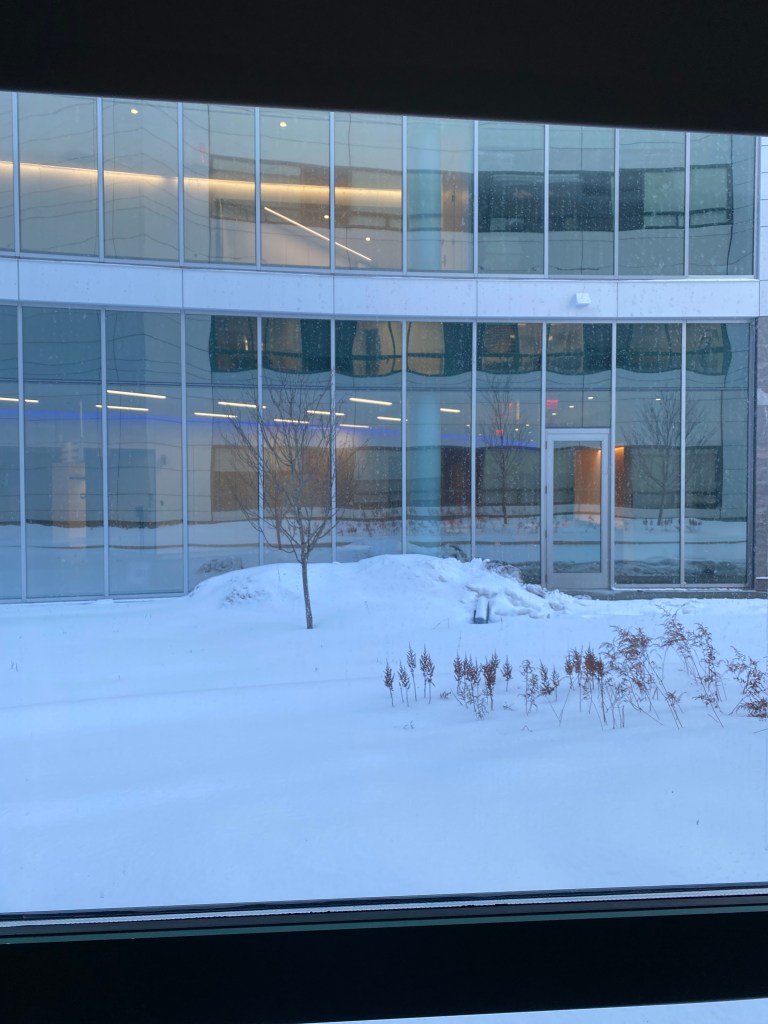
It’s the small hospital not far from our house, not the cancer complex with its soaring blue-green glass. On this zero-degree night, my daughter presses her feet against the room’s wall heater. There’s hardly any patients, save for a man we never see who insists that he must be heard. In the night of dim small lamps, I sleep and wake, talk with a woman from the high plateau country of the upper midwest. She remarks wistfully that Vermont is too tiny and cramped for the sweep of the midwestern sky. Maybe it’s just the Dilaudid, but when sleep folds over me, I dream of those childhood summers my siblings and cousins and I chased fireflies while the grownups drank bourbon and ate our leftover birthday cake and kept at their two-week conversation. The dew washed our bare feet.

The hospital morning flicks on before the sun has dulled the night’s darkness. Mirthless, indeed, I become, crabby with human lack and inhuman fate. Words, words, mine and others’, in a repeating loop. I text my nurse friend. On her lunch break, she appears, and then there’s laughter from nurses in my room. People come and go. I sign for more billing. (How much is this going to cost me, anyway?) The chaplain appears who’s read my book and wants to talk Flannery O’Connor and death. I’m not about to be funeral planning for myself anytime soon, but I plunge right into that death question. Indeed, this wretched cancer, my uninvited guest, perhaps the truest teacher of my life.

He asks, To know to savor every day?

Oh sure. But the disease has whittled me down to a glittering core, to ignore the petty fluff that not so long ago stung my eyes, and certainly my heart, too. What remains is real, both beautiful as those fireflies winking in the sultry midwest night, and ineffably, unbearably sorrowful.

I intend to live a long life; I’ll at least go on for some while, which is all any of us can say. In the meantime, this rarefied illness journey? Not lacking for writing material.

From Flannery O’Connor, The Habit of Being (1988):

In a sense sickness is a place, more instructive than a long trip to Europe, and it’s always a place where there’s no company, where nobody can follow. Sickness before death is a very appropriate thing and I think those who don’t have it miss one of God’s mercies.

What the living do.

I’ve written about the strange and often terrifying world of cancer here over the past few months. In the past week, my eyelashes have thinned. At first, my eyelashes looked as though I had walked through a rainstorm. I’m not at all adverse to rain and lousy about remembering a jacket, so I often end up in a deluge. Last July, I explored trails on a friend’s property. Over the past years, she’d designed and cut narrow trails. I walked through what seemed like enchanting forests of moss, stands of cedar so dense the light darkened, around a former beaver pond filled in as swamp, and finally discovered great white pines. She had unearthed pieces of white quartz and marked the edges of the trail. Walking back, rain fell, hard. By the time I reached my Subaru, I was drenched. I wiped my face on a sweater I’d left on the passenger seat. In the rearview mirror, my eyelashes held crystals of raindrops, diminutive pieces of that forest’s quartz.

January, temperature hovering around ten degrees, rainfall is in no immediate forecast.

As an andidote to the national clamor, here’s a few lines poet Marie Howe wrote for her brother from “What the Living Do.”

Johnny, the kitchen sink has been clogged for days, some utensil probably fell down there.
And the Drano won’t work but smells dangerous, and the crusty dishes have piled up

waiting for the plumber I still haven’t called. This is the everyday we spoke of.
It’s winter again: the sky’s a deep, headstrong blue, and the sunlight pours through

the open living-room windows because the heat’s on too high in here and I can’t turn it off.
For weeks now, driving, or dropping a bag of groceries in the street, the bag breaking,

I’ve been thinking: This is what the living do….

Inauguration Eve. Cold. And me, the mad mutterer.

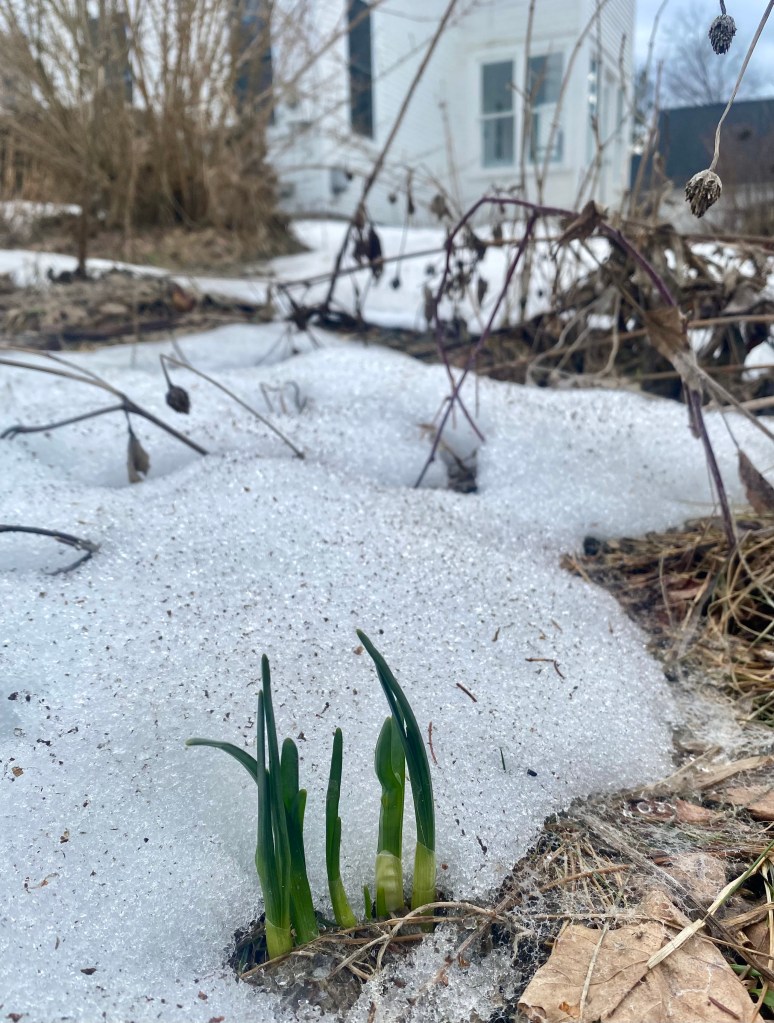
On this Sunday inauguration eve, all day long, intermittently, as I go about the things I do, I’ve been thinking of a Mary Oliver poem. As I’ve written before, a friend has been sending me a poem each day that she reads aloud in her voice as clear as winter wind. Mid-January, Vermont, is the season both of winter settling in for the long haul and, conversely, as life often is, of lengthening days. We seek the merest brightening of the light as proof of spring’s promise. In her recording, my friend mentions seeing the division of seed packets in farm store, solid evidence of spring’s inevitability.

Later, just before twilight filters in, I walk out alone, tromping the short path through the woods and cemetery to the upper edge of the village. A few flakes of snow twirl. Otherwise, no one. My boots crunch over hard, packed snow. My mind is jammed with its usual monologue, when suddenly I realize my euphoria at walking along this wide road, flanked by white pines with broken branches, a single crow winging its way over the snowy Little League field. Yes, yes. I’ve forgotten my mittens, and my hands knotted in my coat pockets throb with cold, and yet I keep chortling like a mad woman, Yes and yes and yes.

Like any writer, I’m quite capable of running wildly with words, but as for the politics and national people, I’ll simply leave Mary Oliver’s words from her poem “Work, Sometimes.”

… What are we sure of?  Happiness isn’t a town on a map,
or an early arrival, or a job well done, but good work
ongoing.  Which is not likely to be the trifling around
with a poem.

Then it began raining hard, and the flowers in the yard
were full of lively fragrance.

You have had days like this, no doubt…. Ah, what a
moment!

As for myself, I swung the door open.  And there was
the wordless, singing world.  And I ran for my life.

Tiny flames, ice.

Bootstep by bootstep, my strength begins to return. It’s cold, darn darn cold, slicing at my eyes and cheeks. The cold and I are no strangers. I made maple syrup for years in an unheated outbuilding, raised my daughters in a house with scant heat, have spent decades of my life tromping beneath snowy trees in search of…. what? The usual things I suppose, by which I mean the unexpected. Or maybe just the sheer loveliness of a fresh snowfall.

Here’s my barometer for how I know I am improving, the cancer lessening. A long ago college friend appears at my house with the flu, explaining away his symptoms. At first, I don’t understand; what is he asking me? My old moxie rears up, fueled perhaps by the Red Devil chemo drugs. I’m taking in a poison to save my life, after all. As if it’s not enough to have cancer, I had to send him away, banish him from our hearth, point that what, whatever he thought he might be doing had nothing to do with me at all. It was all him. At this precise moment, there’s no space here for that, or for the flu.

Later that night, neighbors appeared with ice lanterns made from five-gallon buckets. I grabbed my coat and stood outside, talking, while they lit beeswax candles and shared news of town. When they left, the tiny flames glowed brightly in the starless night, sure evidence that fire can burn even surrounded by fat ice.

Vessels, Rooms, the Unbounded Sky.

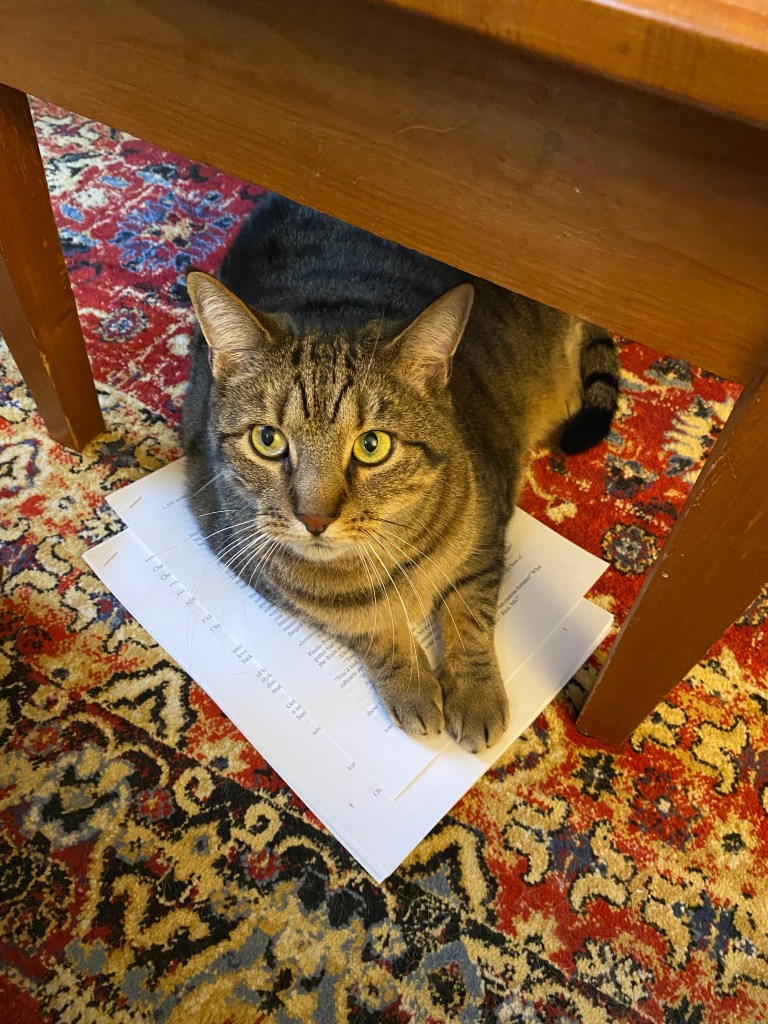
16 degrees on this sun-kissed Sunday, my cat considering the squirrels.

In cancer land, still putting my muscles together, I’m outdoors only with someone else these days, the long solitary walks yet a future promise, again. Early mornings, I brew coffee, fill the cats’ bowls with their breakfast. All day long, we’re filling and emptying things: water glasses and soup bowls and cat dishes (again), filling a notebook page with penciled words, a suitcase with my daughter’s clean clothes as she heads back to college, a new lightbulb in an empty socket.

Likewise, this disease has filled my body for months, now emptying; illness has slipped into every crevice in my family’s life, too, like the power of freeze in a river, rearranging the flow.

In a year that’s begun with so many families losing their homes on the other side of the country, the sunlight on this morning, a chilly walk this afternoon, the cold scraping at my cheeks – yes, yes – a scrap of gratitude for January Vermont sunlight. Here’s line from one of my favorite writers, Andre Dubus, who knew loss keenly.

“We receive and we lose, and we must try to achieve gratitude; and with that gratitude to embrace with whole hearts whatever of life that remains after the losses.”