Like the creation of the cosmos out of chaos…

I stopped in a wood stove/chimney sweep shop in Montpelier, looking for a replacement length of insulation for my stove.

I’d bought the stove in 2020, in that strange period when some businesses had reopened; Vermont’s mask mandate was brand-new. I was looking to install a metal asbestos chimney in my 100-year-old house, determined to heat this house with wood and not rely on oil. I was new to wearing a mask. My teenager waited in the car.

Four years later, on a rainy morning, I stop in and two men are warming themselves at glowing stoves. I ask my question about the catalytic combustors and insulation wrap. One man reaches in a stove and pulls out a honeycomb piece. He asks me if I’ve taken my stove apart. Yes, I answer, and I’ve put it back together — not once or twice, but regularly.

The store is on the retail strip between Montpelier and Barre, and the greasy scent of the never-closed McDonald’s pumps through the damp air. On that same 2020 trip, I texted a staff member of the state’s Department of Libraries about hand sanitizer. The department was closed, of course, and I never met this woman, who left me sanitizer and children’s books. We wrote back and forth to each other, and then she vanished elsewhere into a job, or so I guessed, a different phase of her life.

This morning, my daughters and I park at the edge of town and follow the running water: tracking uphill from river to streams. The mushy snow melts in the rain. Three geese fly overhead, clamoring. There’s that famous line from ol’ Henry David Thoreau: the coming in of spring is like the creation of Cosmos out of Chaos and the realization of the Golden Age. On this March morning, the silty waters running high and fierce, Thoreau’s chaos line returns to me. My old familiar, chaos, the companion sometimes in my pocket, sometimes in my face.

Then, this: the evenings are beginning to stretch with light, rich with the scent of wet earth. Last night, my daughter and I pull on our jackets again and head out into the damp world, in hopes of red-winged blackbirds. A no go, yet. But halfway through, I interrupt her and say, “Robin.”

And again, “Robin.”

Getting Lost & Found.

There’s that old saying You can’t get there from here, which in Vermont means, It’s not easy to get there, but use your wits and you can. Yesterday afternoon, leaving for a Vermont town I’d never visited I hedged bets on the map, avoiding the route that I guessed had wash-outs and detours yet, and headed down two-lane blacktop through villages where hydrangeas are just beginning to bloom.

I was invited to read with Alexander Chee at the Meadow Meeting House, a righteous 1830s former Baptist Church. The ceiling was stenciled in original colors, over straight-backed wooden pews not designed for the listeners’ comfort. The entryway has two wood stoves. The black pipes extend over the pews before exiting. That would have sufficed for heat.

By chance (or maybe not), Alexander Chee and I each read about spaces — churches and homes — particularly apt in that lovely building that had its own generations-long story. It’s a question that fascinates me: how do we hold the past and also make our lives anew? The question links inexorably to the physical places where we live.

Afterward, in a sunlit house surrounded by gardens and apple trees heavy with fruit, I met a woman who’s the daughter of a long-ago friend of my father. Our conversation pulled me back to my college days. (How would I ever explain that I first fell in love with rural Marlboro College lying in fields, awestruck at the undiluted Milky Way and constellations?)

Driving home, threading my way back along unfamiliar roads, I had the strange sensation I held that afternoon and that conversation in my ribcage. Outside of my town, Hardwick, I had a long wait at a temporary red light on the broken highway. The asphalt washed down the Lamoille River. I stood up and leaned out my Subaru sunroof. In the gloaming, I saw how the river had cut a new course, its old path a great swath of boulders.

In the cavern of my ribs: wildfire smoke. The stories of my past, that afternoon, the future, too.

Promising Sign.

Mist lies on the valley these mornings, indicative more of mid-August than this tail-end of July. 2023, the Vermont year with scant summer, thus far.

Nonetheless, on a ravishingly beautiful Sunday morning, we walk along the rail trail beside the Lamoille River. The trail is closed due to the flood’s multiple wash-outs, and there’s no bikers, but by foot and dog paw the walking is easy enough. The debris along the river is appalling. Two by fours with outlets lodge in treetops. We follow the silt and gravel, studying the way the river lifted, changed its course.

This morning, thrush chortle, and the cicadas hum their midsummer serenade. Distantly, across the river and hayfields, traffic grinds along Route 15. Where we stand, my daughter and I would have drowned, three weeks ago, as the river howled and smashed its way west, and then north to the sea.

Now, easy-going end of July.

I glean a washed-sparkling piece of white quartz, half the length of my thumb, in the shape of Vermont, and slip it into my pocket. I’d written exactly this rock and shape and size into the beginning and end of my novel. An auspicious sign — imagination incarnate — or hopeful dreaming at least.

…. Last, I’ve been generously invited to read at Meadow Meeting House, Corinth, Vermont, with the esteemed Alexander Chee, this Wednesday, August 2, 4:30 p.m. Please come if you can.

Four Feet of Mud.

Friday afternoon, when the Fed Ex man drops off a package, I ask what he’s seen on his route, his perception of flood damage and how folks are faring. In places, he says, nearly nothing. In others, houses perch over streams.

This stranger keeps going — and I keep asking questions — about his experience in the national guard, a tour in Iraq, and then a month in New Orleans after Katrina.

We’re back in blistering July, and I’m sweaty and dirty from weeding in the garden. On our sandy hillside, this summer the grass flourishes, a benefit of months of rain. I’ve finally mowed the grass (hardly a top priority these days in our house), and that ineffable and sweetly delicious summer scent of cut grass washes around us.

Our conversation bends back to Vermont and our washed-out valleys, how Hardwick’s Walgreens had four feet of mud. He looks at me and ask how tall I am. It’s true; I’m not that much taller than four feet. For a moment, we stand there, two strangers, contemplating four feet of mud. Then he heads to his truck.

Which pieces of our world will go back together, and which won’t? It’s a metaphor for many of us, perhaps.

All the way I have come

all the way I am going

here in the summer field

— Buson

After the Floods, the Human Conundrum.

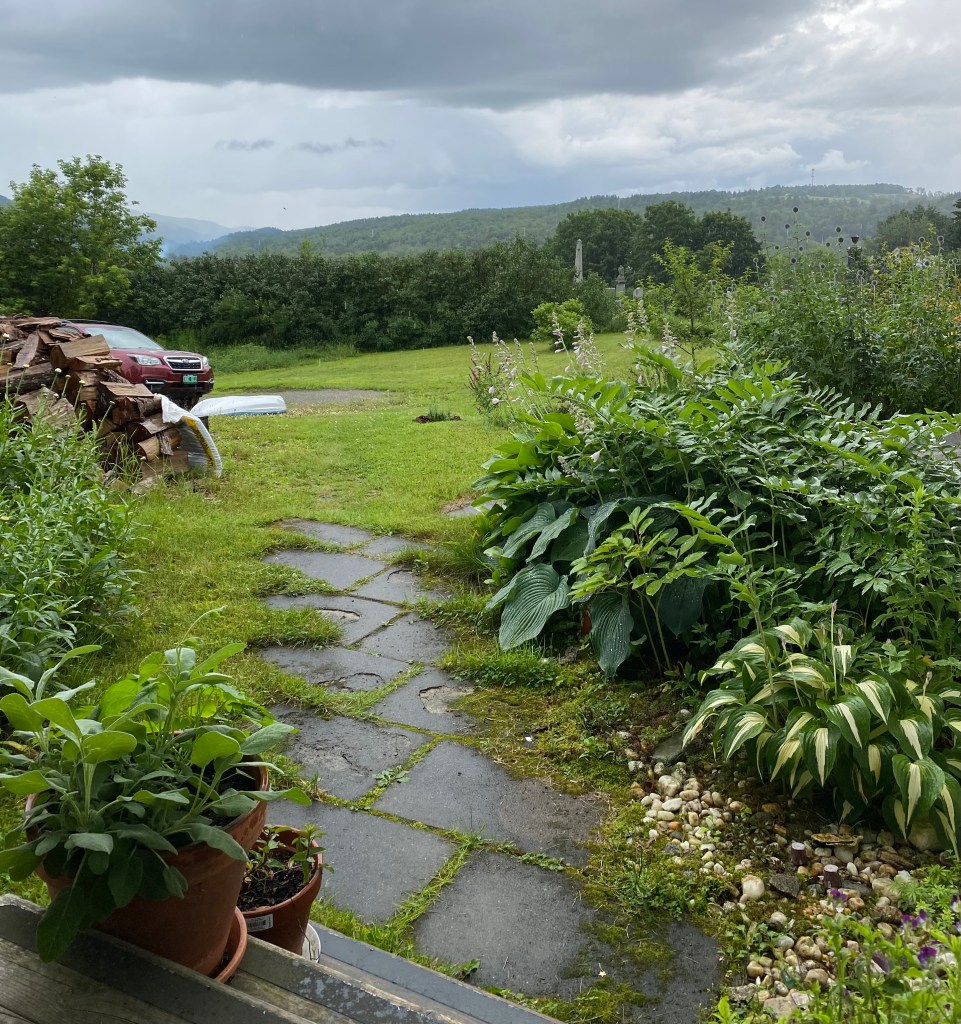
View from the back steps…

This week, I’m driving around a back road, far over the left-hand side, eyeing how a third of the road no longer exists. I’m far off the beaten path, so I don’t hesitate to stop, turn off the Subaru engine, and get out. The road, indeed, has washed elsewhere. The air is thick, sultry in a July way, but suffused with the wildfire smoke we’ve been breathing all summer.

I drive a little further and then drift into a driveway. I know the road drops steeply, and I’ve no intention of heading there. The homeowner is outside, and we talk for a bit, kicking around his view and his calm acceptance of the road’s condition. He asks where all the gravel to repair these roads comes from.

I’m stuck on his thought after this: it’s the human endeavor, the human conundrum. We’re always moving stuff from here to there: in my realm, moving plants from garden to pot, laundry from clothesline to drawers, and then the far larger realm — trees to boards to houses, gravel from pits in the earth to roads. And then the roads wash out.

At home, later that night, I’m still moving things, wool from sheep, to my knitting needles.

Scant Speaking.

The afternoon takes me around two lakes in a kind of work I relish. One visit involves a visit with a contractor at a house he’s building. We muse how water seeks its own wise course. As I drive away, I keep thinking about the immense boulders a king-sized excavator unearthed from that mucky soil. The boulders are some of the most righteous beings I’ve met in weeks.

On my way home, I stop at the high school and take a brisk walk through the woods before an evening meeting. I see someone I know, and we talk about projects at the high school, what money is coming in, and what’s still needed. These days, I often find myself in terse conversations with acquaintances, as though we’re all gnawing a cigarette between our teeth, our backs against a proverbial wall, eyeing the horizon.

Then I’m on my way, and he to his.