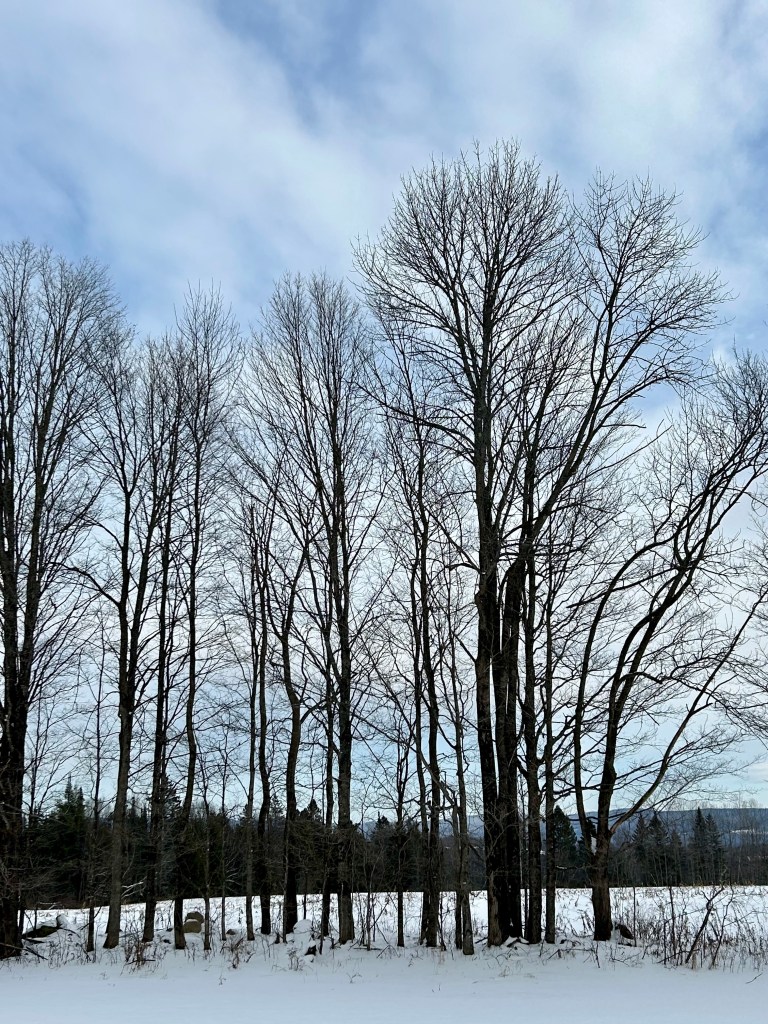
Among Lilacs-Gone-to-Sticks…

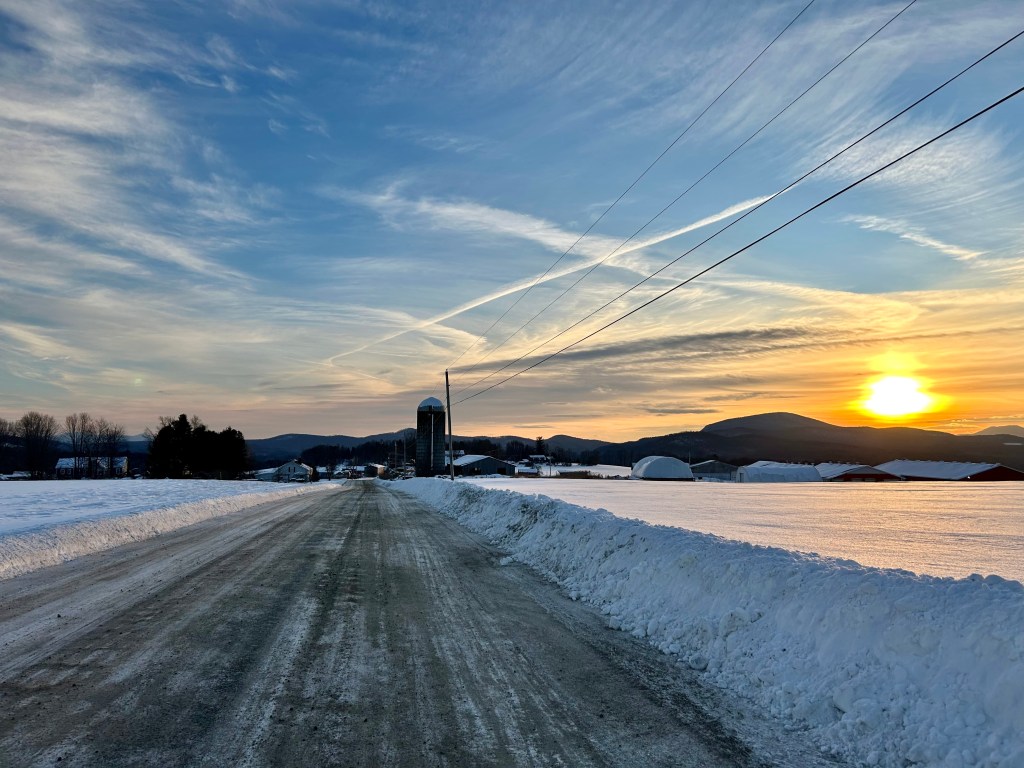
Late afternoon in Vermont December is twilight; I’m hustling along my road, a glass container of hot soup wrapped in a pink cloth in my hands, and I stop for a moment and talk to the neighbor boys who are sledding. The light is dim enough that I squint to count the three children, shadowy figures in snowsuits. The cold is fierce on my face. This day has been sprint from one thing to another, more yet to come, but I pause, that glass steaming in my mittens, the sunset sprawling over the great sky, the stars already emerging in the east’s darkness. A small moment, a tiny exchange of hellos. Such luck to be in this ordinary afternoon.

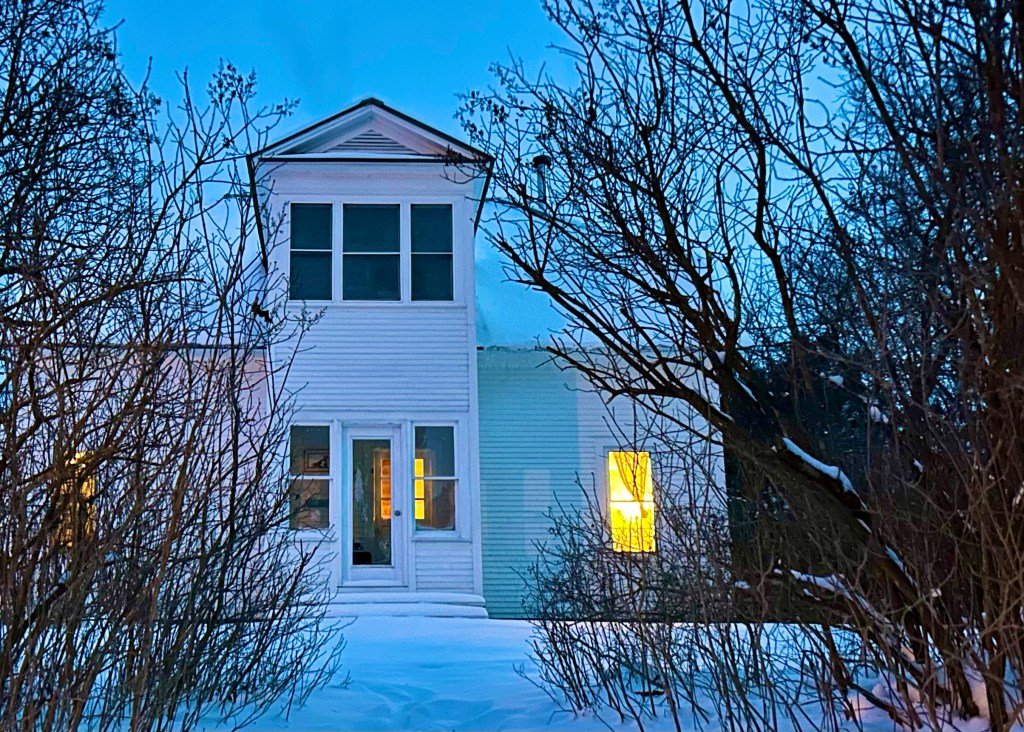
I walk through the parting in the lilacs-gone-to-sticks for the winter, study the bird feeder hung in the mock orange, the seeds sprinkled in the new snow. Behind me, the boys call to each other. In their lit kitchen window, I see the boys’ parents. Dinnertime nears. The cold is so mighty a body without shelter could and would perish. In the snow that gleams with the last of the day’s light, my boot prints lead to me, my lit window and cat, the upstairs bedroom dark where I stood a year ago and wondered if I would die. Wrong question. Not if but when. For this moment, however (a great big however), I remain in this simple-not-simple equation of laughing children, hot soup, the night swooping in. I study my bootprints with satisfaction and then head towards my own kitchen door.

“The Way It Is”

There’s a thread you follow. It goes among
things that change. But it doesn’t change.
People wonder about what you are pursuing.
You have to explain about the thread.
But it is hard for others to see.
While you hold it you can’t get lost.
Tragedies happen; people get hurt
or die; and you suffer and get old.
Nothing you do can stop time’s unfolding.
You don’t ever let go of the thread. ~ William Stafford

The Scythe, the Past.

Twilight, 25 degrees yesterday, the temperature dropping, I’m walking back and forth by the town garage, a tumbling-down quonset hut beside the town’s towering sand pile. Such much winter yet to come. On the snowy road, I pace back and forth, watching the sky turn from blue towards black, the stars hidden behind the clouds, talking with my friend about family and politics. Listening, I remember the Christmas manicotti she brought me last year. My daughter and I ate that delicious meal at the kitchen table; through our glass doors, I watched the snow fall, wondering if I would live another year.

Another year is not a guarantee for a single one of us. Another lymphoma lesson. I’d woken that morning with that now-familiar fatigue, as though sandbags were tied to every bone in my bone, pulling me earthward. I fed the wood stove, drank coffee, rallied and did my writing, rallied again and pulled on my coat and boots and left the house.

Later, by chance, at an outdoor fair I see a woman I’ve known for many years, who was part of a trying time in my life when my daughters were young. She offers me a particular kindness, and I thank her, wondering what I’m supposed to say. She does not seem to expect the standard answer of all’s well, that’s over and done because of course any fool knows, once cancer has rooted profoundly in a body, the reaper’s scythe does not hide. By now, it’s not so much the scythe that frightens me, it’s the suffering to get there.

On my way home from the fair, I pull over and get out of my car. The sun shines brightly, but it’s freezing, and I’m shivering. I walk back down the dirt road that’s empty of everyone, not even a crow perched in a bare-branch maple. Far up the valley I see enormous white wind towers, the Lowell Mountain Project. To my left is a house where one of the leaders of a group that protested the towers now lives. When the tower project began, my then-husband joined that protest group. The experience broke my naive love affair with Vermont and my blind faith in that too-hard-used word community. Not so long after, the husband and I divorced. My life went on, and I became intimately familiar with my own fallibility, my own deep pockets of untrustworthiness. I devoted two years of my life to writing and publishing a book in atonement for my own callous actions. Which never changed the consequences but widened the story. Then, cancer — the plot turn.

Robert Frost, no stranger to suffering, famously wrote that everything he knew about life could be summed up in three words: it goes on. Standing alone on that roadside, I imagine myself as the mangiest cur, footsore, half-starved, near mad. Disease may yet be rising within me. If not now, perhaps soon, perhaps never. This hillside above the Black River valley will endure long beyond my bones and flesh, long beyond yours, too. The sun and wind cut into my eyes. Why do I refuse to remember my mittens? Rather than letting all this go, I stuff these stories back into my heart and trek back to the village. I’m not finished with any of this. I’m still following the strands of all these stories.

…. and last, Rick Agran of Bon Mot has kindly invited me to his radio show at 5 p.m. EST tonight…
Boots on the Land, the Ice.

I’m meeting someone, late afternoon, who’s late, so I wait. The February sun has dropped into the horizon and clouds, and the day’s softening snow is tightening up, freezing again. I’m along one of the glacial lakes, a deep cut in the earth created by the planet’s unstoppable movements. It’s an old, old lake, not a newer pond formed by a human dam construction. Across from where I stand is the beach where I swam last fall, evenings and weekends. The water is shallow for a short stretch and then deepens quickly. My youngest had just gone to college. I would swim out as far as I could, then lie on the shore beneath the shaggy cedars, reading and watching the loons dive and reappear.

February exposes the bones of Vermont, the land’s steepness, the flatness of ice, the pale grace of a white birch in a hemlock forest. That afternoon, the stranger tells me a story of how the land was divided in families, re-divided and swapped, sold. Around this side of the lake, the state highway was built nearly on the water, and from here it’s easy to see the challenges of traffic and how the road hampers runoff from the mountains. It’s a familiar story that plays out in particulars in all but the wildest places.

On my way home, I stop at the town reservoir and walk a short distance over its ice. Walking on ice is always a kind of magic, a temporary thing. I don’t see the two bald eagles who live here: another day, perhaps.