What the living do.

I’ve written about the strange and often terrifying world of cancer here over the past few months. In the past week, my eyelashes have thinned. At first, my eyelashes looked as though I had walked through a rainstorm. I’m not at all adverse to rain and lousy about remembering a jacket, so I often end up in a deluge. Last July, I explored trails on a friend’s property. Over the past years, she’d designed and cut narrow trails. I walked through what seemed like enchanting forests of moss, stands of cedar so dense the light darkened, around a former beaver pond filled in as swamp, and finally discovered great white pines. She had unearthed pieces of white quartz and marked the edges of the trail. Walking back, rain fell, hard. By the time I reached my Subaru, I was drenched. I wiped my face on a sweater I’d left on the passenger seat. In the rearview mirror, my eyelashes held crystals of raindrops, diminutive pieces of that forest’s quartz.

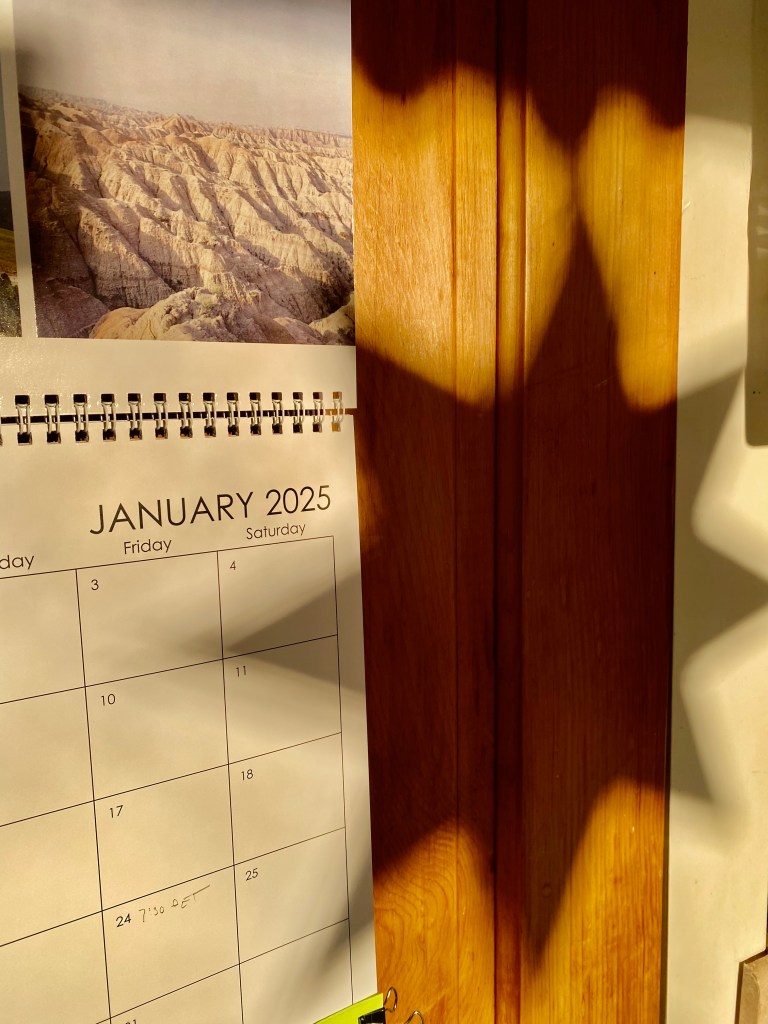
January, temperature hovering around ten degrees, rainfall is in no immediate forecast.

As an andidote to the national clamor, here’s a few lines poet Marie Howe wrote for her brother from “What the Living Do.”

Johnny, the kitchen sink has been clogged for days, some utensil probably fell down there.
And the Drano won’t work but smells dangerous, and the crusty dishes have piled up

waiting for the plumber I still haven’t called. This is the everyday we spoke of.
It’s winter again: the sky’s a deep, headstrong blue, and the sunlight pours through

the open living-room windows because the heat’s on too high in here and I can’t turn it off.
For weeks now, driving, or dropping a bag of groceries in the street, the bag breaking,

I’ve been thinking: This is what the living do….

All kinds of summer rains…

Too stormy to swim on Sunday, I take up a new friend’s offer to walk the trails she’s cut on her property. Her property is off a back road, with a gorgeous view into the valley where the Lamoille River is barely beginning to fatten its strength.

The trails wind down through the woods, studded with white quartz on either side, so gleaming the rocks appear to have been freshly washed. On the verge of rain, the forest is still. In a kind of labyrinth, I walk over springy moss, beneath leaning cedars, around a former beaver pond now dense with green. At the far end, I lean against a great pine, bark rough through my t-shirt.

Rain begins, pattering through the canopy, then soaking me by the time I’ve returned to my Subaru parked at the edge of the road. I’m so soaked the windshield scrims over with fog. But the time the glass clears and I’m on my way, the rain has stopped, the sun burst through the pearly clouds. In no rush, I pull over and walk along the road, admiring the luminescent rainbow, one end in a leafy hedgerow of maples.

Sunday afternoon, rural Vermont, there’s no one around. I keep walking, thinking about a conversation I had recently with a geologist about what’s happening in Vermont. He’d stepped away from a conference to answer my questions for an essay I’m writing, and gently pointed out that the concatenation of flooding and heavy rainfalls and the great shifting around of debris has been human-caused, not by the folks who live on slopes or streams, but collectively.

His voice is persistent, filled with facts, but also not despair; we need to be cognizant, wide awake, look lively. His voice reminded me of what a good summer’s rainstorm used to be, not so long ago. You might sit on the covered steps of your back porch, listening to the rain gather strength to satisfy your kale and broccoli, the thirsty hydrangeas.

The rainbow winks out, and I head home, carrying with me the memory of those silvery cedars, a few chips of pine bark nestled in my hair.

Traveler, There is No Road.

The trail where I ski changes every afternoon. The exposed earth eats away at the snow. The icy patches are harder, or the day has warmed and the snow swooshes mealy beneath my skis. In late afternoon, it’s me and the dog walkers, or two women, always deeply engaged in conversation.

The tech center students have half-tapped the sugarbush. The drop lines hang down in the back section of the sugarbush. The students are gone, too, leaving the tramp of their snowshoes, nothing more. The sunlight comes and goes all day, warm or gloomy. Fresh snow is scant this winter, and the trail’s ice is embedded with a scattering of hemlock and cedar greenery, small things that I fear will snag my skis but don’t.

The streams and rivers are running but the season of frogs is a long way off.

Finished, I clean nubbled ice from my skis with my fingers. A splinter is embedded in my thumb from a piece of firewood, stuck and sore. I press my thumb on the ice, listening for spring birdsong. There’s the sweep of wind, my heartbeat; nothing more.

There’s a reason why King Arthur’s knights were instructed to keep off the trails when searching for the grail, the logic being that if they were on the trail then they were following someone else’s path, so that particular path could not be their true path. Their only hope was to forge their own way through the woods. As Spanish poet Antonio Machado writes: “Caminante, no hay camino/ al andar.” Traveler, there is no road. You make the road as you walk.”

— Stephen Cramer

The Present Moment

Note: guest blogger Yasuhiro Nikolai Shinozaki wrote this entry. He is an eleven-year-old novelist, and a Vermonter currently growing up in Charlottesville, VA.

When I first got this assignment, I wasn’t sure what to write about. So I sat looking out the window at the white blanket of clouds hanging above the green trees. It was 7:47 in the morning.

That’s when I got my idea I would write about just this morning. Nothing much big. Just the present moment.

I always liked mornings. There is always a new day ahead and nothing yet to regret. Everything seems new and bright: the sunlight marching through the window and the silence yet to be broken.

Other than nights it’s always been mornings and evenings people have time to sit around. Most time is consumed by actually doing stuff. So here I am waiting for the rest of my family to get up at now 8:05 in the morning.

Photo by Molly S.

Photo by Molly S.