And More Snow

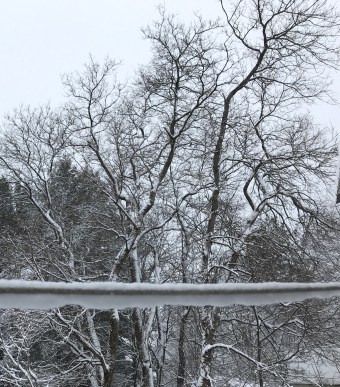
We fell asleep last night with the running of little cat paws from bedroom to bedroom and beneath the silence of falling snow. The cats this morning are sleepy, purring and hungry, and the snow falls yet. Where the grass beneath the mock orange had reappeared last weekend, fresh white has smoothed that over again. One year, eight inches of snow bent down my pea shoots. The peas survived. We ate them in June.

When my daughters were two, three, even five or six, I would have despaired: not more of snowsuit weather, tussling over winter boots, soggy mittens, the creeping pace walking from woodpile to back door with armfuls of wood and a small-legged toddler.

In the way of life ever-changing, here’s a morning spread with white beauty, soundless with falling snow, temporal as anything else.

How long the winter has lasted — like a Mahler
symphony, or an hour in the dentist’s chair.
In the fields the grasses are matted
and gray, making me think of June, when hay
and vetch burgeon in the heat, and warm rain
swells the globed buds of the peony…

— Jane Kenyon
IMG_1309.jpg

Where I Am


The Vermont Season of Pre-Spring

A number of years ago, I conceived an idea that our family’s financial salvation lay in wedding favors. With our maple syrup, colored card stock, a paper cutter, and raffia, I filled tiny bottles with syrup and bow-tied on little cards printed with hopeful things like Julie and Josh, July 8, 2001, Eat, Drink & Be Merry. Or: A sweet beginning. In the long run, my fortune didn’t lie there, but I met interesting people at profoundly pivotal junctures in their lives.

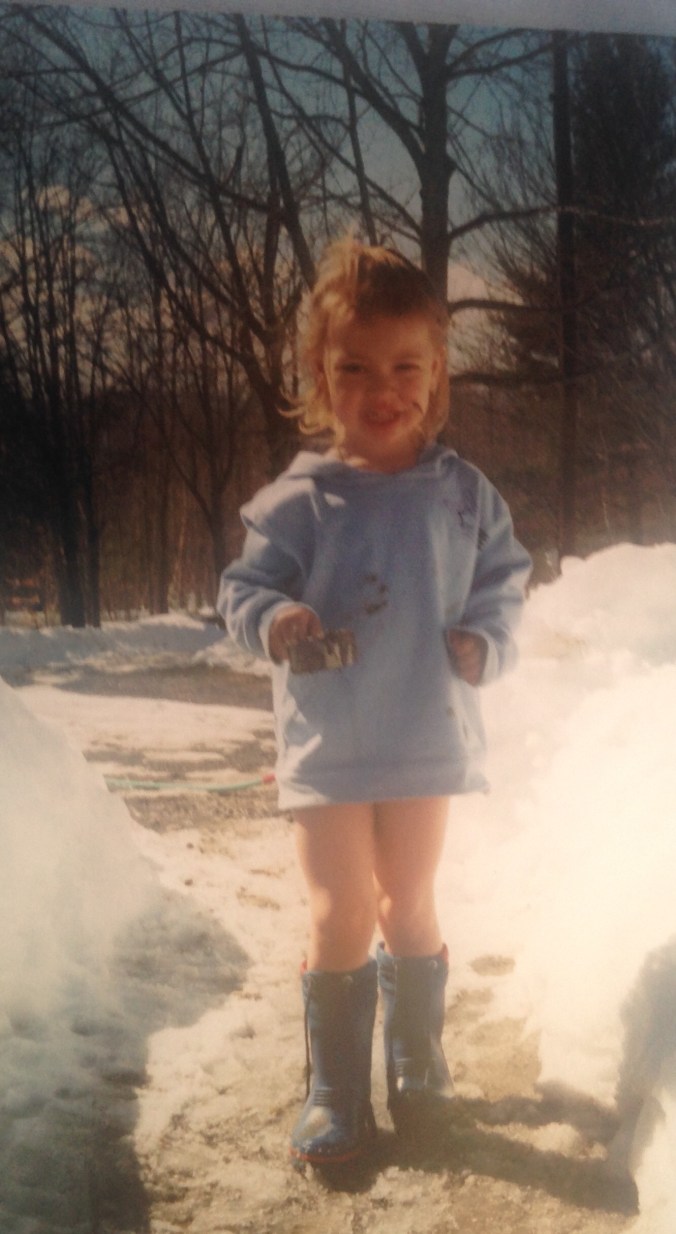
One April, in an intense mud season, a couple unexpectedly drove out to our house. We were deep in the midst of sugaring with a three-year-old. On our back road and driveway – and all around the house where the snowbanks were fiercely melting – lay mud that sucked at our knee-high boots with an audible glop. The winter had been its usual terror, and immense snowbanks mounded all around the house, interspersed by our trodden paths. My gorgeous little girl, with unbrushed hair, walked around shirtless in overalls and mud boots, a yellow plastic sand toy shovel in one hand.

The couple had heard about our wedding favors and had arrived to order in person. He and my husband talked about Ford pickups while I chatted with the woman. She kept looking around, distressed. It’s just so muddy, she kept saying. How do you stand it? Where she cringed from dirt and inconvenience,  I saw sunlight so intensely bright it lay like shining gold coins on the shallow dips of water that spread out all around our house, as though we were a ship on a rippling sea. I knew mud as the world’s thrust from winter to spring, the give from one season to another. My heart lightened with joy at the end of a bitter cold season and the imminence of wildflower season. I knew coltsfoot would shortly bloom.

…Soon it will be the sky of early spring, stretching above the stubborn ferns and
violets.
Nothing can be forced to live.
The earth is like a drug now, like a voice from far away,
a lover or master. In the end, you do what the voice tells you.
It says forget, you forget.
It says begin again, you begin again.

– Louise Gluck, from “March”

FullSizeRender


Hearth

This morning, the house grew cold as I let the fire in our wood stove dwindle. When it was nearly dead, I pulled apart the stove pipe and stretched my arm deep down its throat to loosen the rattling creosote. With a shovel, I removed the ashes from the stove, then vacuumed the damper vents at the back, so the air will flow again. In the baffles at the top, I reached between the metal and fireproof insulation and pulled out handful after handful of silty, warm brown ashes, silky as kittens. I kept thinking of Megan Mayhew Bergman’s story “Housewifely Arts.”

This evening, after a day of snow and freezing rain and sleet, our hearth is rich with heat again, the children sprawled luxuriously on the rug. One of the interesting aspects of writing is a tendency to turn things upside down and inside out. Our stove is not merely a source of heat, but also consumer of wood and air, creator of ash, its lungs linked to the chimney funneling through our house. I once spent the greater part of an afternoon with a heating specialist who explained the inner workings of a nearby hospital, the channels of electricity and oxygen and water and waste, the circulatory system of an enormous building, generally unseen but vital.

Maybe it’s a day like this, when winter relinquishes its hold reluctantly, hurling ice at our windows in fury, that brings us back to our hearth again, gratefully.

There is no need to explain to our daughter the death of her first dog. Poppy, better than any of us, understands the urge to have what you must have. She can still wring what she wants from the world. It has listened to her cries and delivered. She still trusts the raw pull of desire. One day it will tear her away from us, take her down a dirt road to a place she does not recognize, and there she will make her home. Away from everything she understands, and close to everything she wants.

– Megan Mayhew Bergman, “The Two-Thousand Dollar Sock”

FullSizeRender

Winter Garden, Vermont, 2016


May the Road Glaze Up to Meet Us….

No school today, due not so much to snow but to ice. While I was gone most of the day, literally sliding on Barre’s sidewalks, the kids were home. With great gusto, the teenager plowed the driveway, while the ten-year-old teamed up with the neighbor boy. In the afternoon, the boy’s mother and I went walking. I’m reading Rebecca Solnit’s Wanderlust: A History of Walking right now, and I realize my deepest conversations with this woman have been along our mutual dirt road.

Our relationship began before either of us had kids, meeting for the first time along the road when it had washed out in a summer storm. We have now stretched through births, illness, carpooling, innumerable passing back and forth of cake pans and eggs.

And yet it is always the road where we return. Today, with the road’s center sheer ice, she walked on one gravelly edge, I on the other, and we spoke across this narrow road. Back at my house, in the rain, the children had built a couch of snow complete with footrests. I watched the two children later from the kitchen windows, sitting on their mitten-made couch in their bright hats and snowsuits, chatting.

This constellation called walking has a history, the history trod out by all those poets and philosophers and insurrectionaries, by jaywalkers, pilgrims, tourists, hikers, mountaineers, but whether it has a future depends on whether those connecting paths are travelled still.

–– Rebecca Solnit, Wanderlust: a History of Walking

IMG_0698

February, Elmore, Vermont


Icicles as Building Materials

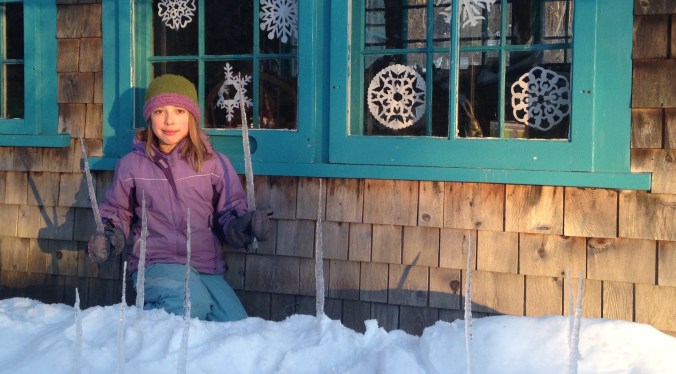
This afternoon, my 10-year-old daughter studiously collected all the icicles that she could reach from the house’s eaves. She then began her winter project of icicle house-building. The icicles have been slim pickings this year, and not for lack of interest. She cajoled her older sister, who had just returned from running, to stretch up and grab a few more.

Returning from a walk, I stood on the road, listening to my daughters at the house, discussing the different colors of ice. This weather, so pure and cold, reminded me of those long walks I took in those last few weeks before my first daughter was born. Every afternoon, I’d bundle up – me and the unborn baby I carried – and walk in what I remember as an especially sunny and cold winter. More than anything, I was most curious to meet this baby, to see this tiny person’s face: my child!

Our relationship has long since grooved into the varied terrain of mother and daughter relationships, far deeper, far richer, far more full than I ever could have imagined, sprawling beyond any cliched confines.

I have one daughter emerging into young adulthood, the other enmeshed deeply in the middle of her childhood. In the end? Who knows? How will these girls look back upon these years? But I hope they remember the loveliness of these ephemeral ice creations.

I do not miss childhood, but I miss the way I took pleasure in small things, even as greater things crumbled. I could not control the world I was in, could not walk away from things or people or moments that hurt, but I took joy in the things that made me happy.

–– Neil Gaiman, The Ocean at the End of the Lane


FullSizeRender

Mid-February, West Woodbury, Vermont

Wolves in the Moonlight

In the deep of last night, I woke with a south wind rushing over the ridge behind our house. In my sleep, I’d been dreaming of howling wolves in the moonlight, and when I opened the balcony door to stave off the wolves from my household, a strange warmth blew in over the snow. In the moonlight, I saw only the bare sticks of blueberry bushes, the hydrangea with its papery blossoms, long since dead yet stubbornly hanging on. Persistent.

With the wind murmuring like the sea, I lay reading Anthony Doerr’s memoir about living in Rome with his wife and two infant sons. In that ancient city, he watched flocks of starlings rise and dive in enormous flocks, while he held a baby, the little one drinking milk. Afterward, the book closed, I lay thinking of the pigeons I’d studied not long ago, weaving in and out of a slate-shingled church steeple in Montpelier. I’d stood alone on the library steps, admiring the ribbons of flight, and then I simply closed my eyes and listened to the cooing.

Knowingly or not, we all stand there… reading the omens of the birds. The real question, the one that keeps me coming back to this railing, night after night, is Why do they bother to be so beautiful?

Starling, earthling. How little we understand, Nero had a starling that spoke Greek and Latin, Mozart kept a starling in a cage beside his piano.

–– Anthony Doerr, Four Seasons in Rome

FullSizeRender

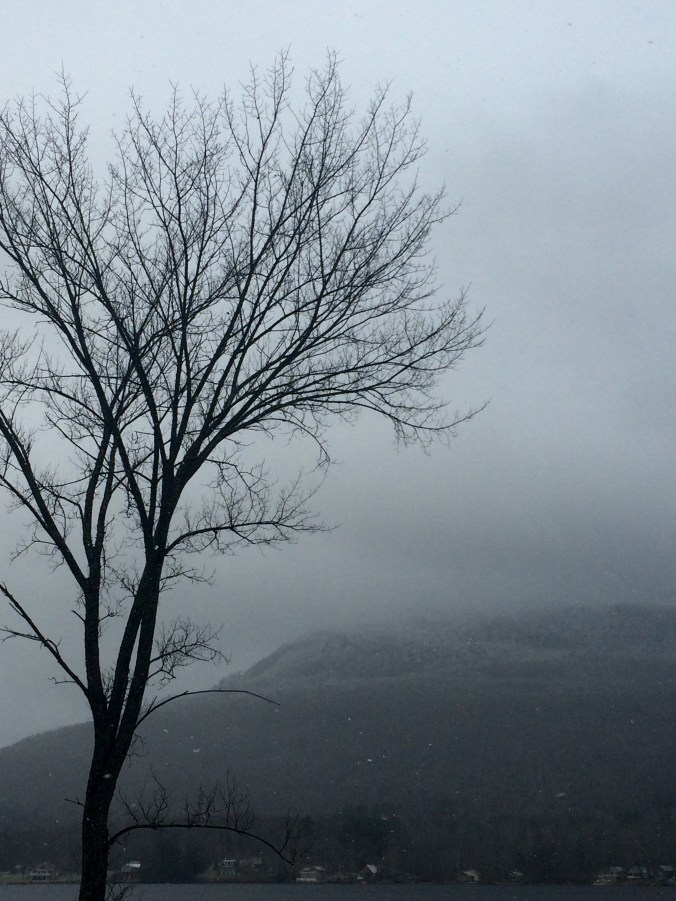
Photo by Molly S./Lake Elmore, Vermont