Blue Winter.

In the early morning, I drive over the crest of Walden Heights into the rising sunlight that’s pink on the freshly fallen snow. Every late autumn, winter’s imminence lies in me — the dread of inarguable cold and shortened days, how my heavy boots clomp. I no longer read outside. And every year, the stellar beauty of this season astounds me.

Over coffee and raspberry jam, we talk writing and disease. My companion reminds me that a writer does not fix the world. A writer writes. By the time we part, the morning gleams a bluebird sky. When I wrote Unstitched, I followed a trail of stories about addiction, person to person, sometimes to frightening places, sometimes to people who amazed me with resiliency and courage. Likewise, this cancer that inhabited me and maybe yet does has both constricted and widened my world. A year after diagnosis, as my breakfast companion noted, is both terrifying and awesome. I’m keenly aware of the limits of my bones jointed together with tendon and muscle and flesh, and that my will which propels this body is mortal and fierce. This, too, that writing mirrors a tenor of that same blind faith, that creative work will wind its way to a reader in need, while salvaging my own limping soul.

At the other end of this day, blue twilight. As the night’s cold falls, the village lights switch on. In my thin coat, I note my longstanding neglect about mittens, my fists jammed in my pockets. Nonetheless, I keep walking, seduced by the beauty of the running river, its edges icing, the sky overhead an infinity.

Here,
I’m here—
The snow falling ~ Issa
Snow geese and cancer and macaroni and cheese.

My friend walks into my kitchen. The windows are shrouded in the remains of last night’s darkness. She bends down and looks at my face, reminding me of those enervating conversations in ERs with doctors. After a careful moment, she pronounces, You look good. My house is warm; her sentence warms me more.

In the St. Johnsbury hospital, she drops me at the laboratory door. A receptionist sends me down the hall, in search of elevators. A woman in the waiting room follows rickety me in my winter boots, and repeats the directions. I wander down halls empty of people, interspersed with lit Christmas trees in what seem to me random corners and notches. Someone calls my name. I turn and look, and of course this is my friend, who for a fleeting moment I don’t recognize in her bundled coat, surgical mask.

Not far from the Canadian border, St.Johnsbury has a faded charm from its former heyday of logging and Fairbanks scales. This December morning, the day sputters, promising no sunlight, maybe a few rosy strands in the opening daybreak. In my strange fog, I wonder if the light mirrors Siberia. My blood is drawn and spun. Waiting for the verdict, I stare out the window, the layers of coal and washed-thin blue and last night’s pale snow. Beside me, a man introduces himself says he owns a garage and towing business. I pull down my mask and offer my name. My voice is so muted he can hardly hear me, but I ask him to tell me about his plowing so far this winter. While we wait, he obliges me. My hands, he says, will never be clean enough for hospitals.

Siberia, I think, Siberia, as the garage owner pinpoints roads. The daylight notches up a bit. Save for my friend, waiting elsewhere, I know no one here, but this winter landscape of snow and pale mountain, the livelihood of working with hands and backs and people, is familiar to me as my thumb knuckles, the loneliness of lingering over the morning’s last cup of cooling black coffee, pondering some decision that’s wormed itself in the day.

So disease, cancer, that forbidding word, burrows in. The disease is me; the blood is mine; the nurse explains numbers, says hematocrit, hemoglobin. Less than a handful of weeks into this journey, I know my blood courses with immutable facts, ragingly powerful chemistry. The blessing to leave is laid upon me.

Home again from distant Siberia — is it midmorning? afternoon’s mire? — my friend sweeps ashes from my wood stove and nourishes gleaming coals with birchbark and splinters, odd pieces of end wood. This day unfurls, somber and patient, settling into winter’s long haul. I offer a piece of my daughter’s gingerbread. For hours now, we’ve talked about migrating snow geese and cancer and macaroni and cheese. She asks if I would take her on a nighttime walk — I envision the throb of spring peepers, the redolent rotting slop of thawing earth — indeed, a pleasure I might give back, to one of my shepherds holding me steady as I wobble down my back steps.

The true religion, the religion of snow…

I stand at my kitchen’s glass door devouring blood oranges and watching the sifting snow. Blood oranges — could I choose a less local delight? I open the door and cast out the peels for the birds.

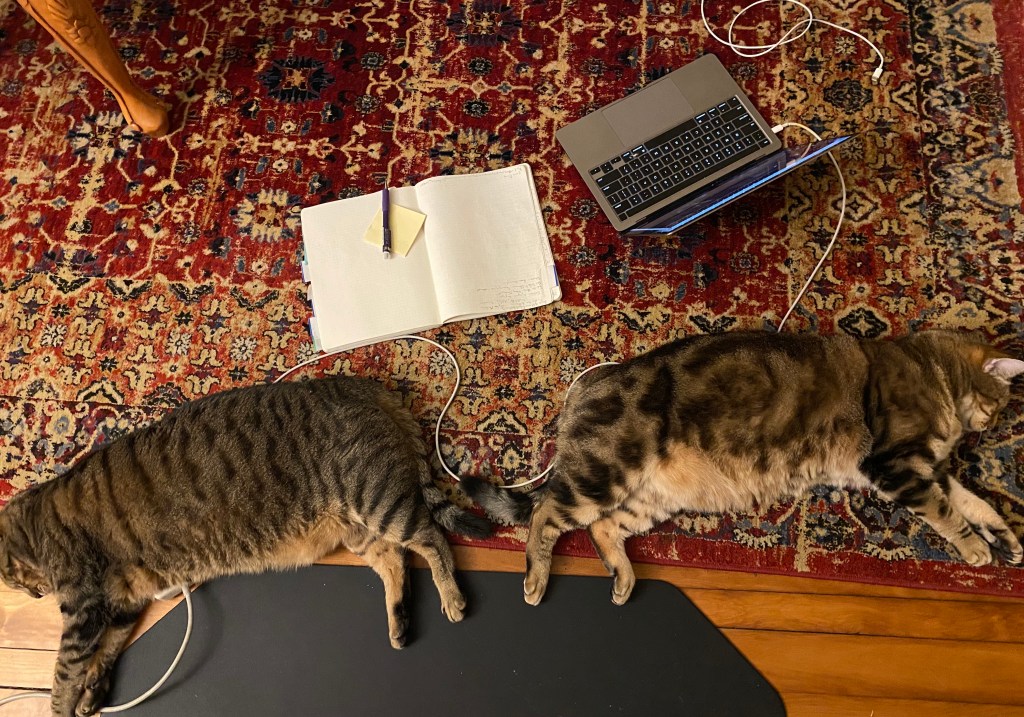
The cat Acer sits on my feet, listening to the morning radio news, too. Just over the river, my home state New Hampshire revels in the Presidential primary. Meanwhile, Vermont prepares for its March Town Meeting Day, with the calculations and passion of budgets and petitions. Close an elementary school? Pledge to become a pollinator-friendly town? So much of January in my state is devoted to public meetings and discussion/debate, to a reckoning of the way forward, a jostling for who’s running for what seat — and what seats might remain empty.

Meanwhile, snowy winter has finally arrived, spare and elegant. Fearsome and enchanting. As the days deepen in cold, the light hours increase: no stasis in this world.

A fan of local chicken, bacon, milk, my cat stares at my orange-sticky fingers with disdain. I crunch the orange seeds, too, devouring this sunlight sweet.

Here’s Billy Collins’ poem about shoveling snow with the Buddha:

[Shoveling snow] is so much better than a sermon in church,
I say out loud, but Buddha keeps on shoveling.
This is the true religion, the religion of snow,
and sunlight and winter geese barking in the sky,
I say, but he is too busy to hear me.

What we can’t know.

The cold hammers down around us in the way we’ve known Januarys before — nothing fierce, but sharp. January is a season that draws us up against our own mortality. Stumble and you’ll break a bone. Sleep outside, ill-prepared, seriously down on your luck, and you could perish.

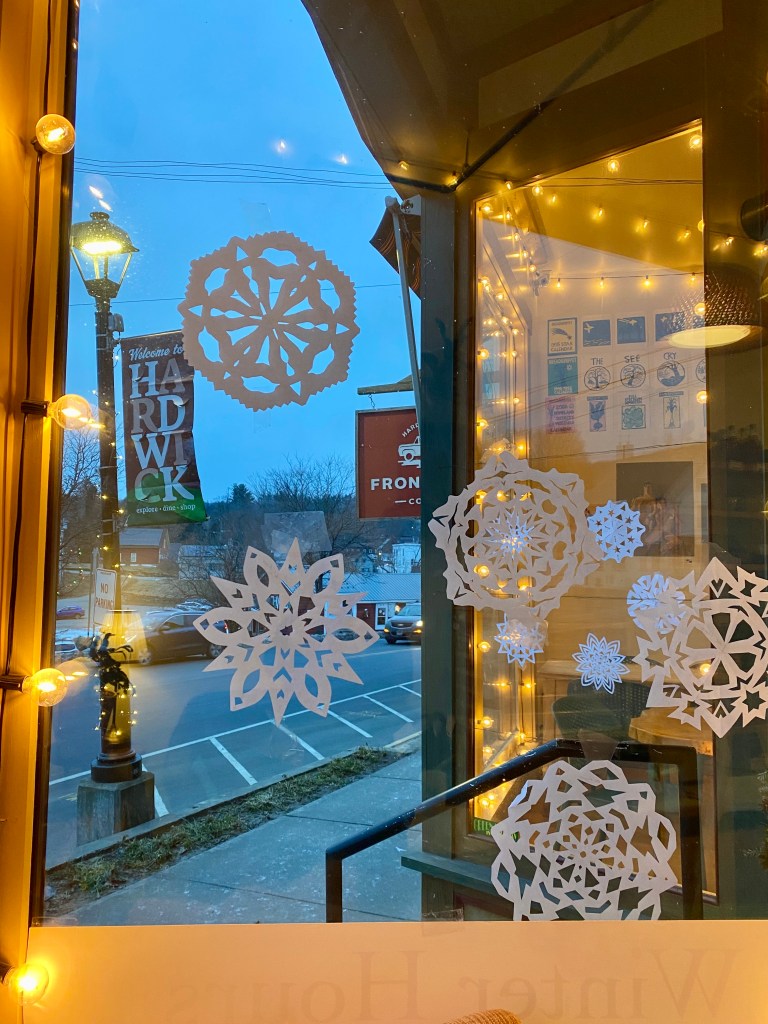
Wednesday morning on the early side, I’m drinking coffee and staring at the snowflakes that have appeared in the downtown again, a memory for an absent person. News has wound my way of the death of a person distant from me by numerous steps, the fate we’ll all meet, one way or another, the great leveler. In the afternoon, when I return from work, the window washers are carefully removing the lacy paper, setting the delicate flakes to one side, and then re-taping them on the windows. A gentle, wordless act of care. A piece of our human puzzle.

These winter days, I’m devouring Paul Lynch, about as good as anything can be.

“I believe it is worth writing to remind ourselves of what we can’t know. To remind ourselves that certainty is dangerous. That factual knowledge of the world casts only a small light. Fiction is necessary because it seems to me that only fiction can accommodate the total strangeness that is life. To remind us that truth is actually impossible.”

Your place in the world.

A rare mid-December day of sunlight, and the town seems festive, stirred by the truly false promise of spring. Not true, not true.

December’s a season of reckoning, of that inevitable look back across the months, to a year ago, to five, more. I’m old enough now that the seasons jumble into a Jacob’s Ladder of years: the Christmas of the hoar frost, the year a mouse drank from our Christmas tree stand, the 60 degree Christmas Eve my brother’s dog went swimming and gasped from the cold. The December snow fell every single day. That year, holed in the house with sick children, I wondered if I would go mad; I did not. All past, all somehow yet still with us. Heraclitus reminds us that the single constant in this life is change, and yet it’s still the same molecular stuff arranging and re-arranging, by the force of the universe and our sheer human will.

Oh December: you heartbreaker, you. Sleet and radiant sunlight in the span of a few days. Icicles drip. Chickadees whistle in the white pines. My wood chores finished, the compost bin dug out, I linger in the sun, leaning against the house, reading Paolo Cognetti:

You find your place in the world much less predictably than you’d imagine.

Falling.

The outside light flicks on early this morning, and my little cat Acer stares wide-eyed at a skunk making its snuffling and curious away around a flowerpot I left on the back step. Well before dawn, the cats are already fed, the kitchen warm, redolent with coffee, and here’s this wild creature, not in the least troubled by the two of us.

The skunk waddles on its way. Shortly afterwards, snow and chunks of ice rush down the house roof and crash on the porch, softened in the rising temperature. My cat runs. I wonder about the porch railing which snapped in prior years, but nothing appears broken. The design is poor — steep roof and wide porch and slender railings — and I let myself wonder just for a moment if this is some kind of hidden cosmic twist, a long-buried plan from when my former husband built this porch. I cut off that sentiment. This far along in life, I’m well-acquainted with the steepness of roofs and the precariousness of ice and snow and dynamic temperature. Gravity is not ruled by human desire.

At the other end of the day, I’m carrying in a few armloads of wood from the barn when another ice chunk falls, shaking the porch where I had tread a moment before. Through the glass door, my teen raises her hands — what’s happening? — Acer at her feet.

The cold’s drilling back in for the night. In the valley below, the village twinkles in the darkness. The wind whirls around the scent of woodsmoke. I step back, finally wary. The roof has cleared.

When you’re young, you are certain of your capacity to imagine a way out of the previous generation’s problems. There is a different way to grow old, paths that don’t involve conforming and selling out….

— Hua Hsu, Stay True