Mad World, Abundant Wildflowers.

For no particular reason, I walk on the path along the river which leads to the road where I once lived. In the meadows and beside the trail, the wildflowers blossom abundantly: yellow toadflax and pink asters, bluets and Black-eyed Susans, cinquefoil.

I dawdle at the dirt road. At a turnout, long ago I had a carpool meeting spot. Over the years, my daughters and I passed hours there. In the afternoons, I lingered with my friend, the girls lingered with their friends. The girls played in a brook. The fields have been used for hay, vegetables, seeds, THC. In the past few years, the flooding river dumped sand in these acres. Burdock and thistle claim this terrain now. These fields are for sale again.

A few pickups zoom by. When my ex and I were splitting up, we’d meet here, too. I’d run down the mountain road and leave the girls at home, baking cookies or riding bikes. In my then-husband’s truck, we’d argue about our lives. That autumn as an early dusk washed in, I leaned my head against the truck window and watched two coyotes running across the field. He kept talking and talking and I kept thinking about our daughters who would be hungry for dinner. Someone else lives in that house now. Our lives have long ago moved on.

A friend pulls up, and I get in her car. We talk about kids and aging parents, about money and oranges. The world around us is falling apart. What we see now might be just the cracks of a shifting society. Yet, our lives spin on. My friend and I keep talking and talking. Children grow up. The fields’ bounty changes. I no longer live a few stones’ throws down an empty road from this friend, but how I love her.

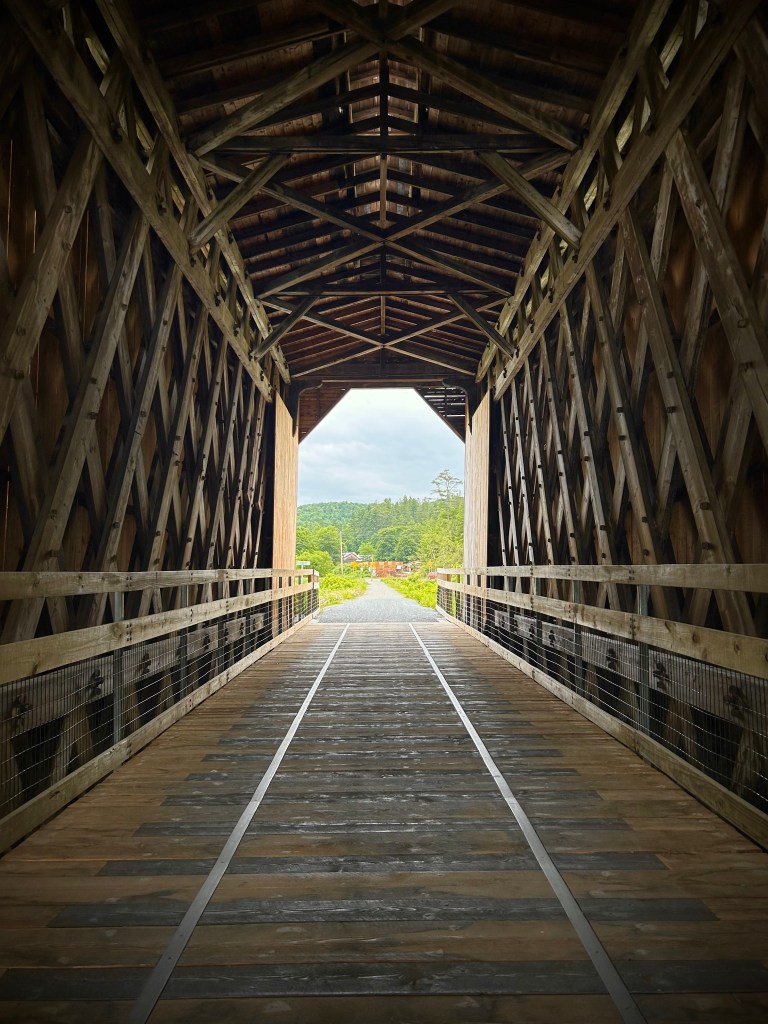
I walk back slowly on that trail, under the cool shading trees. Chicory, knapweed, Canada lily. In the covered railroad bridge, I pause in its interior dimness, light at either end. There’s no one around at all. I soak it in.

The heart’s actions
are neither the sentence nor its reprieve. 

Salt hay and thistles, above the cold granite. 
One bird singing back to another because it can’t not.

~ Jane Hirshfield

Ruined!

In this sweet May rain, working on the covered porch of one of my favorite libraries, I remember a rainstorm about a year ago. My daughter and I were in Rome, eating dinner in an outdoor café. In the storm, the staff had pulled a plastic cover over the terrace. The effect was warm, cozy, intimate. Beside me, a group of young men were drinking wine. One man remarked that Italy had ruined him. There was no way he could return to his Chicago cubicle and drink lousy Dunkin’ Donuts coffee. Hearing this, my daughter and I laughed aloud. Italy had ruined us, pleasurably, too.

Likewise, after a week of such largesse at the Vermont Studio Center — the gift of time and space, the pampering of meals, the kindness of the place — I wondered if I might be a little ruined, too.

Not so, perhaps. May in Vermont is one of my most favorite times. Here’s the gold of marsh marigolds behind an old grange. Gold.

The dark blossomings of chaos…

Again, this metaphor lens (how is it possible not to see the world in metaphors?) Paul and John’s Long and Winding Road, Dante’s gloomy forest, Sylvia Plath’s bees and beekeepers…

I lead a friend into a forest, a piece of Nature Conservancy land on a dirt road. We’re talking, talking, my eyes searching the forest floor for ephemerals (the trilliums folded shut, trout lilies still only leafy, no blossoms yet). I take one wrong turn, a second wrong turn. I backtrack, looking for the narrow stone steps. Our walking and talking — and my eventual smartening up to pay attention — takes us to Chickering Bog. In this pristine place, it’s just us and frog eggs, fat tadpoles, crimson pitcher plants — the confluence of ancient and freshly brand-new.

The strange thing is, I’ve walked to this bog half a dozen times, easily. Yet never in April when the sunlight drops down through the trees’ bare branches, when the winter-fall of broken branches strews over the paths. Or maybe I’ve never been here with this conversation about things tiny and great. The glassy water shimmers so clear the bog’s mucky bottom tantalizes, unreachable, so many centuries of so much life.

At the journey’s end, at the dirt road’s edge, the sprinkled gold coins of coltsfoot, a purple sprig of flowering Daphne.

On the reading front…..

“We must therefore be willing to get shaken up, to submit ourselves to the dark blossomings of chaos, in order to reap the blessings of growth.” — Gregg Levoy, Callings

Round Earth.

Autumn reminds me the earth is a globe. The days shorten; dusk draws in earlier. The shadows hold a chill.

This year, purple asters spread prolifically — along roadsides, in the woods, in seemingly random sprigs around my house. The flowers flank the two pears in my front yard that someone planted years ago. One tree mightily growing, the other a persistent dwarf.

Autumn is the season of so it goes. What passed for summer this year is finished, the harvest wrapping up. In its own way, perhaps, the most poetic of all season.

Someone goes by wearing a hood
in his own darkness
not seeing the harvest moon

— Buson

The Putting Back Together.

A coffee drinking companion, winding around at the end of our conversation, posits that our world appears to be unraveling. He notes that grass and dandelions break sidewalks: an act of defiance.

While I’m meticulous about certain things (keep mice out of the house, learn to use a comma), my garden this year obeys no orderly rules. Cosmos and calendula mingle with tomatoes. Amaranth reseeded among the dill and parsley. Forget-me-nots, to my great joy, blossom in random patches. I plant giant coneflower — Rudbeckia maxima — around my house. Have at it. Rage on. Rage.

End of August, the frogs and crickets keep singing. Overhead, a gibbous moon in the night, creamy light through roving clouds. Here’s a thousand action and more…. all alive, multi-faceted, full-throatedly in defiance….

Travels.

Driving down the heart of Vermont today, I hear an ecologist on public radio explaining how trapping beavers altered our landscape. Something that seems so simple and petty — a craze for beaver hats — changed the flow of water, the flora and fauna, and human transportation, too. As a kid, we made tiny birch bark canoes in grade school. Birch bark canoes were once a kind of Volkswagen for people who lived in Vermont. Serious water flowed over this landscape then.

I drive along the Connecticut River. Eventually, I just pull over and admire where I am. So much green. Such an infinity of shades, and all that water, flowing steadily to the sea.

Our world smells of lilac these sweet days.

I’m parked near an abandoned brick mill, in a town that has seen more vibrant days. The temperature may hit 90 this weekend — in May! in Vermont! — and no one in a rational frame of mind can claim this is right.

But yet….. here I am by the side of this great river, the mountains rising on the other side, the leaves leafing out in summer beauty. I’m in a shifting place in my own tiny life, my youngest nearly grown. Which way this will go, I have no idea, but I’m here, breathing in the humid lilac air, for this moment at least in no rush at all.

Lilacs in dooryards

Holding quiet conversations with an early moon;

Lilacs watching a deserted house

Settling sideways into the grass of an old road;

Lilacs, wind-beaten, staggering under a lopsided shock of bloom

Above a cellar dug into a hill.

You are everywhere

~ Amy Lowell