In these days of long light, my daughter and I are drinking tea and talking on our glassed-in porch when she spies a fox walking along the lilacs that fence us from the road. The red fox, a real beauty, turns and looks at us.
June has been a season of the wild pushing in — the prolific groundhogs (and my thoughts will come to naught about this, but I’m wishing for a more even ratio of groundhog to fox, for my garden’s sake), the multiplicity of birds, raccoon and possum, the circling turkey vultures. This year, too, my garden grows half-wild, the amaranth reseeding around the Brussels sprouts, coreopsis sailing over the fence. One morning, I straighten and pause, brushing dirt from my fingers, when I spy a fox staring at me through the layers of hydrangea and pin cherry trees. For a time without borders, we hold each other’s gaze. What passes between us is a wordless language, with no clear question or agreement. Maybe simply curiosity.
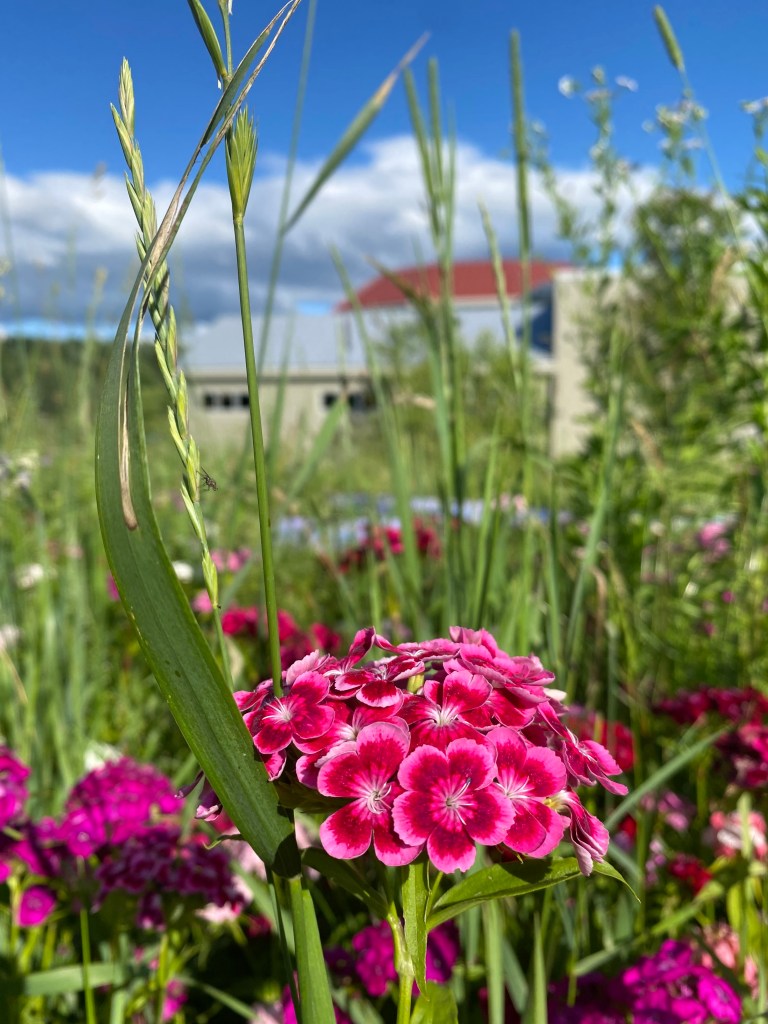
There’s plenty of the human chatter around me these days, much of it rippling up in chaotic waves. But then, this, too. Last night, poetry at a rural arts center, with all the best things of Vermont June: wildflowers and the pleasure of company, the beauty of words stitched finely together.
…. Last, never least, here’s some words about the unsurpassable Vermont novelist Jeffrey Lent, in need of a little lift…
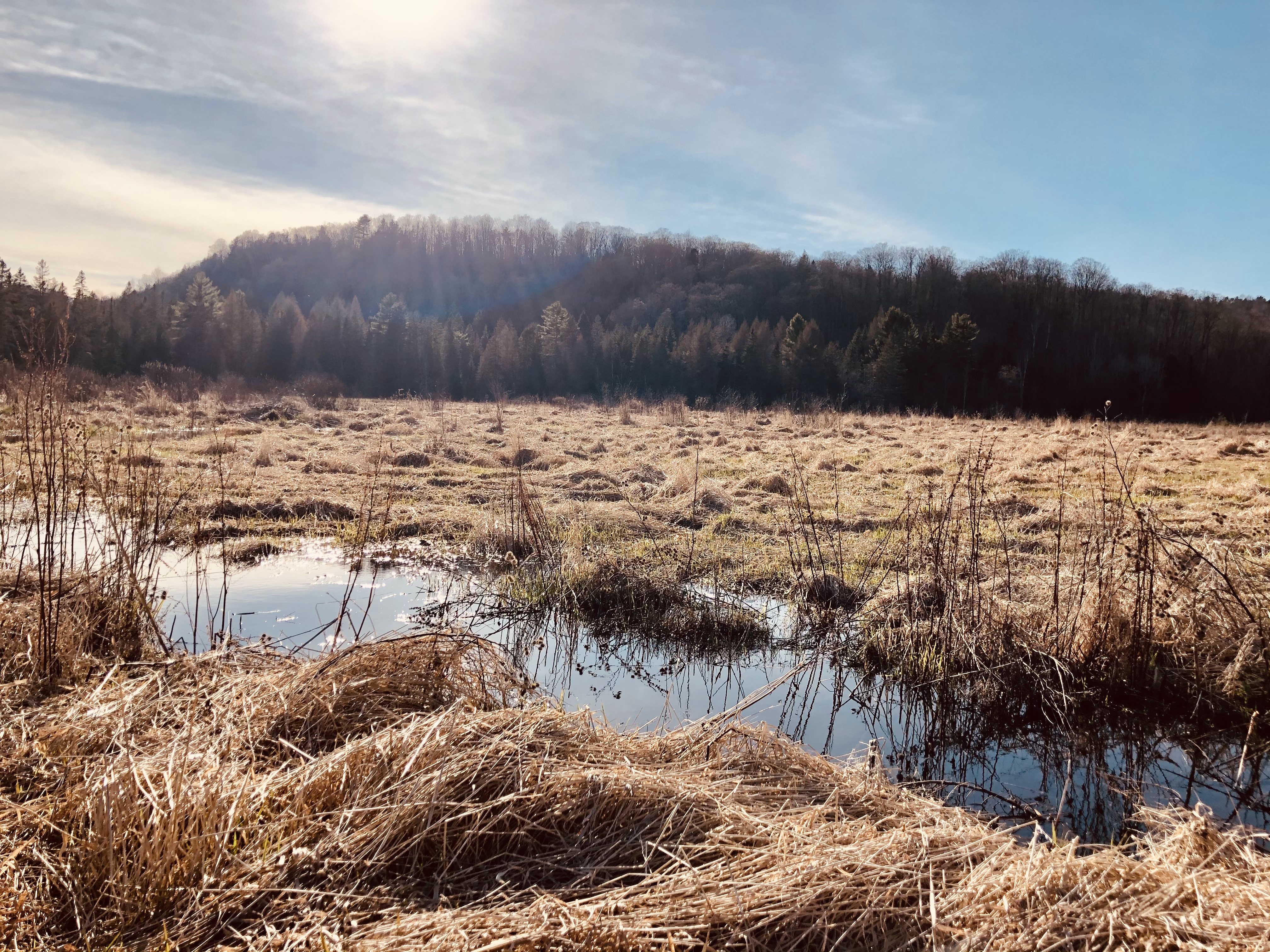
Friday night, driving home along a familiar road from visiting friends, I stop by the elementary school. Solstice, the Strawberry Moon, the daylight lingers, and the dusk is long, multiple hues of blue. No one’s there, of course. I follow the path along the wetlands. Shimmering with lilypads and twilight, the water chirrups, sings, buzzes. Fish leap and splash. I loiter, and the dusk closes in. Still, I keep walking, following the path through the brushy woods up a slight hill, so I can get to the other side.
In my twenties, I had a tendency to get lost in the night woods, stumbling off the path. Years before cell phones, we were always searching for flashlights with working batteries, to visit somebody in a remote cabin. But I’m in familiar territory, and I take my time, in this bowl of evening, letting the cacophony of the wild chorus diminish my stringy thoughts.
I haven’t been back here for a good long while, but this school and the town and the library where I worked was a warm place, with its own complicated stories, sure. Those were the years when my life fell apart. I pause, hoping to see the quicksilver flash of a fish. Across the wetlands, a single vehicle rolls along the road. Maybe it’s the passage of time, or the evening’s mellifuous beauty, but I see suddenly that I was following two strands of my story in those years. I was leaving my husband (and for months, I wasn’t at all certain how to do that), and I was also recreating my life (and how exhilarating and hard that was, too.) I’ve written about my struggle with addiction; when I began to lift that veil, my fierce hunger quickened for what I had wanted all along — to pursue my own creative and often dicey life. In this throbbing evening, I sense the limits of language, that words fail here, that to divide creation and destruction into two words, held in two hands, is illusory.
The fish I didn’t see smacked through the water. Fireflies winked around me as I threaded my way back to civilization in the dark.
“Train Ride”
All things come to an end; small calves in Arkansas, the bend of the muddy river. Do all things come to an end? No, they go on forever. They go on forever, the swamp, the vine-choked cypress, the oaks rattling last year’s leaves, the thump of the rails, the kite, the still white stilted heron. All things come to an end. The red clay bank, the spread hawk, the bodies riding this train, the stalled truck, pale sunlight, the talk; the talk goes on forever, the wide dry field of geese, a man stopped near his porch to watch. Release, release; between cold death and a fever, send what you will, I will listen. All things come to an end. No, they go on forever.
I’m meeting someone, late afternoon, who’s late, so I wait. The February sun has dropped into the horizon and clouds, and the day’s softening snow is tightening up, freezing again. I’m along one of the glacial lakes, a deep cut in the earth created by the planet’s unstoppable movements. It’s an old, old lake, not a newer pond formed by a human dam construction. Across from where I stand is the beach where I swam last fall, evenings and weekends. The water is shallow for a short stretch and then deepens quickly. My youngest had just gone to college. I would swim out as far as I could, then lie on the shore beneath the shaggy cedars, reading and watching the loons dive and reappear.
February exposes the bones of Vermont, the land’s steepness, the flatness of ice, the pale grace of a white birch in a hemlock forest. That afternoon, the stranger tells me a story of how the land was divided in families, re-divided and swapped, sold. Around this side of the lake, the state highway was built nearly on the water, and from here it’s easy to see the challenges of traffic and how the road hampers runoff from the mountains. It’s a familiar story that plays out in particulars in all but the wildest places.
On my way home, I stop at the town reservoir and walk a short distance over its ice. Walking on ice is always a kind of magic, a temporary thing. I don’t see the two bald eagles who live here: another day, perhaps.
Robin songs come through my open window this morning. Although I’m still keeping the wood stove at least tepidly warm, we leave the bedroom windows open all night. In this corner of Vermont, we’ve had Easters of snow, others of hot sun.
After dinner last night, we started talking about what this holiday is about anyway. My teenager pulled her sweatshirt hood over her head and scooted down on the couch. Unintentionally, she looked like a little kid again, listening to the chat around her and diving in at times.
I remembered the Easter she was four or so, and her friend from down the road came to play. The girls ran around under the giant spruce tree in our scrappy yard. When I stepped out of the kitchen to sit on the porch and talk to the girls, the little children were running around with two large snowshoe hares that were molting to brown. The girls asked me what was wrong with their fur; it was so patchy and strange. They were worried the hares were injured.
Our house was surrounded by thousands of acres of wilderness, but we had never seen hares, only their tracks all through the woods. The hares stayed for a visit that morning, running between the girls. Delighted, the girls kept calling, “rabbits! rabbits!” I moved on, distracted by whatever chore I was sure I needed to do. When I returned, the hares had disappeared. We never saw them again.
This morning, my alarm buzzed before dawn, and I lay there, wondering if I really needed to keep on with what I’m doing. Indeed, apparently, I do, although I often feel like a molting hare. The robins sang sweetly, actually for dear life. I got up to feed the cats and make coffee.
It’s been a very long two years. Savor whatever birdsongs or sweetness or coffee comes your way.
While waiting for my daughter to finish soccer practice, I wandered down the road and discovered three geese gliding through a wetland. I stood at the wetlands’ edge for the longest time, simply watching, as if by observing I can absorb some of their quiet certainty.
Everyday in Vermont, a few more strokes of green, a little more color.
“Empathy is more than putting yourself in someone else’s shoes; it’s using your power to fight for changes that don’t directly benefit you.”


 Stony Soil Vermont