Making more tracks than necessary…

I’m standing on a dirt road, looking up at the blue sky unblemished by any smear of cloud as my friend wraps a scarf around her face, when a Subaru speeds over the crest. Jolted, I lurch to the roadside.

$750k in cancer treatments and I’m felled by wrong-place, wrong-time on an otherwise untraveled back road? Not this afternoon.

Bitter cold warnings jam the local news. In snow-drenched Vermont, February marks winter’s swing, where the daylight begins to rush back, the light tinged with warmth, suffused with this second-half-of-winter’s promise that seeds will stir again. In the meantime, I take off my mittens as we walk and talk about writing and people and the value of a precise query letter.

We step aside for intermittent vehicles, a silver pickup, a friend’s Prius, a Corolla with split exhaust. A year ago, I’d been sprung from a stay at Dartmouth-Hitchcock and returned to my cancer-and-chemo habits that shifted from bed to couch to what felt like a Herculean effort to open my notebook at the kitchen table and scrawl a few lines, my shaky pencil a balloonist’s line that tethered me to the world. What I didn’t know then was that the hard things I’d endured in my life, some of my making, some not so (sobriety, a divorce, selling a house and lighting out for new territory with my daughters, writing and selling books, the pandemic, the constant wear of subpar home economics), was training for the next 10 weeks. In what is now a blur of that back-and-forth from home to Dartmouth, at one point my oncologist’s eyes widened just the slightest; I wondered if my life was tapering to its end. Was my body about to be driven under?

But not last winter. Not this sunny afternoon, either. What rich luck to walk on a Vermont ridgeline road, the snowy mountains in the distance, finches in a roadside maple. To work, to share a plate of roasted salty Brussels sprouts with a friend, bake a chocolate cake for my daughter’s birthday.

I will never escape this cancer, whether I live a year more or thirty. Its fearsome and awesome power churns through my heart. How it revealed unequivocally to me the brutality and dearness of this world.

Meanwhile, as I cherish these days, these hours and minutes, the country where I live hemorrhages, the last moment of a man’s life pounding through the chaos, his words to a stranger, “Are you okay?” illuminating suppurating wounds. All the things, sadness and delight and such sorrow, the radiant sunlight. Each of us, moving along our paths: separate, together.

Be like the fox
who makes more tracks than necessary,
some in the wrong direction.
Practice resurrection.
― Wendell Berry
Go Without Sight…

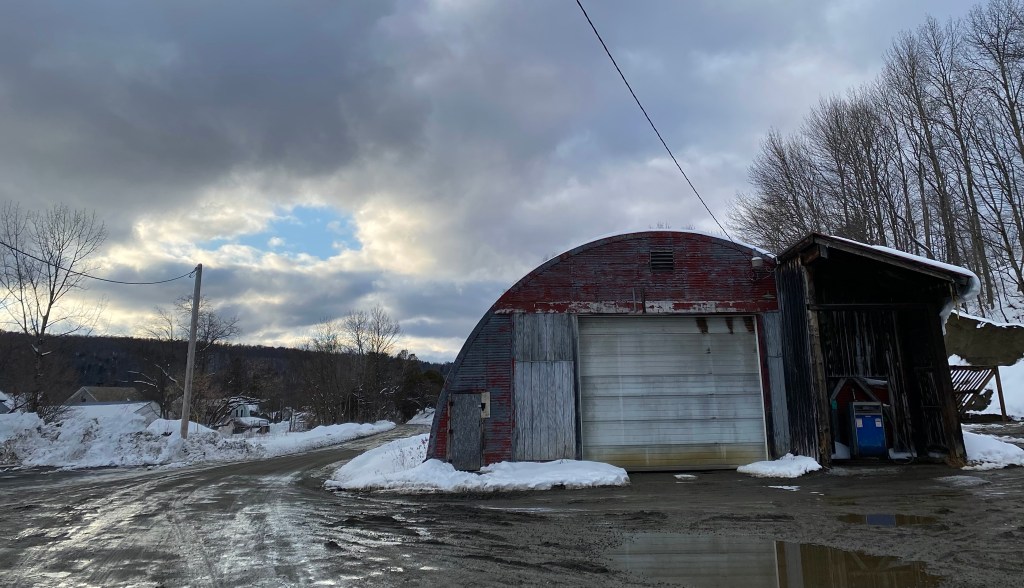
On this day of sunlight and chores, I end the afternoon walking through the back areas of town, behind the town garage and around this year’s dwindling sand pit. I turn around in the neighborhood with the scary unleashed dog, backing up slowly and doing, perhaps, exactly what should not be done.

Out of sheer carelessness, I never got the wood stove heated up to temp this morning, early at my desk, so intent, that I carelessly let the stove smolder low. In the day’s heat, I’ve let the stove dwindle further. That chore awaits me. My carelessness annoys my daughter, who’s afraid of burning the house down (what sane Vermonter isn’t at least slightly afraid of that?) and in love with the stove’s fierce heat. Two things at once. Which sums up March. Winter and spring. Breezy clean and ponderous with the thawing earth’s muck.

I pass hardly a soul on my walk and wonder if I should have made friends, or at least a kind of peace, with that snarling dog. As I walk, the air cools. The puddles are luminous with what remains of the day. I remember that beloved line from Wendell Berry — To know the dark, go dark — the line that’s driven so much of life. When I get home, I look it up.

To go in the dark with a light is to know the light.
To know the dark, go dark. Go without sight,
and find that the dark, too, blooms and sings,
and is traveled by dark feet and dark wings.

Miniature Mandibles

I’m reading outside with my bare feet on the firepit stones when I feel something like my cat’s tongue on my toe. I’m reading intently, in the few remaining minutes before my daughter returns from soccer practice and my attention will abruptly shift into chat about school and peers and the righteous outrage I suddenly see emerging in this teen. How had I forgotten that one of the most interesting aspects of adolescence is an emerging moral sense of the world? What’s wrong? Who’s right? (And, please, as a parent, could I just remain low and out of the light?)

I’m reading, of all things, Wendell Berry, when I realize a grasshopper is nibbling my toe. It’s the very end of August, the sunflowers are opening, the basil is prolific, the beans have spread into a sculpture in the middle of my garden. I close the book and let the grasshopper gnaw.

We are dealing, then, with an absurdity that is not a quirk or an accident, but is fundamental to our character as people. The split between what we think and what we do is profound.

— Wendell Berry, The Unsettling of America: Culture & Agriculture

IMG_6407

Mid-July… Slow Down The Days

The summer’s so brief and nearly unbearably beautiful in Vermont that I believe we stock up these days for the monotone of winter ahead. Maybe it’s different for families who travel a lot, who possess the luxury of multiple vacations, but the few days my girls and I camp each summer, sleeping beside lakes and under cool trees, return to us often in winter conversations…. Remember when the raccoons ate our food? When the canoe nearly tipped? When we watched the full moon rise from the breakwater?

Practice resurrection.

— Wendel Berry

IMG_2564


Hardwick Sign of Spring #1

My daughter sunk above her knees into the snow over my garden. Somewhere, deep down, lies my garlic. Are you stirring, little white cloves? In your tender hearts, are green shoots stretching?

Bit by bit, the world changes. Starting with the soil, I’m searching for ten solid beacons of spring. How much better does the world get for children than mud?

The soil is the great connector of lives, the source and destination of all. It is the healer and restorer and resurrector, by which disease passes into health, age into youth, death into life. Without proper care for it we can have no community, because without proper care for it we can have no life.

— Wendell Berry, The Unsettling of America

IMG_1413.jpg

Hardwick Postcard #7: Middle School

At the middle school concert’s intermission, my merry-eyed daughter sat behind me with a girl I didn’t know, so I turned around and introduced myself. Being 12, the girls laughed at this weirdly formal introduction, and then the couple beside me began laughing, too. I had been sitting beside the girl’s parents.

It’s a little world we live in.

I chatted with the new friend’s parents. Quickly, the girl’s mother and I realized we had both served on an elementary school board. The lights dimmed just as we started a conversation that could have launched into a very long conversation about school consolidation.

For all its myriad faults, public education — at least in Vermont — is still all about the local community. Chances are, at a middle school concert, you’ll sit beside people you like, and, equally possibly, besides people you don’t.

But you’re all still there.

My father sent me this Wendell Berry essay. Read it.

In 1936, moreover, only a handful of people were thinking about sustainability. Now, reasonably, many of us are thinking about it. The problem of sustainability is simple enough to state. It requires that the fertility cycle of birth, growth, maturity, death, and decay—what Albert Howard called “the Wheel of Life”—should turn continuously in place, so that the law of return is kept and nothing is wasted. For this to happen in the stewardship of humans, there must be a cultural cycle, in harmony with the fertility cycle, also continuously turning in place. The cultural cycle is an unending conversation between old people and young people, assuring the survival of local memory, which has, as long as it remains local, the greatest practical urgency and value. This is what is meant, and is all that is meant, by “sustainability.” The fertility cycle turns by the law of nature. The cultural cycle turns on affection.

Wendell Berry

IMG_0622.jpg

Main Street, Hardwick, Vermont