“beyond the face of fear”

I’m at the dentist for an X-ray of a front tooth that’s gone sour three times before — two failed root canals and one beastly apico — which also equals pain, more pain, and so many dollars. We compare the X-ray to the one taken six years ago, just before the pandemic, around the time when my brother and I were marveling at drone footage of empty cities in China. The tooth looks pretty darn fine. I explain that I recently endured chemo, and I’m off every which way. I no longer seem to know this body. Plus, the added layer of paranoia.

He says simply, Chemo will do that. He offers me antibiotics. I’ve had enough antibiotics in the past year to reasonably heal a village, or at least a hamlet, and I pass.

The very last day of December, the day is cold and sparklingly sunny. I work at my kitchen table for a bit, and when the sun shifts around, I drive to a nearby town to return library books. It’s the holiday season yet, and the library is nearly empty and quiet. The librarian and I have known each other for years now. We were once farmers market colleagues. Eventually, I buckle down and work hard for a good long while. When I leave, twilight is just beginning to settle in. The library is warm, and the staff is setting up chairs and cushions. Parents and little kids troupe in, their cheeks glowing with the afternoon cold.

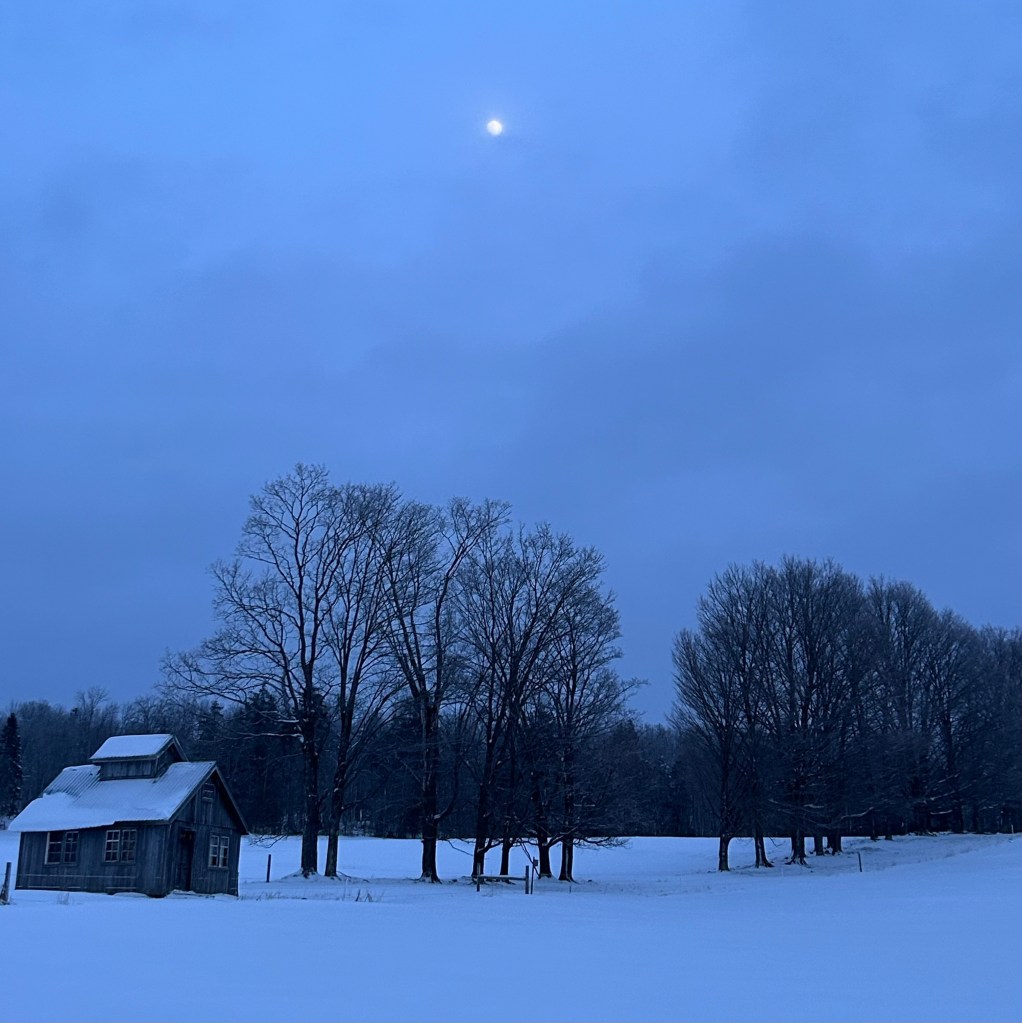
On my way home, I drive up to the ridgeline and take the walk I learned from my poet friend Mary. The cold sinks its teeth into me as I hurry along. The gibbous moon appears and vanishes in the scrim of clouds. All summer and far into the autumn I felt surrounded by a holy veil, a phosphorescence, trial by devastating disease and the violence of chemo and surgery, a trial I survived. I counted each moment as a lucky gem. Slowly, my pockets began to fill with the world’s detritus, with those nagging financial fears, the inevitable disappointment of relationships, the ever-present terror of relapse a knife against my gullet. In plain words, the stuff of living.

Walking, I studied the horizon as the blue deepened, pure ineffable winter, and the night cloaked me. I passed a few farmhouses with little twinkling lights. I was so cold and yet I did not turn back. Instead, the winter night flooded into my heart. My whole adult life I’ve been a crepuscular woman, seeking the radiant edge of sunrise and sunset, reveling in twilight, the majesty of the starry heavens. I’ve transformed grit and solitude into books. Enduring lymphoma made me wary of those recesses in my soul. I relied on others for sustenance and heat, for clean clothes, for glasses of water, in the way of very young children. Both my beloveds and strangers kept me alive. But slowly I’m beginning to admit that the coarser and rougher shades in my soul kept my body alive, too.

All of this is to say that a heartfelt seemingly casual chat and a walk into the cold night quelled my uncertainty, steadied me again. At home, I’d let my woodstove fire burn dead so I could unscrew the back plate and clean the ash-choked metal filters. My ruined hands could not hold the wrench. So I shoveled out the coals, set a match to birchbark, and lit a fire. Good enough for now. Soon, I’ll summon the energy to ask for stronger hands…..

Last and certainly not least, you readers have poured such love towards me this year. I’ve been sparse in writing here as I struggle to find footing in my changed world. Thank you for your patience. Thank you for reading. And may this new year shine joy for all of us, in the universe’s mighty and myriad ways.

A dear poem from Lucille Clifton:

blessing the boats

may the tide

that is entering even now

the lip of our understanding

carry you out

beyond the face of fear

may you kiss

the wind then turn from it

certain that it will

love your back     may you

open your eyes to water

water waving forever

and may you in your innocence

sail through this to that
The Featherweight.

“Once I witnessed a windstorm so severe two 100-year-old trees were uprooted on the spot. The next day, walking among the wreckage, I found the friable nests of birds, completely intact and unharmed on the ground. That the featherweight survive the massive, that this reversal of fortune takes place among us — that is what haunts me. I don’t know what it means.” — Mary Ruefle, Madness, Rack, and Honey

Blue Winter.

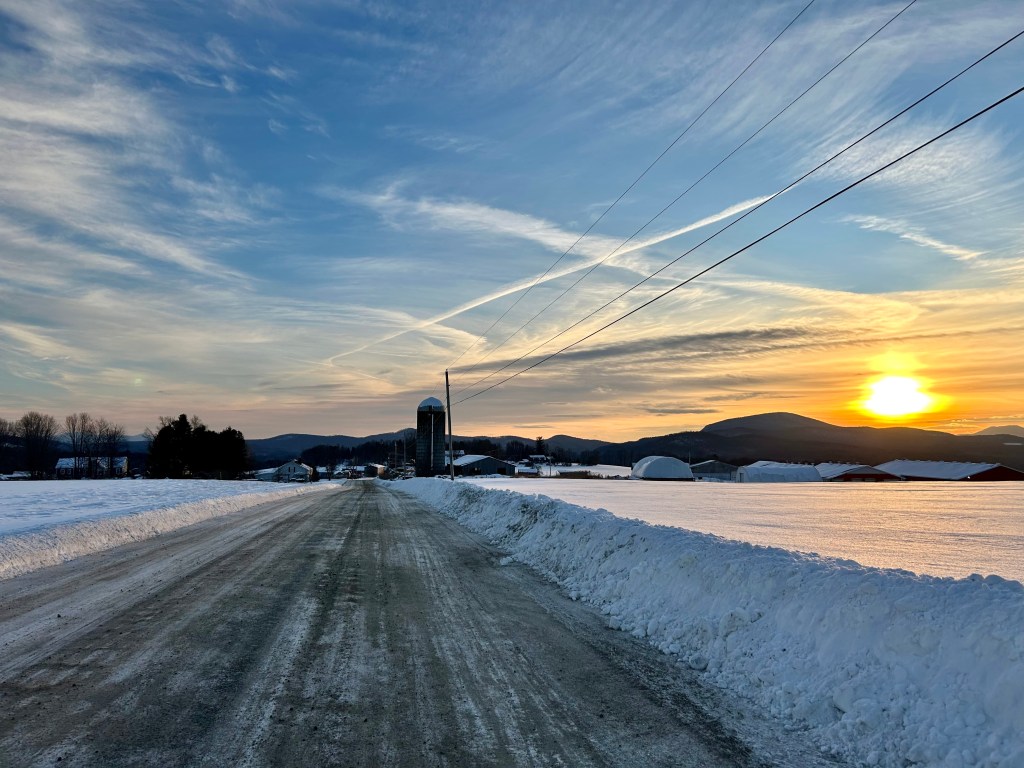
In the early morning, I drive over the crest of Walden Heights into the rising sunlight that’s pink on the freshly fallen snow. Every late autumn, winter’s imminence lies in me — the dread of inarguable cold and shortened days, how my heavy boots clomp. I no longer read outside. And every year, the stellar beauty of this season astounds me.

Over coffee and raspberry jam, we talk writing and disease. My companion reminds me that a writer does not fix the world. A writer writes. By the time we part, the morning gleams a bluebird sky. When I wrote Unstitched, I followed a trail of stories about addiction, person to person, sometimes to frightening places, sometimes to people who amazed me with resiliency and courage. Likewise, this cancer that inhabited me and maybe yet does has both constricted and widened my world. A year after diagnosis, as my breakfast companion noted, is both terrifying and awesome. I’m keenly aware of the limits of my bones jointed together with tendon and muscle and flesh, and that my will which propels this body is mortal and fierce. This, too, that writing mirrors a tenor of that same blind faith, that creative work will wind its way to a reader in need, while salvaging my own limping soul.

At the other end of this day, blue twilight. As the night’s cold falls, the village lights switch on. In my thin coat, I note my longstanding neglect about mittens, my fists jammed in my pockets. Nonetheless, I keep walking, seduced by the beauty of the running river, its edges icing, the sky overhead an infinity.

Here,
I’m here—
The snow falling ~ Issa

How We Spend Our Time…

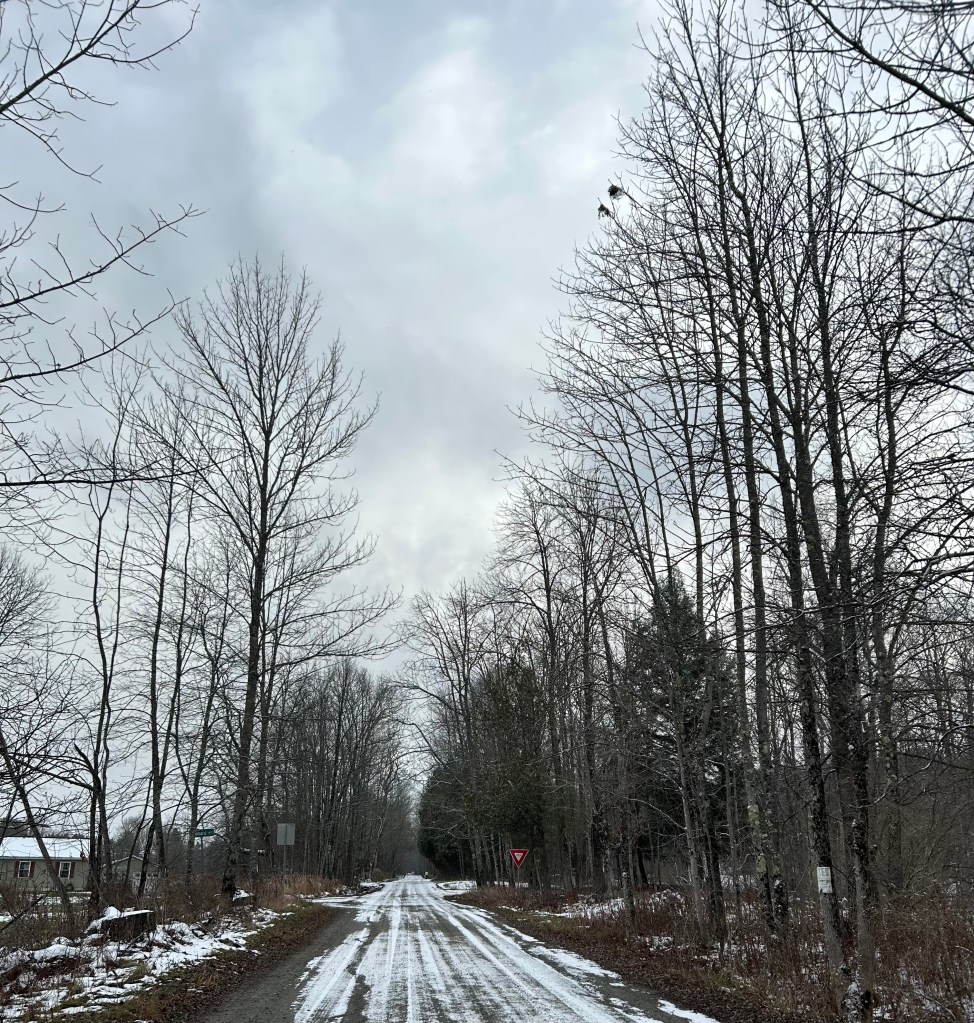
Sunday, I ask a friend to take a walk. It’s been a morning of housekeeping and writing chores, vacuuming and laundry, and the easiest thing would be to lie on my couch all afternoon and read. A light snow falls — pretty flakes and scant accumulation. As we walk, I pull off my hat and take off my mittens. It’s not the swimming season, not an afternoon where we meet at #10 Pond and talk about kids and work, about old parents and gardening, the loons calling and the sunlight thick with pollen. November is the honed-down season, stick and bone season, where your eye admires the landscape’s starkness. On these back roads, we pass farms, fields scattered with equipment, the shorn-down remains of last summer’s crops.

For so much of my life, I seemingly always had somewhere to be — and, raising kids, I probably did. I hurried to work and home to make dinner, or to pick up a daughter at school or a soccer game. Now, my girls are grown, with their own places to be; how hungrily I’m anticipating the abundance of our small family and apple pie this holiday. But this Sunday, I leave my post-it list on the kitchen table, check the woodstove dampers, and lace up my boots.

A year ago, I was for the first time in the Dartmouth-Hitchcock ER, in the trauma room with my daughters and the first oncologist I met. I was so new to the cancer patient world that I did not yet understand IVs and fluids and pain meds. That night, a surgeon told me I had to have surgery right now, immediately or I may not live, and I might not live through the surgery, either. It was the first time I had gone under in an operating room and woke in a dim recovery room and wondered, what now?

What now is the privilege of the living, and my god, I embrace that.

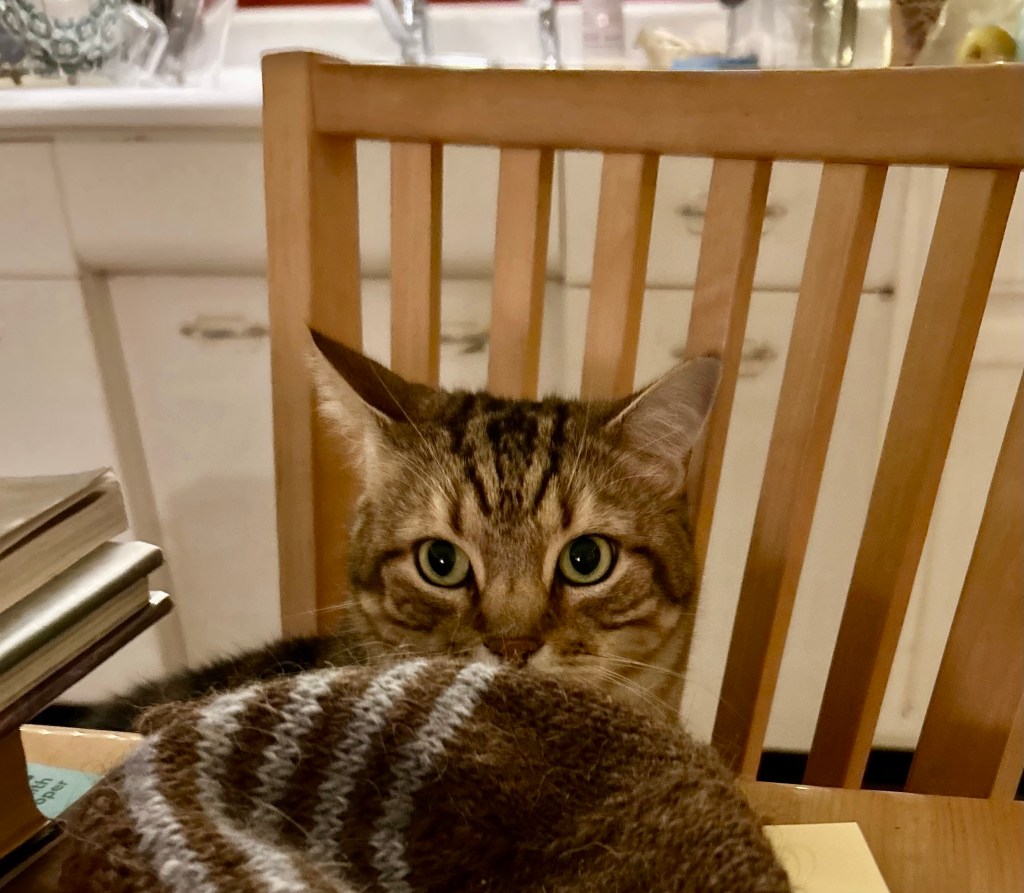
A year later, a few hours in the afternoon on a slippery dirt road. Later, I arrive home as twilight falls, the darkness so impenetrable in late autumn, back to my clean house and the cats who insist upon their dinner immediately, my solitary and sometimes un-solitary life, and what I’m making of my mortal time: fiercely writing, keeping the cats and myself fed, the hearth glowing, a holiday meal imminent. These earthly joys.

“… how we seek to spend our time may depend on how much time we perceive ourselves to have.” — Atul Gawande

Disease as Teacher.

About a year ago, a friend asked to borrow knitting needles, a request I almost certainly ignored as I could hardly walk up the stairs in my house, and forget the effort of opening the closet door and searching through my needles. A year ago, my family moved my bed downstairs, and I wondered, Well, is that? Am I now confined to one floor like an old woman? I was not, thankfully.

Half a year out from chemo and surgery, my family moved my bed back upstairs. The first morning I wake, I stand at the window looking down at the mock orange planted decades ago. In June, this giant bush is covered with small white blossoms, but in November, the bush is mostly sticks, save for a few withered leaves.

Standing there staring down, I felt suffused with profound grief. Almost immediately, I chastised myself. Why grieve when I survived a terrible illness? When this might have easily gone otherwise? And yet, grief.

Nearing the holidays, I think often of my mother who died not so long ago. She and I had years ago separated our lives for reasons both silly and profound. Only at the end of her life did I begin to have empathy for her and see her not merely as my mother but a woman in her own right. So that morning, thinking of her, my grief is for her absence, for what might have been between her and my daughters and myself. So many years I invited her to holiday meals, and all those years, she refused to join us. How I would love to invite her this year. Surviving cancer (thus far) broke me in so many ways, shoved me right up against the fragility of the world, revealed my own meager strength, but it also allowed me to grieve the loss upon loss that is not endemic to me but woven integrally through our mortal lives. Cancer empowered me to hold that grief without rage, to acknowledge simply what is.

But sadness, of course, is one variation of the complex symphony of our lives. Yesterday, walking along a hillside dirt road in the November sunlight, hat pulled off my head and in my hand, eyes on the spine of the Green Mountains in the distance freshly covered with snow, pure joy suffused me at simply being in the world. Six months ago, my companion had walked with me from my house to Main Street. It wasn’t at all certain to me that I could manage that short walk there and back. Now, the two of us moved quickly through the world, talking poetry and plans. How remarkable is that?

What if we embraced the messy, evolving, surprising, out-of-control happening that is life and reckoned with its proximity and relationship to death? What if, instead of being afraid of even talking about death, we saw our lives in some ways as preparation for it? What if we were taught to ponder it and reflect on it and talk about it and enter it and rehearse it and try it on? What if our lives were precious only up to a point? What if we held them loosely and understood that there were no guarantees? So that when you got sick you weren’t a stage but in a process? And cancer, just like having your heart broken, or getting a new job, or going to school, were a teacher? — Eve Ensler

Such a World.

Late afternoon, walking with a friend on the town forest trails and talking all-things-grownup-and-fascinating, her little girl runs ahead of us, stops suddenly, raises her arms in a Y over her head, and exclaims to the woods, “I love this place!”

Relish this.

Slowly, the rain is returning, the streams beginning to flow again. Puddles muck the trails in a few low places. Meanwhile, people ask, “How’s your water holding up?” Word travels of dried up wells. This morning, I stand on my porch in the dark, listening to rainfall patter through the leaves that linger on the trees around my house. The crests of the apple trees hang onto their crowns of gold. We’re at that dipping point, the swing of seasons, the earth yet warm, redolent with this summer’s abundance.

Such a moon —

the thief

pauses to sing. — Yosa Buson