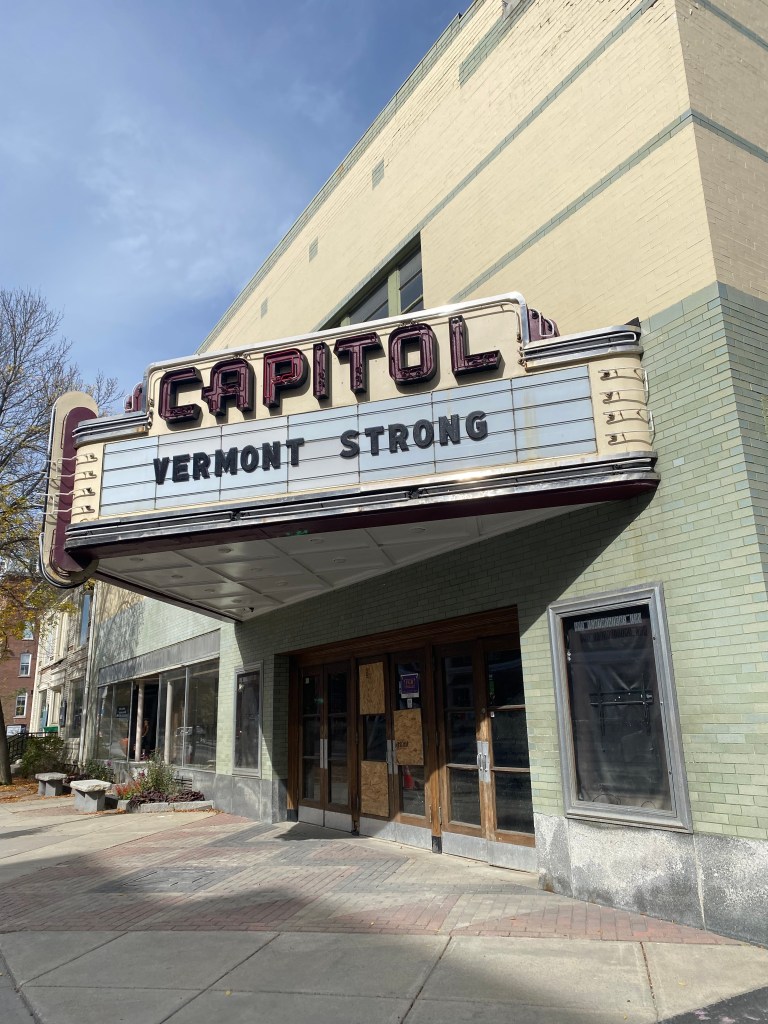
Post-Flood, Montpelier.

As if overnight, the fall foliage has vanished, swept into gray. The secret of Vermont’s autumn is the long lingering twilights, languorous and violet. Branch by branch, the trees are emerging from their summer splendor. Before frost yet, my garden rages on, orange tithonia, candy-colored cosmos, the morning glories that intrepidly vine through sunflowers and tomatoes and borage.

This weekend, I walked through Montpelier. So much of Vermont’s capital remains boarded up after the July flood, in need of money or labor. Other folks have shuttered up and headed elsewhere. It’s impossible to pretend that the world around us isn’t swirling in chaos. Nonetheless, when I come in with my fingers and toes cold, I build a fire. The neighbors string up gold lights. Quickly, quickly, and immensely slowly, the season settles in.

“You must try,
the voice said, to become colder.
I understood at once.
It’s like the bodies of gods: cast in bronze,
braced in stone. Only something heartless
could bear the full weight.” 

— Jane Hirshfield

FEMA Folks and Us.

Last week, when the FEMA folks make their initial appearance in our town office, I step out and chat with a woman from Georgia. I intend to skip the meeting that’s about to transpire, but I’m interested to hear what these people are seeing around my state and how this whole FEMA thing works anyway. My new acquaintance tells me immediately that she’s exhausted. They’ve visited multiple towns, driving through rural Vermont.

She’s quite concerned about the impending cold, and I assure her that snow is (probably) not going to appear in October, almost certainly not accumulate. The FEMA folks are apparently working on the state’s natural deadline, putting as much of the state back together before the snow sets in.

By the time she heads up to the meeting about the FEMA portal and so much talk about culverts and more culverts, we’ve swapped stories about working and parenting and she’s shared her love of Atlanta.

On her way out, she leans in my door and says goodbye. It’s a moment: the handful of Vermonters and a few FEMA people — politeness all around — brought together by enormously complex events. A selectboard member says, We’re hoping for a nice fall so you can see Vermont at its best…

Last evening, I’m talking to my parents on the phone, standing on my porch and leaning against my house’s corner board, looking across the little valley that holds the town where I live, when I realize the world around me is pink. The light isn’t the streaming crimson of sunset. A soft pinkness suffuses our world: sky, valley, village, right down to my bare toes. September that feels like August, but is still definitely September. That’s where we are.

Stealing Flowers Gone Wild.

Bear Pond Books in Montpelier reopened yesterday, nearly two months after the July flood, beloved bookstore in Vermont’s capital city. “The flood” sounds Biblical, and I’ll note that the Old Testament has never been known as a Hallmark read.

Last fall, I often parked my car behind the town garage so I could run on the rail-trail. On a heap of gravelly slag, a variety of yellow asters blossomed. At the fall’s end, shortly before frost, I brought a bucket and shovel and dug up a clump of stalks. I buried that clump in my garden. The leaves emerged this spring. By then, I had forgotten that re-homing of the yellow aster. Now, the green buds are on the verge of opening.

There’s a submerged theme between the three things in this post that I imagine only I can see— the bookstore and the flood, my stolen flowers, Mary Ruefle’s lines about clouds: the unstoppable force of our planet, immense, immense. Meanwhile, our toiling: the bookstore folks carrying out mud bucket by bucket, me with my shovel and a small handful of what might appears to be merely weeds.

Mary Ruefle:

All that summer there were so many clouds we

didn’t know what to do with them. They overflowed the

sky – they were on our streets, in our homes, in our draw-

ers, and in our cabinets. They were in our cars and on our

buses, I even saw them in taxis. No one had ever seen so

many clouds, to the extent that, as often happens with a

glut, no one could remember a time without them…

From My Private Property

Here: Where I/We Are.

Post leaving my daughter in her college dorm, the cats and I hole up and read Here by Richard McGuire. A sample of this amazing book is:

Here: the cats and I wake, in the morning that’s yet dark, to the rain pattering through the open windows on the stones and leaves around our house. One more week of August remains, and the swimming prognosis is lousy.

Around me: backroads in places still barely passable, bridges out, the riverbanks strewn with human junk — pieces of the ripped-apart motel, wires wound around wood and twisted clothing and two cars and so much plastic. I started this summer, July 1, driving to an Independence Day celebration, cloudy with smoke from the Canadian wildfires, noting that day as my own marker: the smoke has become part of our life. We accepted it, kept on with our lives, as we had — and have — to do.

A summer of the strangest things. The world’s great problems, my own petty woes. In all this, we filled our days with working and drinking coffee, hiking and playing cards and eating tacos and talking, so much talking. Gravy.

On this rainy Friday morning, a Raymond Carver poem:

“Gravy”

No other word will do. For that’s what it was. Gravy.
Gravy, these past ten years.
Alive, sober, working, loving and
being loved by a good woman. Eleven years
ago he was told he had six months to live
at the rate he was going. And he was going
nowhere but down. So he changed his ways
somehow. He quit drinking! And the rest?
After that it was all gravy, every minute
of it, up to and including when he was told about,
well, some things that were breaking down and
building up inside his head. “Don’t weep for me,”
he said to his friends. “I’m a lucky man.
I’ve had ten years longer than I or anyone
expected. Pure gravy. And don’t forget it.”

In High Waters & Broken Roads, Temporarily Put Up.

A stranger tells me about her flood experience. She and her grown son had been camping beside a lake when the water began to rise. Unable to drive south to the town where they lived, they drove north to high ground and slept in their car in Craftsbury Common. The next morning, seeking road intel, they walked over to Sterling College. The college staff offered them breakfast. The roads had been damaged all around the town, and no one was getting in or out. The college put the family up for three nights in empty staff housing and offering gratis meals in the dining hall. “The food,” the woman told me, “was so good. Everything fresh from their farm.”

In the scheme of things — a problem: two people, marooned, sleeping in their car. The solution: empty rooms, plenty of food. Practicality and kindness.

…. And in this end-of-summer rainy-but-possibly-to-clear morning, a few favored lines from E. B. White:

“The crickets felt it was their duty to warn everybody that summertime cannot last for ever. Even on the most beautiful days in the whole year – the days when summer is changing into autumn – the crickets spread the rumour of sadness and change.” 

— E. B. White

August Gloaming.

The foxes that denned behind our house did not return this year. A neighbor who lives around our hillside shares that she saw a kit earlier this summer, and we speculate that the fox family set up summer quarters nearer her. It’s all speculation, neither here nor there.

Who has returned are the turkey vultures, roosting in the pines between our houses, reliable as the rain this summer.

Mid-August, and the kids are trickling back to school. A friend texts me that her son is headed into his senior college year. I remember when this kid was born. He used to come to our house and stand on a kitchen chair and bake cookies. In this soggiest of summers, still time unspools inexorably. In the evenings, we sit outside and watch the sunset sprawl crimson, the mosquitoes drawing drops of our blood.

The pollinators suck at my small garden’s calendula, gold and orange. A few years back, I sowed a few seeds. Gone wild, the calendula reseeded rampantly, nestling against tomatoes, among cucumber vines. I haven’t the heart or will to pluck a single flower.

It rained for three days straight, a relentless steady rain that kept up its monotonous rhythm day and night, there being no periods of waxing and waning or moments of imperceptible brightening…

— Mary Hays, Learning to Drive