Some Warmth

Yesterday burst into a late Indian summer, the early morning balmy, the air alive with the scent of thawing frost. A day like that stretches on and on. Working in the library, I propped the door open, and a little girl went in and out, her small hand outstretched, patiently waiting for tiny blue flies to land on her fingers. The flies had a scruffy bit like a seed carrier. Waiting for her father, she stapled together a book of colored paper, and wrote a story about a rabbit and her fly friends.

As the dusk descended, in a gorgeously gradual fall twilight, my daughter and her friends played outside, pumping on swings beneath a crescent moon and single twinkling star that gleamed with a faint amber hue. A teacher worked late in the school garden, the long strips of dark earth tilled up, sweet rich soil for garlic, my most favorite of the garden’s savoriness.

Today, those tiny blue flies have vanished. Here but for a single day, they filled our world with a snow globe variation of Indian summer, a reminder of unexpected good things.

Here’s one sentence from what I read this morning:

… from the palm of her hand against the palm of his, from their fingers locked together, and from her wrist across his wrist something came from her hand, her fingers and her wrist to his that was as fresh as the first light air that moving toward you over the sea barely wrinkles the glassy surface of a calm, a light as a feather moved across one’s lip, or a leaf falling when there is no breeze; so light that it could be felt with the touch of their fingers alone, but that was so strengthened, so intensified, and made so urgent, so aching and so strong by the hard pressure of their fingers and the close pressed palm and wrist, that it was as though a current moved up  his arm and filled his whole body with an aching hollowness of wanting.

– Ernest Hemingway, For Whom The Bell Tolls
fullsizerender


Feather Pens

Last night, in a wild windstorm, we were lucky to have the lights go out. My teenager and I had – painstakingly – filled out her college financial aid papers, and, at the very end, I could not electronically sign and submit. The younger daughter lay on the rug asking what’s wrong?

Frustrated, I snapped that, in a real world, I could just take a pen and sign my name. But not in a virtual world where the synchronicity of username and password didn’t jive.

With relief, darkness unexpectedly enfolded us. I closed my laptop, and we lay on the rug before the woodstove’s glowing glass door, the firelight flickering over us. The wind whooshed around our wooden house. Lacking light, we played my old stand-by, 20 Questions, traveling in our imagination to Portland, Maine, and then remembering sweet potato tempura we had eaten in a Japanese restaurant in that city. We discovered an interestingly ontological conundrum: was my brother’s dog Mona a thing? A live thing? She’s not a person, not a place….

By candlelight, we brushed our teeth and, rather than read by flashlight, I went to sleep far earlier than usual.

This morning, I’m reunited with my laptop, in work I genuinely love; however, while I do live in the world where papers are signed with clicks of my keyboard, I also reminded my girls that their ancestor signed his John Alden on the Mayflower Compact with a scratchy quill. And the implications of that document have long lingered…..

IN The Name of God, Amen. We, whose names are underwritten, the Loyal Subjects of our dread Sovereign Lord King James, by the Grace of God, of Great Britain, France, and Ireland, King, Defender of the Faith, &c. Having undertaken for the Glory of God, and Advancement of the Christian Faith, and the Honor of our King and Country, a Voyage to plant the first colony in the northern Parts of Virginia; Do by these Presents, solemnly and mutually in the Presence of God and one another, covenant and combine ourselves together into a civil Body Politick, for our better Ordering and Preservation…

– Mayflower Compact 1620

IMG_2677.JPG

Hardwick, Vermont

The Barbed Past

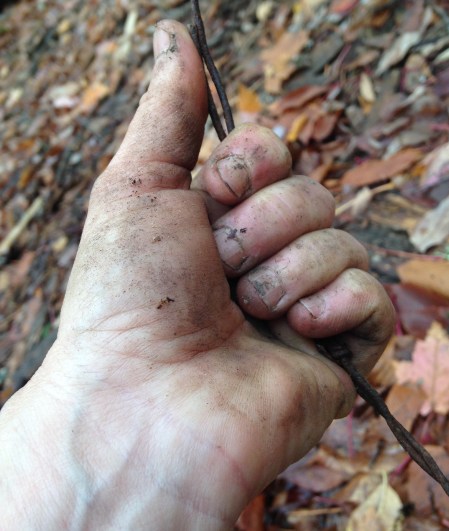
Hefting rotted stumps in fall clean-up today, I tripped on a surprising strand of rusted barbed wire and tore my pants. What crude past is this, surfacing near my well-trod woodpile path?

Whoever strung this barbed wire is no doubt long since passed from the living.

Here’s the past again  – tangible in my hand and elusive with its story – or so the cliché goes. But this last week, I received an email that explained a great deal of my life, all the way back to my very earliest childhood, that gloaming of early memory. Like a tangled wire that has been straightened and trued, I saw a clear thread of my own life shiningly clear.

And yet, time is a strange thing. Ten years ago, I might not have understand what an illumination these words are; I kept the letter to myself. Someday, perhaps, I’ll pass it along to my own children. In the meantime, I’m likely to snip away at that barbed wire, so no one else trips on that particular debris of the past.

There, in front of us, where a broken row of houses stood between us and the harbour, and where the eye encountered all sorts of stratagems, such as pale-blue and pink underwear cakewalking on a clothesline, or a lady’s bicycle and a striped cat oddly sharing a rudimentary balcony of cast iron, it was most satisfying to make out among the jumbled angles of roofs and walls, a splendid ship’s funnel, showing from behind the clothesline as something in a scrambled picture – Find What the Sailor Has Hidden – that the finder cannot unsee once it has been seen.

– Vladimir Nabokov, Speak, Memory

fullsizerender

And Then This…

Yesterday, the heavily overcast sky hung low, sullen with the threat of snow. The day lay cold and gray. In this dismal time of year, even the most valiant of Vermont admirers must wonder what holds us to this piece of earth.

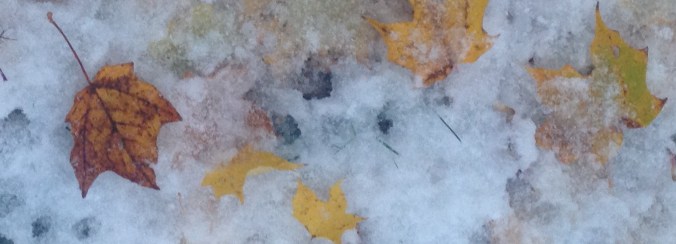
In the night, emerging from the school’s basement library after a lengthy school board meeting, one of us marveled it did snow, after all. In the school’s sharp floodlights, the snow sparkled, and I remembered in a flash that the saving grace of winter is its beauty. Even in the darkness, I saw how the snow promised a brightening of the next day.

In Hardwick, I met my daughters, the town nearly closed up for the evening. The younger girl, giddy with staying out late, scooped up a handful of the wet white stuff and kept giggling, What is this? before she answered herself: Christmas coming. She pressed her face near the snow, dreaming.

It is January, and there are crows
like black flowers on the snow…

– Mary Oliver,”Crows”

fullsizerender

Photo by Molly S.


Early Evenings

Just when it seems like the gray may finally be settling in for months, it’s tamarack season. On my way to pay the yearly property taxes today, I realized those trees were rich gold. Then that amber, too, will pass, and I’ll forget about that autumn splendor, until next year. I’m not a fan of that phrase “it’s all good,” because nothing is all good, but this autumn has been radiantly gorgeous.

Someone remarked me the other day that there’s so little time in our lives, but late fall holds a profusion of time. Night closes in early these afternoons, and our after dinner strolls along the road have ceased for now. The children sprawl before the wood stove. Our house smells of slightly overripe apples, and around us glow the last vestiges of this fall.

The fishermen know that the sea is dangerous and the storm terrible, but they have never found these dangers sufficient reason for remaining ashore.

– Vincent Van Gogh

fullsizerender

Woodbury Village, Vermont


Transit

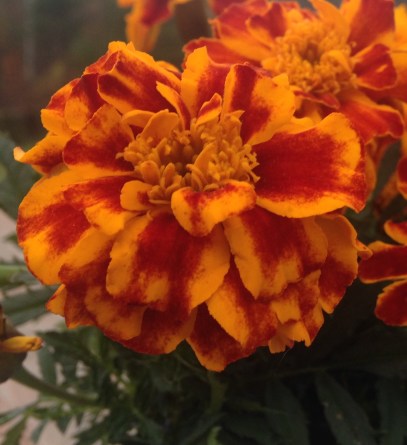
Despite the snow, marigolds are blooming in my cobbled-together greenhouse, their scent still a sharp tang. I carried a handful with me this afternoon to my Woodbury library job. With the light ending early this days, it’s the Vermont reading season.

My bookseller friends at the Galaxy scored me an Advance Copy of Rachel Cusk’s new book, Transit, a novel title I love: what else is our lives but transitioning from one moment to another, so constant, perhaps, we’re hardly aware of the unbroken undulation and flux of our lives. Transit, transit. Going about my day, I murmur that word.

Around me, the natural world mirrors this movement: golden leaves shower from trees, the sunflowers have laid down and pressed their wide faces into the ground, the river is slate gray, cooling down and readying itself for the coming of ice.

I said it seemed to me that most marriages worked in the same way that stories are said to do, through the suspension of disbelief. It wasn’t, in other words, perfection that sustained them so much as the avoidance of certain realities.

– Rachel Cusk, Transit

fullsizerender

October, Woodbury, Vermont