Writing & Money

The other day, my Facebook-loving teenager casually mentioned to me that, on average, writers make $149K per year. “You’re doing something wrong, mom.”

These lines are full disclosure that, in fact, I am not earning $149K per year. The children and I are, however, still afloat. While I know all kinds of writers, many of whom are terrific writers as well as decent people, no one I know has ever undertaken the vocation of writing for money. Writers may be many things, but we’re generally not stupid.

When I taught a one day class at Johnson State College a year ago with Dede Cummings, my most useful piece of advice for aspiring writers was two-pronged: write and keep your expenses low. I really wasn’t kidding on either count.

Money is merely practical. Writing is art. Both are necessary – in my life (and my daughters’ lives, at least). So it was with real pleasure that the day I received a royalty check from my novel, I also met a woman I hadn’t seen for a few years. She had read my book (– and loved it; I write this with real pleasure), because another woman gave her the novel and told her to read it. That woman didn’t know me and didn’t know I had any connection to her friend. She is my ideal reader: someone who loved my book and passed it to another reader, as I do with so many books I love.

What a piece of luck was this chance encounter in the co-op’s coffee aisle, on a subzero and sunny day.

Writing a novel is like driving a car at night. You can only see as far as your headlights, but you can make the whole trip that way.

– E. L. Doctorow
fullsizerender

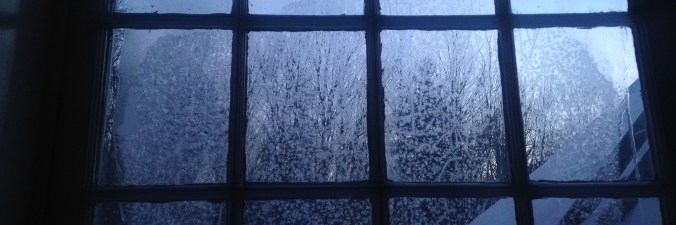
Living Room Windows, Mid-December
Appetite

When my teenager was an infant, I peddled maple syrup, homemade root beer, and ice cream at what was then the very tiny Hardwick farmers market, so sparse that some Friday afternoons it was just me and another vendor.

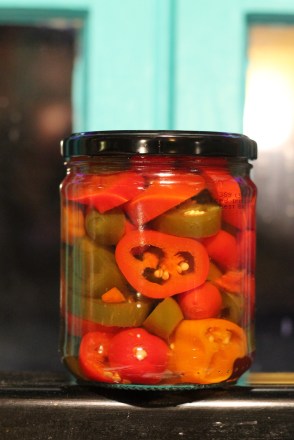
In those long hot afternoons, the vendors got to know each other. My friend Charlie Emers, of Patchwork Farm, had an enormous orange, rust-eaten Suburban, that would eventually head to the junkyard with years’  worth of debris inside. Son of an artist and an artist himself, Charlie grew the best peppers I have ever eaten. In late summer, he began pickling my favorite variety – Habanero Hots – in small jars he called Poker Peppers after his favorite game.

Yesterday, in a Williston store I’d never entered, I found a jar of bright red peppers that reminded me of those Poker Peppers: jalapeños, but deliciously fragrant with the spicy summer season. I might eat the whole jar myself.

‘Eating is an agricultural act,’ as Wendell Berry famously said. It is also an ecological act, and a political act, too. Though much has been done to obscure this simple fact, how and what we eat determines to a great extent the use we make of the world – and what is to become of it.

Michael Pollan, The Omnivore’s Dilemma

img_4354

Photo by Molly S.

My List Begins…

When I was a kindergartener, I discovered Thanksgiving was combined with cool crafts of making paper turkeys by crayoning around my hand. I also learned that people called pilgrims who lived a very long time ago wore strange white hats. Which was the sum total of my knowledge of that holiday for an embarrassingly long time.

Many years later, when homeschooling my ten-year-old and digging through her father’s past, I realized her ancestors arrived on that rickety wooden ship called the Mayflower. I was riveted. Related to the pilgrims? Those hardy, fanatical souls?

This time of year, I can’t help but think of those Mayflowerites, and not because of the colorful paper turkeys everywhere, but because right around now the cold and dark encompass my cedar-shingled house, and, instinctively, as I go about calculating my wood pile and battening down storm windows for our house’s journey through the coming perishingly cold months, I imagine the keening worries of families who had too little for sustenance and shelter – and too much of illness and exhaustion.

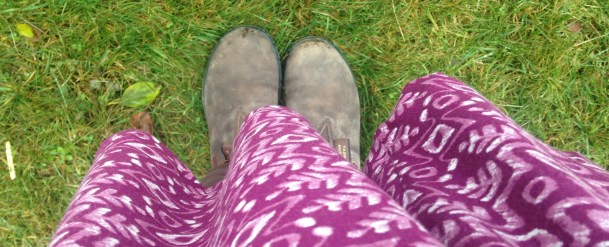
My list of thanksgiving begins with what I have here: pies on the table, a sweater to knit for a gift, warm boots. Us.

Many of us came away from our youth thinking that the story of the Revolution was that the Americans were patriots fighting the oppressive British. It was kind of good versus evil, liberty versus tyranny. When you get into it, you find that it was much more complicated.

– Nathaniel Philbrick,  Mayflower

img_3783

Photo by Molly S.

The Value of One Word

My 11-year-old opened a box with a brand-new puzzle today and said happily, “This smells puzzle-y.”

What a world this is, where a kid can make up a word that’s indicative of so much – winter evenings around a table, cheerfully chatting – and spin together that treasured past with the tangible promise of future pleasure literally in her hands.

Our physical world is dictated by laws of equal and opposite action; the earth gives generously, but the earth taketh, too, and doesn’t skimp on the taking. Which is perhaps why that word puzzle-y shines so brilliantly. Like Noah’s olive branch, my daughter’s word treasures the past and beckons in the goodness of the future.

And it came to pass… the waters were dried up from off the earth: and Noah removed the covering of the ark, and looked, and, behold, the face of the ground was dry…. (The Lord said) bring forth with thee every living thing that is with thee, of all flesh, both of fowl, and of cattle, and of every creeping thing that creepeth upon the earth; that they may breed abundantly in the earth, and be fruitful, and multiply upon the earth… While the earth remaineth, seedtime and harvest, and cold and heat, and summer and winter, and day and night shall not cease.

Genesis 8:13-22, King James Version

fullsizerender

Stowe, Vermont

Dirty Shoes

We’ve officially entered into the season of increasing darkness – not merely politically but because of the planet’s tilt. My teenager, home early from school, slouches at the kitchen table and moans about the gray. I advise her to head out for a run in the rain. She’ll return, pink-cheeked, and far more cheery, her running shoes smeared with greasy mud on their soles.

Post-election, all these words have surfaced again, the same ones Vermonters use over and over – community, persistence, hope – words that are distressingly meaningless without tangible action. How do our footprints mark our paths? For my daughter who will mature to adulthood under a new administration, I’m going to keep advising her to muddy your feet, girl. In my garden, the johnny-ups are yet blooming amongst the weeds.

I’ve been reading Scholastique Mukasonga’s Cockroaches, her memoir of growing up in Rwanda, and that’s all I’m going to write about this slim, powerful book.

The ultimate measure of a man is not where he stands in moments of comfort and convenience, but where he stands at times of challenge and controversy.

– Martin Luther King, Jr.

fullsizerender

November color


How the Water Flows…. Or Doesn’t

A number of years ago, The New Yorker published a photograph of Marina Oswald the morning after Kennedy’s assassination. She was pinning diapers to dry on a clothesline. Last night, I was remembering this photo while solving my washing machine’s leaking cold water. While my mothering energy often heads toward the future – what will my older daughter do after high school graduation? will I make it to my younger daughter’s concert? – the nitty-gritty of daily life is really the grease in family wheels.

Case in point: my washing machine. Leaking hoses have now led to a clogged water filter (or so I believe….) Some days, family life seems one problem-solving exercise after another. This problem, in the scope of things, will crest and diminish. Via google, I’ll remedy the situation or find someone who will. More fodder for the creative grist mill; an aspect of modern family life I’ll master; one more piece of know-how my fingers have dirtied their nails upon.

The most common way people give up their power is by thinking they don’t have any.

– Alice Walker

img_2775