Secret Chute

House hunting with my enthusiastic contingent, us adults stood in a dim basement yesterday, so cold we kept swaying from one foot to the other, trying to stay warm. Outside, the children tromped in the snowy yard, warmer in the sunlight than we were in the house.

In the basement, someone discovered a wooden chute, carefully nailed shut from the cement floor to the under boards of the dining room above. Intently curious, my friend pried off a board, and I peered up through the darkness where I saw a gleam of daylight through an ornate floor grate.

What the heck?

It made no sense to any of us, running through our logical possibilities.

In the end, blowing on my hands, I said, But it must have made sense to whoever built it. Look at the labor.

Upstairs, the children were laughing and throwing snowballs at each other, busy in their own meaningful kids’ work.

Whether I buy the house or not, we’ve spent serious time already, running palms over pipes, fingering up loose linoleum, rapping on old plaster, getting to know just a few mysteries of this old house.

When the old way of seeing was displaced, a hollowness came into architecture. Our buildings show a constant effort to fill that void, to recapture that sense of life which was once to be found in any house or shed. Yet the sense of place is not to be recovered through any attitude, device, or style, but through the principles of pattern, spirit, and context.

Jonathan Hale, The Old Way of Seeing: How Architecture Lost Its Magic – and How to Get It Back

FullSizeRender.jpg

West Woodbury, Vermont

Voting

Less than a hundred years ago, the 19th amendment to the US constitution was ratified on August 18, 1920.

Yesterday, my newly-turned 18-year-old daughter registered to vote for the first time. Not that long ago, on town meeting day, this girl played under long tables in the back of the town hall, burrowing beneath a giant pile of winter coats. This year, she’ll weigh in for herself on numerous votes that day, on town business ranging from electing select and school board members to setting the year’s tax rate.

Like her first day of kindergarten, I couldn’t resist snapping a photo. She politely acquiesced before heading off on her busy way.

The amendment reads simply:

The right of citizens of the United States to vote shall not be denied or abridged by the United States or by any state on account of sex.

Congress shall have power to enforce this article by appropriate legislation.

fullsizerender

Town Clerk’s Office, Woodbury, Vermont

Lying

I laughed at the utter aptness of the Oxford Dictionary word of the year for 2016 – post-truth – but the word (and this time) reminds me of Ernest Hemingway’s famous iceberg theory of writing, his “theory of omission.”

Years ago, when I began writing fiction, I also began reading differently, too, wondering what made terrific dialogue snap, but I also began listening in a very different way, too, and gradually realized our everyday speech often contains variations of lies, intentional or not. Lying by omission slides around in our speech, a somewhat slippery critter.

What’s the story? I sometimes ask my daughters. What’s happening under the surface of our language? Maybe there’s two, three, four stories winding together? Think complexly. Don’t assume.

Perhaps because our political world is so intensely polarized these days, the stories of greed and bigotry and outright desire for power push toward the surface. My suspicion is that this post-truth is apter than I realize, this nearly maniacal intent to create chaos and confusion, to obscure the real threads of the story beneath non sequiturs and outright blaring nonsense. History is one long story of the success of dominance, over and over. Why not chose confusion of speech as the weapon du jour?

Now I will tell you the answer to my question. It is this. The Party seeks power entirely for its own sake. We are not interested in the good of others; we are interested solely in power, pure power. What pure power means you will understand presently. We are different from the oligarchies of the past in that we know what we are doing. All the others, even those who resembled ourselves, were cowards and hypocrites. The German Nazis and the Russian Communists came very close to us in their methods, but they never had the courage to recognize their own motives. They pretended, perhaps they even believed, that they had seized power unwillingly and for a limited time, and that just around the corner there lay a paradise where human beings would be free and equal. We are not like that. We know that no one ever seizes power with the intention of relinquishing it. Power is not a means; it is an end. One does not establish a dictatorship in order to safeguard a revolution; one makes the revolution in order to establish the dictatorship. The object of persecution is persecution. The object of torture is torture. The object of power is power. Now you begin to understand me.

– George Orwell, 1984FullSizeRender.jpg


A Fierce Heart

Years ago, the house we lived in had an enormous King stove, about as ugly as could be with a rust-colored shield. When that stove threw off BTUs, its damper clicked like a mouse in a live trap, rattling.

I once owned a terrible round coal stove I used for wood. Its damper sometimes slipped loose, and I feared that stove would burn down the house. Eventually, that stove was donated to the scrap yard.

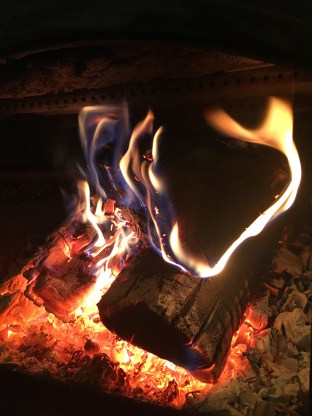
Now, cold as my house is around the edges, with too many doors, recycled and unweatherized windows, far-from-well-done insulation, my stove burns its mighty heart, truly keeping my girls and myself alive in these wintry nights. Of the few objects I hold most dear – my cast-iron skillet, laptop, garden shovel, knitting needles – this stove, its brass-handled door so familiar in my hand, is my dearest companion these days, place of succor.

Around our house lies sugary white, sprinkled with a wavering trail of black ash, but inside is glowing red and yellow, flames laced at the edges with blue.

….Oh, now I sing praises to a wood fire,
to the heat this smoky burning liberates,
the heat that keeps us warm all winter.
Oh, praise this primordial fire, praise heat
in its most basic form:
the blessed warmth that comes from
our old, wood burning, Round Oak stove.

– David Budbill, “Ode to Fire, Ode to Heat”

IMG_9064.JPG

Photo by Molly S.

A Whale’s Heartbeat

In these subzero nights, I’ve abandoned my room of windows on the top floor and started sleeping in my daughter’s lower bunk bed, in her room cozily located over the wood stove. Upstairs, my older daughter’s room is just across the hall from mine, and we generally talk before sleeping. My younger daughter is pleased with her turn at companionship. Plus, she doesn’t complain when I read late at night with the lights on.

Last night, before falling asleep, she told me a whale’s heart beats about 10 times per minute, while the tiny shrew’s heart can pulse away at a 1,000 jumps per minute.

I reached up and snapped off the light. In darkness, we imagined how voluminous might be a whale’s heart, hot blood churning through its chambers. She told me about a trip she’d taken a few years before with her father, to Provincetown, where she and her sister walked through the ribs of whale skeleton. In the warm dark room, we lay imagining what it would be like to live in the belly of a whale, and late in the night when I woke to feed the fire, I was still dreaming of that dark, living interior.

A good laugh is a mighty good thing, and rather too scarce a good thing–more’s the pity.

– Melville, Moby-Dick; or, The Whale

FullSizeRender.jpg

October Snow…

…. is not my favorite. Too wet, too scant, and the hydrangea suffers.

With enthusiasm, though, the children have dug into paper crafts and apple pie baking. My contribution to the household is vacuuming the ratty living room rug, spreading out my papers, and working in front of the wood stove. My brother sends a request for a knitted winter hat.

Our house, tall and narrow, reminds me of a clipper ship sailing through uncharted waters, resilient through gusty wind, its largely inaccessible cupola a crow’s nest. Overnight, while we were sleeping, the seasons turned. We are now gliding into the outer edges of the snowy season, and the children seek mittens. I’ll search for sage beneath that white for sausage and potato pie.

It is not down on any map; true places never are.

– Herman Melville, Moby-Dick; or The Whale

fullsizerender

West Woodbury, Vermont