Garlic Planting/Rough Draft

I planted the garlic this afternoon, late in the season, a few weeks beyond my more orderly neighbors. Sleet fell this morning when I walked around the property with the logger who delivered firewood. He and his nephew had bought a sugarbush, and we shop talked sugaring. By afternoon, the sleet had wandered off, but the remaining light is meager as November presses in. Working alone, I remembered how long it took to plant garlic with my one-year-old. She dropped each clove into the hole I dug, even then diligent, careful to set ragged roots down.

Despite the bleakness settling in, garlic is hands-down my favorite crop to plant. My cloves this year, from last year’s harvest, are some of the fattest and savoriest I’ve ever grown. Deep in this rich black earth they’ll hibernate all winter, covered with compost and a matted quilt of dry maple leaves. Next spring, the question goes around, How’s your garlic looking?

The garlic is like the second novel I’m writing, where the seeds of the rough draft have been silently sleeping, and now this book is rising and stretching. Grow, I think, in what way will you grow? I’ve carefully sown and fertilized these seeds, and now is the time to dig in with my hands and scrape off that matted mulch and let the green begin to rise and see where it might grow.

 Our bodies are garbage heaps: we collect experience, and from the decomposition of the thrown-out eggshells, spinach leaves, coffee grinds, and old steak bones out of our minds, come nitrogen, heat, and very fertile soil. Out of this fertile soil bloom our poems and stories. But this does not come all at once. It takes time. Continue to turn over and over the organic details of your life until some of them fall through the garbage of discursive thoughts to the solid ground of black soil.

–– Natalie Goldberg

IMG_0118

Apple Tree & Elmore Mountain, West Woodbury, Vermont

Seeds

After a morning’s work, I stepped out on the balcony and saw wild turkeys slowly picking their way through the frost-bent buckwheat around my garden. These birds are amazingly large, with their red and gum-blue heads vibrant colors against the autumn’s gold. By the time I was in the garden, the turkeys had gone on their way, back into the woods.

With my hands, I tore out the pepper plants, the marigolds and nasturtiums, the cosmos, the end of the squash, these beauties finished for this year. The sunflowers and zinnias I left standing, heads bent down, yet rich with seed, for the birds.

Life is not orderly. No matter how we try to make life so, right in the middle of it we die, lose a leg, fall in love, drop a jar of applesauce. In summer, we work hard to make a tidy garden, bordered by pansies with rows or clumps of columbine, petunias, bleeding hearts. Then we find ourselves longing for the forest, where everything has the appearance of disorder; yet we feel peaceful there.

–– Natalie Goldberg

IMG_0131

Garden/West Woodbury, Vermont

Storm Windows, Fiction

While I was at work yesterday, my daughters washed and latched storm windows on the kitchen windows. They also biked in the season’s first snow, baked a chocolate cream pie from Pie which the younger daughter is reading, argued, played memory games, and spread out a rug in front of the wood stove as an official opening to the wood stove/snow season. Already, the piles of games and books and knitting are growing in uneven piles on that rug.

As my own book nears its publication date, I’m pushed to speak more about how I came to write this book, and why. In my own busy household that mixes children and rural Vermont, what’s increasingly clear to me is that writing is a human activity as essential to our lives as stocking your root cellar or bank account or however you do it for the long, colder season ahead. Our culture emphasizes material gain above pretty much everything else, but, really, at the day’s end, there’s little else of relevance besides stretching your bare toes toward a hot fire, with the children nearby, and the windows buttoned up against the growing dark and cold.

The society to which we belong seems to be dying or is already dead. I don’t mean to sound dramatic, but clearly the dark side is rising. Things could not have been more odd and frightening in the Middle Ages. But the tradition of artists will continue no matter what form the society takes. And this is another reason to write: people need us, to mirror for them and for each other without distortion – not to look around and say, “Look at yourselves, you idiots!,” but to say, “This is who we are.”

Anne Lamott, Bird by Bird

IMG_0119

October/West Woodbury, Vermont

Financial Aid Lingo

Tonight, my older daughter and I sat in her high school library listening to a power point presentation on college financial aid – don’t nod off right now! Sitting there, wishing I had a cup of coffee, I glanced at my daughter’s eyes glazing over as she doubtlessly sat thinking of something else entirely. I added up the loan amounts for four years of college (holy cow!) and underlined my note: Don’t miss deadlines.

On our way out, I asked for the presenter’s email address, and she asked me if I had gone to collegeI told her I had, but my dad filled out the forms – and that was in the prehistoric non-digital age. The woman commiserated that my dad had to xerox tax forms.

Driving home, my daughter remarked that no one used the word xerox anymore. Why do you and grandpa keep doing that? The word is copy.

I assured her xerox is definitely a verb. Like a more modern version of mimeograph.

She was silent a moment, driving through the darkness, and then she asked, Mimeograph? What’s that?

… Sometimes, I see parts of myself in my older daughter – an exasperation I had when I was younger at the adult world’s infuriating mediocrity, a why-can’t-you-get-yourselves-together-ness.  At sixteen, on the cusp of stepping into her adult life, the whole great world of love and desire and ambition (and heartbreak, inevitably, although not too much, please) yet to spin out before her. And then sometimes, in that cyclical way time moves, I see my father reflected in me, all those careful files he kept, putting his three kids through college.

At home, I laid the evening’s materials in a folder on my desk. My daughter came into the room and asked with great seriousness, Can we do this?

I smiled at her. Piece of cake, I assured her. Meet deadlines, stay organized, follow the rules, fill out all the forms. 

Forms are the easy part.

When we are loved, we wish the other to recognize our presence, and this is a very important practice. You must do whatever is necessary to be able to do this:  recognize the presence of the person you love….

— Thich Nhat Hanh

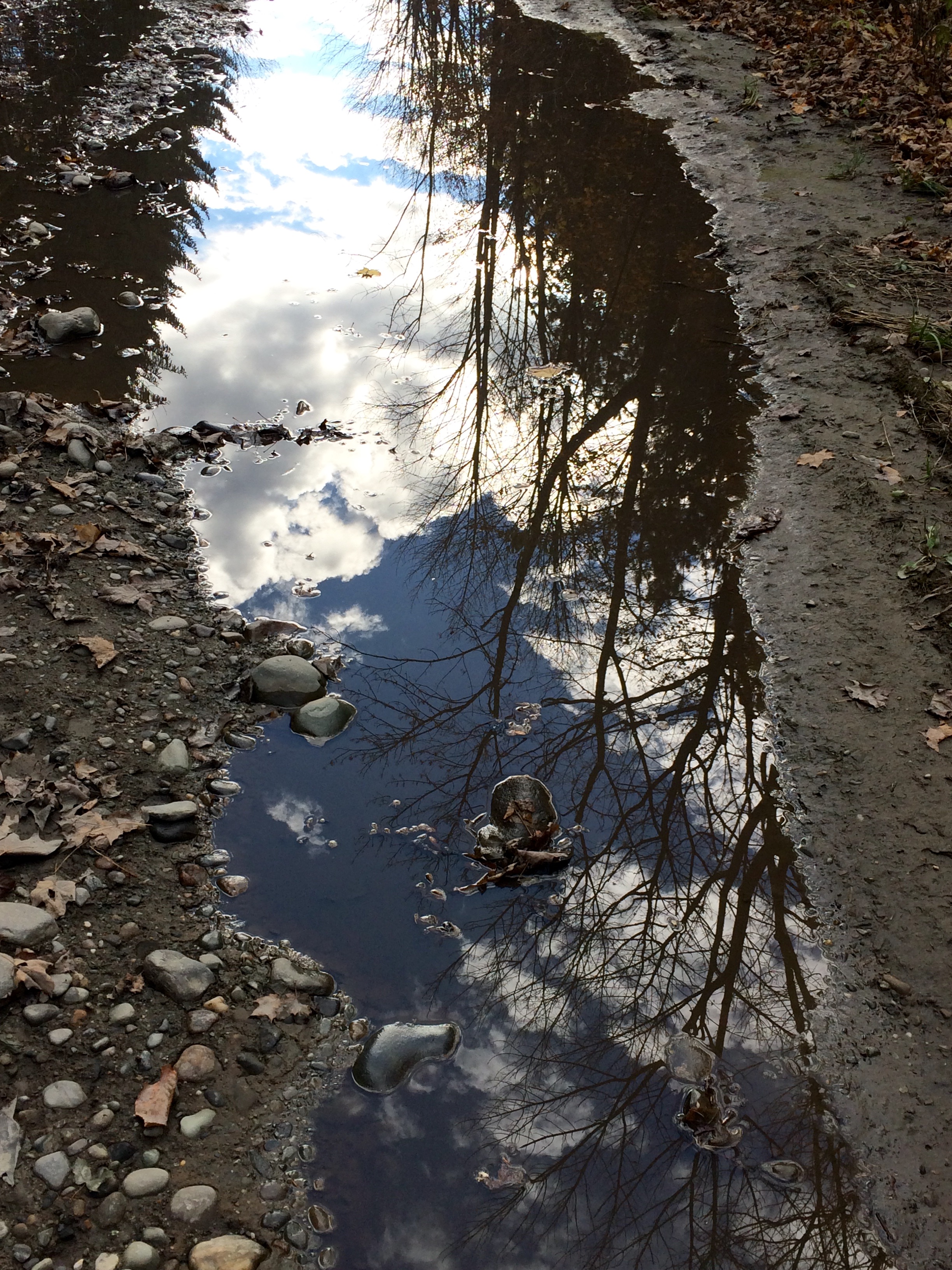
Small Pond in Woodbury, Vermont

Small Pond in Woodbury, Vermont

Enjoying the Digital Age

While I frequently rail against the digital age, the nefariousness of video games — while I believe children should play outside in apple trees and ride bikes, and read real books — while I am the champion of the world made by hand and do-it-yourself ad nauseum — the truth is, I find the digital world just plain fun at times.

My dad sent me a power point presentation he made for his class, and I watched it with my older daughter. At one point, she started exclaiming, Did grandpa photoshop that? I had no idea; I was too busy reading the words. God, she said, of a monastery in Bhutan, I’d like to be there.

At the end, she said, Cool beans to grandpa — that’s high accolades from a teenager.

This past day, I’ve been sending text back and forth to my publisher, making the very last changes on my novel before it heads, digitally of course, to the printers. An s was dropped here; I added acknowledgments, a dedication, and permissions. It’s all email, back and forth, with notes and exclamations, and phone calls of course, too. But truly, having read these 278 pages over and over, in the end, it all comes down to the writing. To story, craft, beauty, and meaning.

But the digital realm offers much to us in rural Vermont. I remember some winters standing outside the co-op with a baby on my back, reading the posters as cultural infusion. Here’s a paragraph I filched from that bounty of my dad’s material:

Like anything that one makes well with one’s own hands, writing good nonfiction prose can be profoundly satisfying. Yet after a day of arranging my research, my set of facts, I feel stale and drained, whereas I am energized by fiction. Deep in a novel, one scarcely knows what may surface next, let alone where it comes from. In abandoning oneself to the free creation of something never beheld on earth, one feels almost delirious with a strange joy.

“The Craft of Fiction in Far Tortuga”
Interview of Peter Matthiessen
The Paris Review 60 (winter 1974)

IMG_9111

East Calais, Vermont/Photo by Molly S.

Laughter and Rain

The February my older daughter had just turned one, she and I went to a playgroup in Craftsbury, and only a woman I hadn’t met and her one-year-old son showed up. The tykes fought over a red plastic shovel (my child was the aggressor), and eventually we hid the shovel. While the kids checked out the plastic toys, the woman and I talked, and talked, and talked, and in some ways haven’t really stopped talking since.

Today, in one of these weird slips of time, my friend and I drove around Woodbury, this rural Vermont town, population 902, over dirt roads, up hills and along narrow roads without guardrails beside ponds, looking for one particular thing.

Crisscrossing these roads in the rain, we passed my daughter’s elementary school several times, and I thought of my child at her tidy desk, in the warm red schoolhouse with the rain coming against the windows.

My friend and I met no one else but a pickup truck or two on these back roads. Several times I asked, Should I drive up there? It looks like a bike trail and not a road.

Yes, she insisted, yes — and only once got out so I didn’t back into a ditch.

How long our friendship spins out, stitched through with so many things:  new babies, and gardening, books and more books, a courtroom, jobs, days at the lake, coffee, broken vehicles, farmers markets, deaths, and a whole lot of laughing. I wouldn’t trade the laughing for anything.

Nobody sees a flower, really – it is so small it takes time – we haven’t time – and to see takes time, like to have a friend takes time.

– Georgia O’Keefe

Photo by Molly S.

Photo by Molly S.