December Solstice

Having kids means, in part, passing through childhood again, but with an entirely different lens, a perspective deeply entrenched in childhood, yet wholly beyond childhood. One slight thing I’ve learned over these decades is that our world, as still and stagnant as it sometimes appears, is always moving, always in flux, our bodies shedding skin while simultaneously producing new cells.

On the edge of this December solstice, with the threads of worldwide violence thickening and spreading and our own good, green planet poisoned and ill, it’s worth remembering the universe we inhabit always, in perpetuity, rotates back toward the light.

What does the solstice mean? my daughter asked. How to answer this primal question? Cusp, I answer. The place to open your heart and eyes and lungs, and breathe in.

In darkness things merge, which might be how passion becomes love and how making love begets progeny of all natures and forms.

– Rebecca Solnit, The Faraway Nearby

FullSizeRender

West Woodbury, Vermont

Autumn Dusk

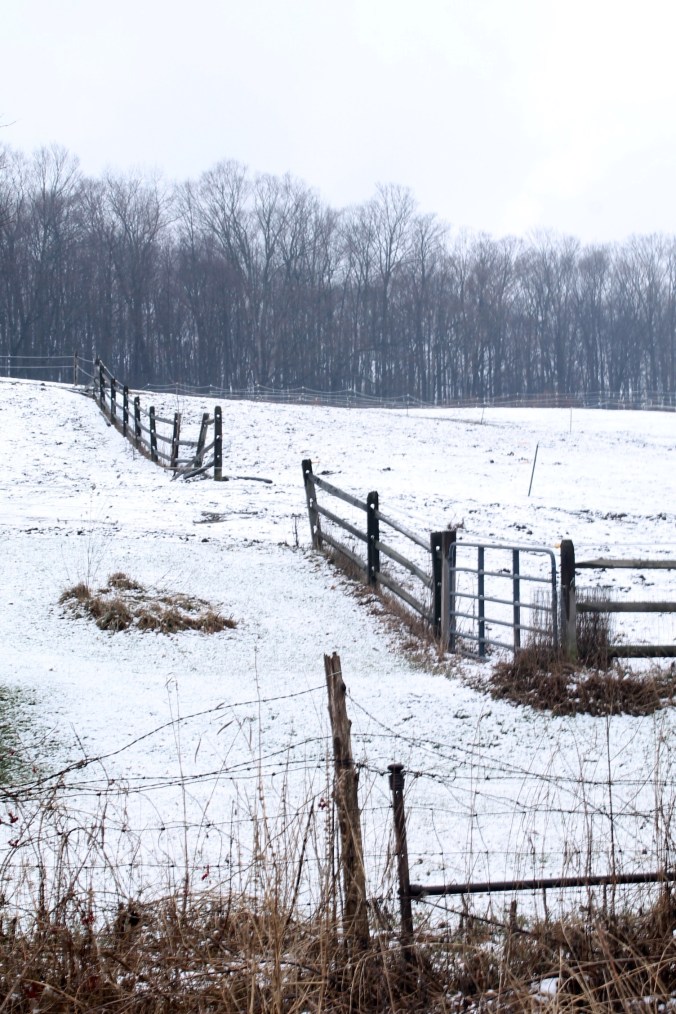
With no snow, our late autumn Vermont appears like coals burned out, none of our summer’s radiance, our snowy luminosity. This afternoon, not yet four, with the light already leaking away, I lay down in my daughter’s forest lair, dead logs propped up against an enormous white pine. While she wandered away, busily scavenging planks for a footbridge over a culvert with a running stream, I lay back on the pine needles and closed my eyes.

The afternoon was extraordinarily still, with not even a stir of wind, a chatter of chipmunk. I smelled mud, that thick, humusy scent of forest floor opened up. Still waiting, I opened my eyes and, through a part in the branches overhead, saw three crows traveling across the gray, cloudy sky, their wings steadily flapping, quite possibly not at all disturbed by the night falling down and the dearth of glow. And that, perhaps, might be the flight of autumn across our sliver of the world.

A lone crow
sits on a dead branch
this autumn eve

— Basho

IMG_0420


Ready

A year ago, I finally wrote the query email that sold my book. With no internet access at home, I wrote the email in a corner of a public hallway in Montpelier, my back up against the literal as well as proverbial wall. I began, I’m going to go out on a limb here…

Later that afternoon, in a cold December rain, the day before Christmas break at my daughter’s school, I stood on the asphalt talking with her teacher, who, in his kind way, asked about our vacation plans while I willed myself not to begin crying. My entire world, interior and exterior, was suffused with dreary rainfall. I had no idea what would happen that afternoon, let alone in the next two weeks.

That was almost exactly a year ago. Did it take all of my life to write those words? To edge so far out on that limb there was no conceivable way I might crawl back?

The press published Leland Kinsey, a Vermont poet of phenomenal strength and beauty, a poet whose vision of the world cuts sharply, bloody at the bone, with rare grace. So much has happened in this year of my life, and yet, every time I sit down to write, I remind myself again that’s what I’m aiming for: push.

TO OUR VERMONT FATHER ON HIS EARLY WINTER BIRTHDAY

Our father who is in hospital,
hallowed be your name
though you are hollowed.
Your kingdom gone,
your will undone
on this earth, and there is no heaven.
You gave us, until this day, our daily bread.
and you forgave us our debts,
though you could not forgive your other debtors.
A fierce Scot, you were not led into temptation.
and tried to deliver us from evil.
You worked your life in the Northeast Kingdom
with power,
and no glory,
ever.

— Leland Kinsey

FullSizeRender

Lake Elmore, Vermont/Photo by Molly S.

Singing in the Dark

This time of year, the darkness knits around us. Waking early, I’m awake for hours working into the light. Very early evening, I returned with the children in the full dark, the stars overhead distantly radiant in the pitch firmament. The shortest day of the year is now so near, I can feel the arc of our universe nearly rounding the bend, gradually slingshotting us back toward light.

This is my one life. Say you know.
Say this means many things, say snowy owl,
say three feet of snow, say kestrel. My one
life is here at the table, next to me. Say you know,
say fine night for soup, glad to have you,
how was your drive….  Say here,
One Life, settle in with us. Here is the fire.
Say here is a warm stone. Say sing.

Say Sing, Kerrin McCadden


IMG_0430

Plot, or Opening Doors

My ten-year-old daughter told me she was in the school’s elevator the other afternoon and couldn’t remember whether she was supposed to press L for Lobby or 1 for the first floor. While the elementary school is micro-small, the schoolhouse was built over a 100 years ago, with the gymnasium and kitchen on the second floor. A number of years ago, the town opted to put in an elevator for public access, and, hence, my child with her buckets of compost in the elevator. The door opened… and she found herself looking at the first-and-second grade class.

She said, Ooops! and explained her predicament, before swinging the door shut and continuing on her school chore way. The teacher told her, Well, it’s nice to see you.

What a lovely surprise my daughter must have been behind those doors, a bashful smiling girl. Working out the plot of this second novel is like opening doors in my characters’ lives: what now? Too many times in our lives, the opened door isn’t necessarily a smiling girl with a bucket of lunch compost. I’ve often thought, What fresh new hell is meeting me now? But in fiction (as, I suppose, in life), opening a door means the unspooling of a new thread of story, and I try to remind myself, Greet that opened door with some moxie of optimism.

The things we want are transformative, and we don’t know or only think we know what is on the other side of that transformation. Love, wisdom, grace, inspiration — how do you go about finding these things that are in some ways about extending the boundaries of the self into unknown territory, about becoming someone else?

–– Rebecca Solnit

FullSizeRender

Hardwick, Vermont/Photo by Molly S.

Unraveling and Knitting

This cold, dank and inimitably dark season is also the yarn season. Unlike living, any knitting project can be unraveled and reknit. Late last night, knitting while reading my bell hooks library book propped open with my bare toes, I realized the needles and yarn I had mated didn’t fit. Still reading, I  unwound the hat and rolled up the yarn. This evening, I chose a smaller needle size, and this hat I’m knitting for a friend’s Christmas present is aptly on its way.

Not so, our lives.

I’m sometimes asked, But is your fiction real? Of course it’s real, but it’s also fiction. Isn’t the craft of writing rewriting ad infinitum? Take out a character, emphasize a plot point, weave through an image of a great blue heron? Our lives are bulkier and baggier things.

I was reminded of this, stopping along a roadside today, admiring how the trees knit into the sky. One of my childhood’s keenest memories is standing at the edge of a giant cornfield in Illinois, where our family was camping on one of our numerous cross country treks. I was likely ten, the age of my younger daughter now, and I stood with my father, excited as I have ever been about anything in my life. Good lord, all that corn and the sky! The world was limitless.

The true artist is never so lost in his imaginary world that he forgets the real world, where teenagers have a chemical propensity toward anguish, people between their thirties and forties have a tendency to get divorced, and people in their seventies have a tendency toward loneliness, poverty, self-pity, and sometimes anger. The true artist choses never to be a bad physician. He gets his sense of worth and honor from the conviction that art is powerful – even bad art.

John Gardner, The Art of Fiction

IMG_0405