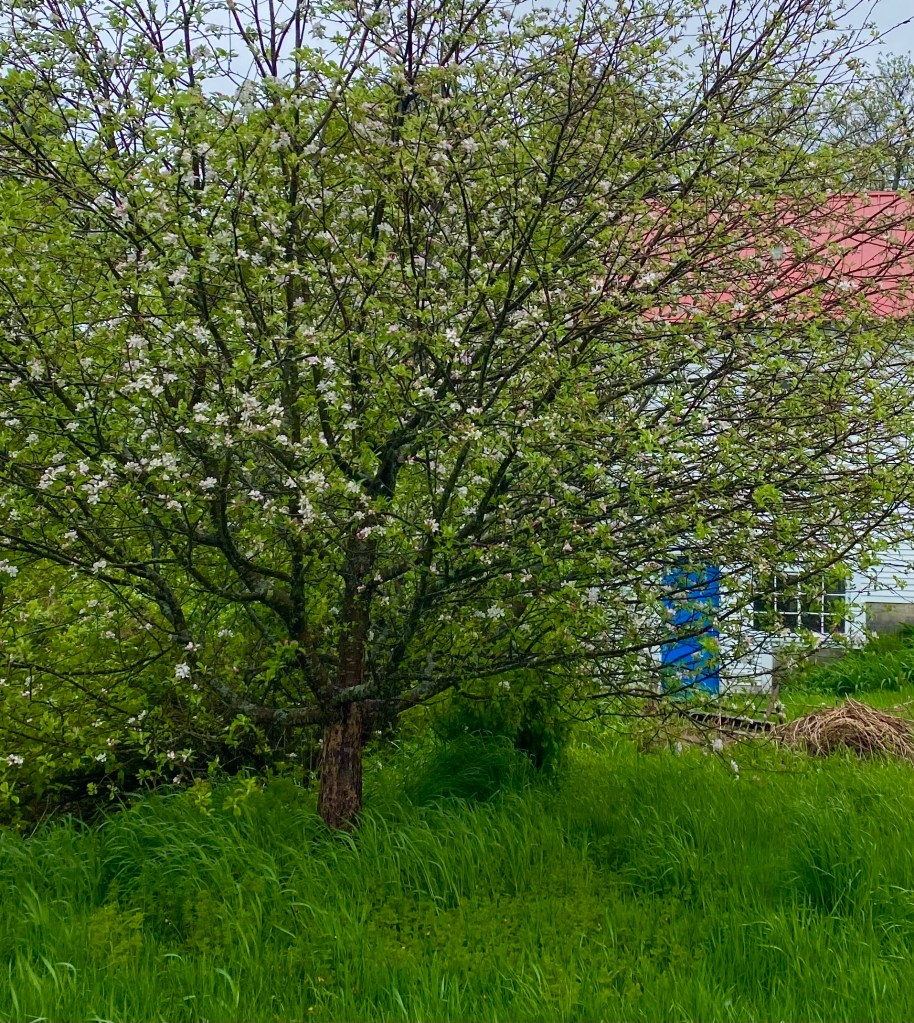
Bluebird, possibly…

Balminess for April – or maybe it’s just me, happy to be walking, walking, heading out on the path where I once walked nearly every day. I trek through the cemetery; I have friends who shun this space, but I’ve lived near cemeteries for years, with their hidden and true stories. At the top, the grass is all brown, not a hint of spring green yet. A bluebird flies by. I stop, mesmerized. I’ve seen so few bluebirds in Vermont. Could this be a bluebird? I follow the creature as it lands from stone to stone, then darts into an apple tree. A little breeze kicks up. Sunlight spikes through the clouds. Abruptly, I’m ecstatic, as if a magical wind whooshes around me. I might as well be in Portugal or Spain, some country I long to visit, but I’m here, in April-brown Hardwick, Vermont, completely happy.

And for the very first time, I have faith I will survive this cancer, that in fact I am surviving this cancer, that my life will go on in mundane and marvelous ways. I’m meant to be here.

Thank you to those who generously donated to my daughter’s participation in Dartmouth Cancer Center‘s annual fundraiser. I’m beyond touched.

Bluebird
Charles Bukowski

there’s a bluebird in my heart that
wants to get out
but I’m too tough for him,
I say, stay in there, I’m not going
to let anybody see
you….

“When the electricity shuts off, you boil water, you crack ice.”

In addition to showing up at Dartmouth-Hitchcock for chemo and consults to save my life, which thankfully appears to be going nicely, I also joined a writing group the hospital offers. Because writing saves lives, too.

Here’s a poem I read in this class, too good not to pass along.

“Chickens” by Kate Gale

I come from hay and barns, raising  
chickens. In spring, lambs come.  

You got to get up, fly early, do the orphan run  
sleep till dawn, start the feeding.  

When the electricity shuts off, you boil water, you crack ice.  
You keep the animals watered.  

You walk through the barn, through the hay smell, 
your hair brittle where you chopped it with scissors  

same ones you use for everything. Your sweater has holes.  
When you feed the ram lambs, you say goodbye.  

Summer, choke cherries; your mouth’s dry. Apples, cider.  
Corn picking. Canning for weeks that feel like years.  

Chopping heads off quail, rabbits, chickens.  
You can pluck a chicken, gut it fast.  

You find unformed eggs, unformed chicks.  
They start chirping day nineteen.  

You make biscuits and gravy for hundred kids  
serve them up good. You’re the chick  

who never got past day nineteen, never found your chick voice.  
You make iced tea. They say, you’re a soldier in the king’s army.  

At night, you say to yourself, Kathy, someday.  
We go walking. We go talking. We find a big story.  

A cracking egg story. A walking girl story.  
A walking out of the woods story. A not slapped silly story.  

A not Jesus story. Hush, Kathy you say, we get out of here.  
We find out where chicks go when they learn to fly.

Beyond words.

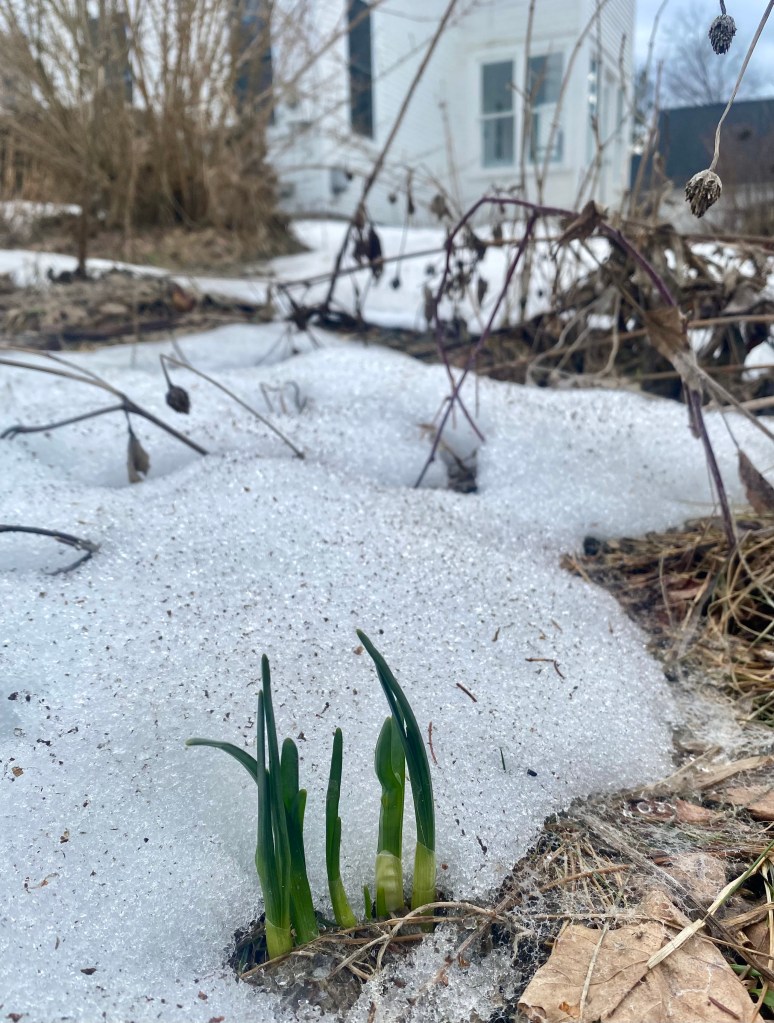
A few days of streaming sunlight. I wander around outside, over the crusty remains of snow, the thawing grass. The garden yet lies covered. A junco picks at seed scattered beneath the feeder. This far along in the chemo, staring at the end, I’m hard used up, muscles withered, fat trimmed near to my bones. But here, here, alive.

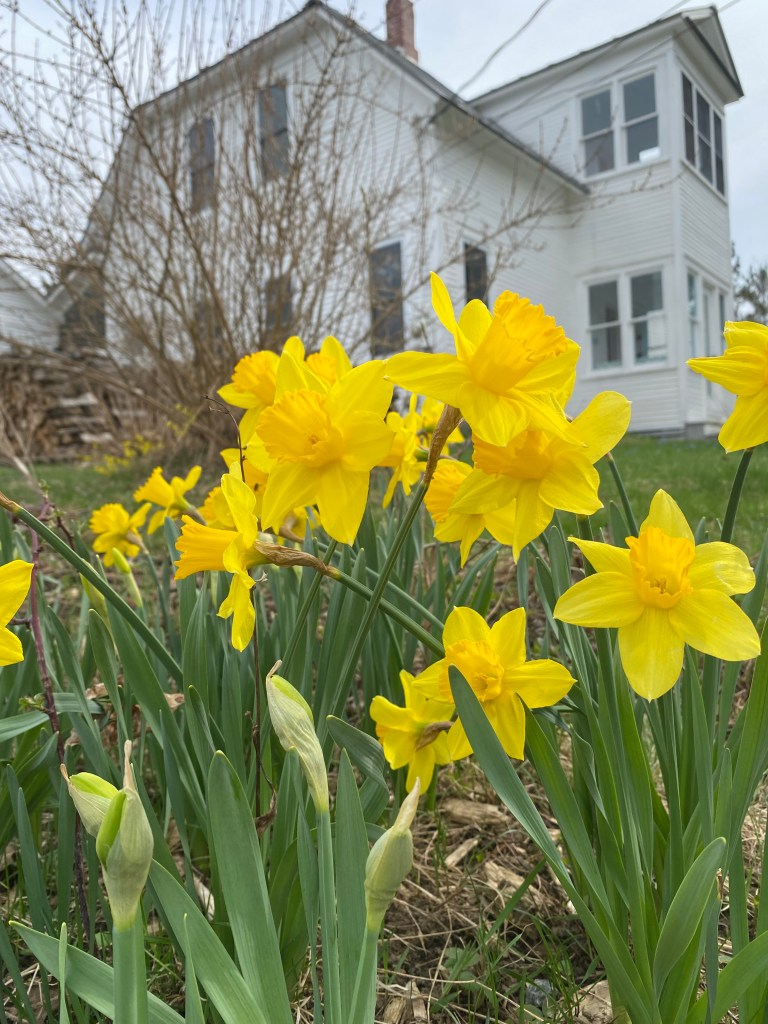
My life – physically, mentally, economically, spiritually – has been crumpled up by disease. Now, ahead, lies the unfolding, the remapping. A friend visiting with her three-year-old, with daffodils and chocolate, points out what I’ve recently reckoned with: that my fierce independence, my raving insistence to live my life, on my own terms and never shaped to the pattern of any man (as Tillie Olsen wrote), has long been my lifeline, the way through lean times, betrayal, uncertainty. But cancer, that mighty devil, flipped that in my face and revealed it as my hollow weakness, too.

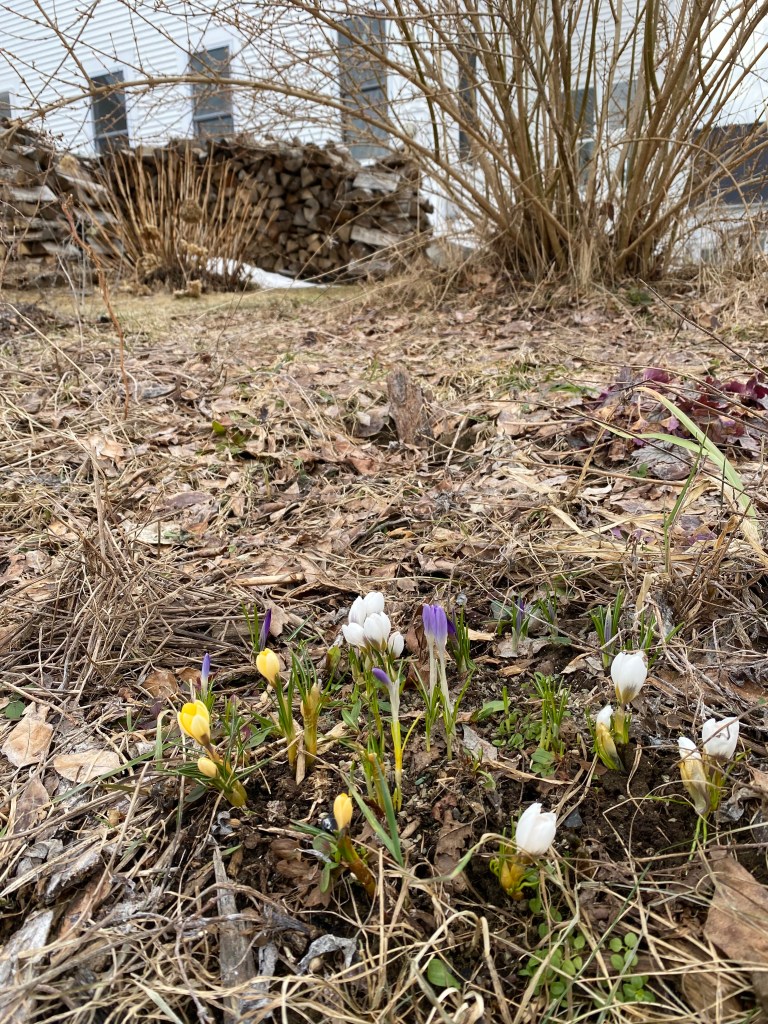
Day by day here, determined to remain free from the hospital, to finish to the final drop this course of so-called treatment, glean back what I can salvage. Four months ago, I didn’t think I would live to see this season’s Chionodoxa blue flowers. This afternoon, my daughter and I remarked that the walnut tree I planted seven years ago as a mere twig has plump buds on its lengthy branches. Buds, blossoms, leaves. Beyond words.

“Why do you want to shut out of your life any uneasiness, any misery, any depression, since after all you don’t know what work these conditions are doing inside you? Why do you want to persecute yourself with the question of where all this is coming from and where it is going? Since you know, after all, that you are in the midst of transitions and you wished for nothing so much as to change. If there is anything unhealthy in your reactions, just bear in mind that sickness is the means by which an organism frees itself from what is alien; so one must simply help it to be sick, to have its whole sickness and to break out with it, since that is the way it gets better.” ~ Rilke

Finding Jesus with the star sunglasses…

Home again and somewhat shocked to see an ice floe leering off my back roof, not exactly the size of A23a Iceberg, but approximating it….

I’m under strict orders to drink broth, eat saltines, lie on the couch and read — the last two I’ve been perfecting for months now. As for the rest of the order (this is the only thing you should be doing, Brett), I’ve been quietly breaking rules for years. Now, intimate with cancer and my mortality, I push myself to obey the orders, stick with the plan, follow the course precisely.

The winter thaws. The iceberg chips, shifts. I step outside and lean against my house in my down jacket that is now limp and beaten down, a sad thing that, this quarantined winter, I’ve used so little. How will my thousand words a day fit into these orders? A grant deadline looms. When will I put on my clean shoes and that linen sweater I knitted and return to work? A cardinal perches on the railing.

In those 48 hours I spent in the Dartmouth ER, in a beige isolation room, an upbeat nurse with amazing eyelashes occasionally stopped in to cheer me and whoever of my daughters was there. On the TV, which we never turned on, she pointed out a tiny orange plastic duck, and told us someone had placed small figurines all over the hospital. “I found Jesus,” she said. “I know that’s weird, to go around a hospital saying I’ve found the Man, but really…” She reached in her pocket and pulled out an inch-high plastic Jesus in a long robe, black curls, gold star sunglasses. He smiled so widely his teeth gleamed.

In that same room, I spied a second duck, brought the ducks home with me and lined them up on the bathroom mirror beside the wooden blue elephant from the Metropolitan Museum my daughter gave me. Two tiny things that arrived in my pocket, after a week of manifold things, after months of many manifold more. All day, it will rain, the warmth softening that iceberg on my roof, falling on the deck and breaking the wood, or not. If it’s broken, we’ll repair it this summer. If not, we’ll move on to the next thing.

And utterly seasonally inappropriate, here’s a Galway Kinnell poem I’ve been loving:

Blackberry Eating

I love to go out in late September
among the fat, overripe, icy, black blackberries
to eat blackberries for breakfast,
the stalks very prickly, a penalty
they earn for knowing the black art
of blackberry-making; and as I stand among them
lifting the stalks to my mouth, the ripest berries
fall almost unbidden to my tongue,
as words sometimes do, certain peculiar words
like strengths or squinched,
many-lettered, one-syllabled lumps,
which I squeeze, squinch open, and splurge well
in the silent, startled, icy, black language
of blackberry-eating in late September.

Giving the slip….

Back again at Dartmouth, anyone entering my room dons a yellow gown, inadvertently hiding staff name tags. Two nurses enter yesterday and pause. My daughter and her boyfriend stand at my bed’s foot.

A nurse asks, Are you two the main medical team?

The three of us look at each other. In these days where not much has been funny at all, I’m tempted to roll with this, but my daughter jumps in and says, We’re family.

Oh, the nurse says, the Main Team. You looked so intent.

I add, Talking politics….

I’d been in the ER for two nights. The fact that I didn’t care is evidence of how lousy I felt. Due to my contagious infection, I’d been squirreled away. Wheeled through the hallways, I see how jammed this place is, people waiting in hallways, tucked into corners.

In these days, my daughters arrive with their cheery energy, with stories of their lives, their patience with me. I tell them my dream to start walking again…. A few warm days and I’m imagining the four feet of snow have vanished into mud. Not so.

My girls laugh. We’re going to have to Apple chip our mother so she doesn’t wander off….

No fear of my wandering in the (very near) future. But how I’m hungering for that. Just where, exactly, would I look for that chip? Under my boot sole? In the hem of my jacket? So I can give the slip when spring calls…..

Born in 1933…

William Maxwell writes in his riveting short novel So Long, See you Tomorrow: “The reason life is so strange is that so often people have no choice.”

This strange world, indeed. My daughter drives us up Vermont’s long loneliness of I-91, the interstate running above the river. Villages are tucked into the blue and snow-sprinkled mountains, these tiny clusters dominated by spires of white clapboard churches. This has been a week of in-and-out of ERs and hospital rooms, of resurgence in energy and a low so low I’m unable to bother to speak. Now, the ride home, the passing through of this winter country, where the new snow (so pure white) piles high on tree branches. This northern land in midwinter is territory I know with a familiarity akin to the veins on the backs of my hands. A haven of cold, often slow-going, a muted palette of pale blue, sooty gray, evergreen nearly black.

We talk until we’re spun out from chatter. I lean my head against the cold Subaru window. In the last room where I stayed, my companion was a woman born in 1933. 1933 marked the end of Prohibition, the year stenciled on the green-glass-bottled Rolling Rock beer we drank in college. 1933, the year of Roosevelt’s New Deal. The woman’s voice was clear as a spring stream, often studded with small wry jokes. When she saw me, her face glowed in a smile. Of all the things I’ve learned from this week and scribbled into my notebook, this woman’s radiant smile and easy language sticks with me. A few times, I wandered her way, hoping to have some of her joy rub my way.