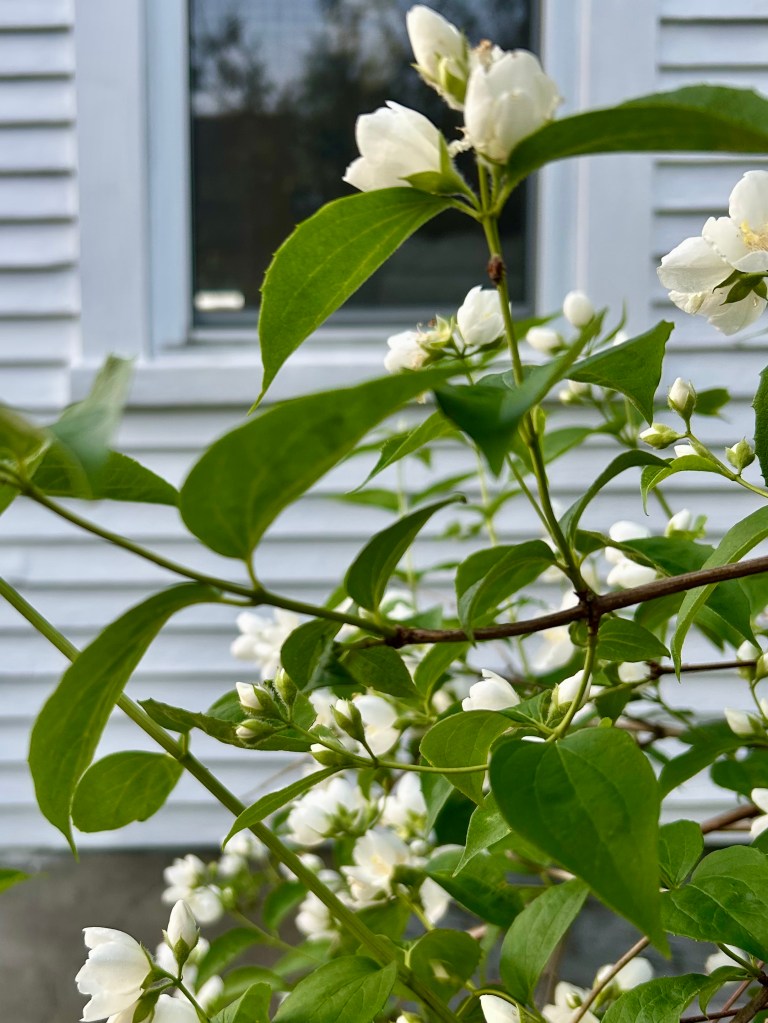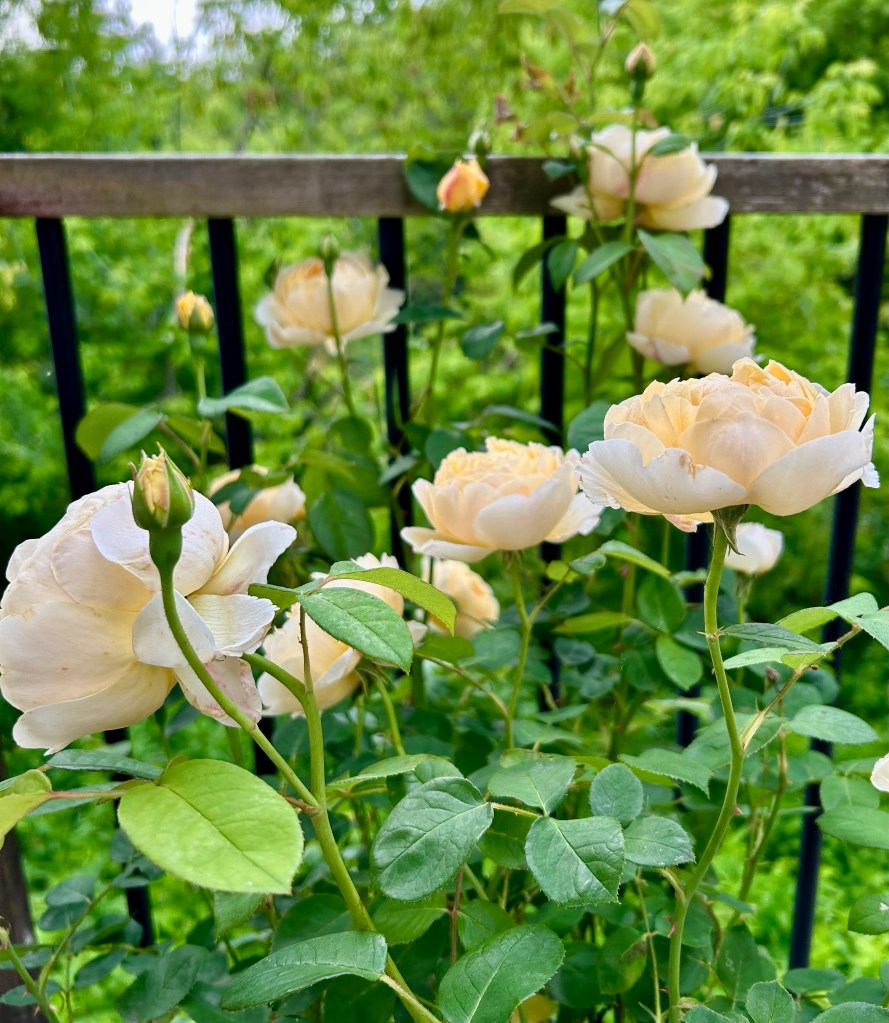
“Everything blooming bows down in the rain…”

We make the trek again to Dartmouth for a surgical consult, the sign-off after surgery. I’ve met numerous members of this team, but not this kind NP, who’s read my history and says, What an ordeal. I’m not expecting these words, and I pause. Last November, when was I first admitted to Dartmouth, I had unplanned surgery. That snowy November night, the surgeon spent so much time with me. Then her Fellow returned and answered my endless questions. In May, I had surgery again. Two bookends – that November night and this sultry summer day. I’ll be treated here for years, but my hope – and none of know squat about the future – is that I’ll never need a surgeon again.

I thank her and the surgical team and student entourage who appeared in all those ER and hospital floor rooms where I stayed – me, the reluctant patient, who tried to negotiate some other outcome than surgery. To my surprise, she’s grateful for my words, too. We try our best but it’s hard to know how we come across to patients. The surgeons who operated on me are trauma surgeons. My surgery was routine, but routine surgeries go south. Mine did not.

Afterwards, my daughter and I stop at Dartmouth College’s Hood Museum. There’s a Georgia O’Keefe painting we want to see and two Monets. The current exhibit has mesmerizing photographs. This is a good day and a good visit. We eat sandwiches in King Arthur Flour’s patio, where so many families have pudgy babies tucked into a parent’s arm. We linger, talking about my mother who would have loved eating here.

So many of those drives on the interstate home, I slept, nodding in and out of conversation. My weak days are long passed, and we keep talking, the interstate edging near the Connecticut River and up on the ridge again. In June’s green, the drive no longer seems so desolate. Traffic here is always sparse. We pass a trailer of hay bales, a pickup with three wheelbarrows.

Enduring cancer turned my world (and my family’s world) inside out. In the first five-day continuous course of chemo, I forced myself to wash every morning. In those days, my hair had not yet fallen out. I was too weak to brush my hair, so I tied it at the nape of my neck. That month, my daughter cut what snarled hair remained. Those miserable uncertain November mornings, how grateful I was for hot water and soap, to have access to a brutal but hugely effective treatment, in a sterile hospital in one of the richest states in a phenomenally country. I made my choices, but I had choices.

In the inside-out world where I am now, I’m ticking through my list: profusely thank my oncologists and surgeons for saving my sometimes-surly life, tend my garden, figure out my youngest’s college bill, finish my book, accept the ravenous roaming woodchucks….. my domestic realm.

In our little end-of-the-road neighborhood, visitors come and go on my back deck, gardens on three sides, the wild pressing in on the fourth. My own nexus.

Everything blooming bows down in the rain:

white irises, red peonies; and the poppies

with their black and secret centers

lie shattered on the lawn.

~ Jane Kenyon

Do Two Things at Once.

Walking on a trail beside the Lamoille River, my daughter points out a snapping turtle, a giant creature, its head tucked in, watchful. Her partner reminds us that he grew up in a village where snappers took over the elementary school playground to plant their spring eggs. An inherent element of that school’s curriculum was try to get along with other beings.

The irises and rhododendron bloom profusely. Rain falls, chilly, for much of the day. In the late afternoon, the sun emerges. I cut back the hostas alongside my house to stave off the wet and rot. By late afternoon, I’m finished with my work and chores. I hang out on the porch, read, drink my cocktails of ice water and lemon. Listen to Nina Totenberg.

A month out from surgery, six weeks from chemo, I met a friend for coffee. We talk cancer and community, about the joys of traveling overseas and shifting perspective. Myself, I will be traveling near to home this summer, most of it by foot. Each day, I walk more and more, reclaiming my strength. As next year’s woodpile is transported into my barn (thank you, thank you, kind wood mover), I imagine planting a garden on that emptied place. As a younger woman, I believed vegetable gardening would change my world. I wasn’t wrong; Red Russian kale and bull’s blood beets fed my growing children for years. But blossoms and bushes and trees nourish the wild (and me, too).

I live on a hillside where hungry young woodchucks run rampart. Not so long ago, I considered the chucks my enemies. Now, having endured the scorched-earth transformation of chemo and cancer, I worry far less about these sleek-furred creatures. By summer’s end, I know the foxes thin this population. In the meantime, I slowly go about that repetitive work of weeding and mulching, and the visioning research of transforming lawn into wildflowers.

My coffee companion reminds me to take my time and take risks. Who wants to take risks after surviving cancer treatments? Answer: why not, why not? Dig more gardens. Contemplate the woodchucks. Plant coreopsis to replace the hollyhocks holes from the woodchucks’ foraging… Do two things at once: go with the flow and keep paddling.

White peonies blooming along the porch
send out light
while the rest of the yard grows dim.

Outrageous flowers as big as human
heads! They’re staggered
by their own luxuriance: I had
to prop them up with stakes and twine.

The moist air intensifies their scent,
and the moon moves around the barn
to find out what it’s coming from.

In the darkening June evening
I draw a blossom near, and bending close
search it as a woman searches
a loved one’s face.

~ Jane Kenyon, “Peonies at Dusk”

Under a Thousand Stars.

Walking home, I spy a smattering of white blossoms among a stand of pines, off the path. That short stretch is a strange area, more sand than soil, unusual on my Vermont hillside. Running theory is that someone stripped the top soil, years ago. Although I haven’t energy in excess, I’ve enough that I wander from the path. The blossoms are wild strawberries. Sweet mark of June.

For those not in New England, the common gripe is the weather. Every weekend, rain. Figures are tossed that there’s not been a fully sunny weekend since December; then I hear November. As for me, recovering, the days and weeks merge. Now, three weeks out from surgery, I’m easing back into work. The cats wake me at early light. In recovery, my old worries rekindle, but so does my drive and curiosity. I get up, eat cereal and maple syrup, brew coffee. I spread the manuscript of my fourth book over the kitchen table, cut, rearrange, stitch.

What’s changed, though, is a new slowness, a willingness to let the course of things unfold, to crouch beside those strawberry blossoms, wondering which birds will snag the tiny crimson berries. In a few weeks, I may wander here and sample this sweet delicacy. Half of this May, I lived in a hospital. Finally, I limped out the door with my brother. While he drove me home, I kept saying, “I’m out, I’m out,” and “The trees are leafing, the forsythia is blooming, the lilacs are opening.”

That surgery and that stay might likely have saved my life, again; and again, how immeasurably capable and kind was the hospital staff. Nonetheless, it’s June. The sky this morning is scrimmed over with smoke from wildfires. Under that dome, I have work to do. A friend will visit. I’ll move through this day, this Wednesday, happy.

I want to lie out

on my back under the thousand stars and think   

my way up among them, through them,   

and a little distance past them, and attain   

a moment of absolute ignorance,

if I can, if human mentality lets us.

I have always intended to live forever;

but not until now, to live now.

~ Galway Kinnell, “The Sekonk Woods”

Mending…

After nearly two weeks away, I return home to the trees in full leaf, the lawn gone wild with violets and strawberry blossoms. Drizzly, cold, my brother starts the wood stove. The cats uncurl themselves before the blaze, satiated. A cold May, but verdant, lushly and satisfyingly so.

In these post-surgery days, I limp from room to room, venture outside to tug down a lilac branch and breathe in. The weeds run rampart, but whatever… the garden, too, will be sorted and tidied.

I’ve written repeatedly about the lilacs around my house, but again, I reiterate my joy in the soaring bushes. When I was five, we lived in a small green rented house, its yard surrounded by chainlink fence. A lilac bush leaned over the fence from the backyard neighbors. My second-grade sister was in school afternoons, my toddler brother sleeping, and so, after kindergarten and lunch, I lay on the long grass, staring up through the quaking leaves. These bushes, so New Englandy quaint with lavender, violet, and white blossoms, remind me of those unbounded childhood hours. One o’clock, two o’clock? Who knew? Who cared? I had just learned how to tie my shoes.

Like the walking wounded, I hobble from couch to chair, through the long grass, out of the workaday world and, yet, far from being a child. In glorious remission, in recovery from surgery, I keep thinking of this poem below, as I begin, day by day, to mend my body and life.

“Da Capo”

Take the used-up heart like a pebble
and throw it far out.

Soon there is nothing left.
Soon the last ripple exhausts itself
in the weeds.

Returning home, slice carrots, onions, celery.
Glaze them in oil before adding
the lentils, water, and herbs.

Then the roasted chestnuts, a little pepper, the salt.
Finish with goat cheese and parsley. Eat.

You may do this, I tell you, it is permitted.
Begin again the story of your life.

— Jane Hirshfield

“…the strange idea of continuous living…”

A knock at my kitchen door wakes me. Midafternoon, home from a long morning at Dartmouth for routine things, nothing major, but a day that began in the dark after scant sleep. The week before, I’d left a message for a man who painted three sides of my house a few years ago to ask about an estimate for my barn and that fourth side that somehow I’d never painted. Last fall, sick and not knowing the (cancer) reason why, I’d managed to get out my sander, but that was about as far as that plan went.

The painter is a person my daughter and I know in our overlapping circles, so I’m not surprised when he says he’d heard of my illness. We talk for a bit in my kitchen. Then I grab my sweater, and we walk around the barn. A stunning sunlight makes me blink. Our conversation winds around primer and caulking and ladders. In the back, where the woodchucks claim domain, the painter turns the conversation towards politics and the word that’s so commonly used now — cutting. We talk about cancer research (which saved my life) and the bitch of enduring chemotherapy. A house finch perches in the honeysuckle in the wild tangles below my house. The honeysuckle’s bent branches are dotted with tiny fans of new leaves.

It’s been a day for me. I once had unbounded energy that I spent so easily with my garden shovel, my paintbrush, laptop, trowel, my two hands. I lean back against the barn’s peeling clapboards, beside last summer’s clematis vine that appears shriveled, used-up, no good. I have complete faith this beauty will bloom again this year. Listening to the painter, I wonder, why make any guesses about anyone or anything, really? What will happen will happen. Yet, I can’t help myself. I’m betting on the clematis and its purple flowers. The painter offers me his good will, and I take that, too.

Instructions on Not Giving Up

More than the fuchsia funnels breaking out
of the crabapple tree, more than the neighbor’s
almost obscene display of cherry limbs shoving
their cotton candy-colored blossoms to the slate
sky of Spring rains, it’s the greening of the trees
that really gets to me. When all the shock of white
and taffy, the world’s baubles and trinkets, leave
the pavement strewn with the confetti of aftermath,
the leaves come. Patient, plodding, a green skin
growing over whatever winter did to us, a return
to the strange idea of continuous living despite
the mess of us, the hurt, the empty. Fine then,
I’ll take it, the tree seems to say, a new slick leaf
unfurling like a fist to an open palm, I’ll take it all.

~ Ada Limón

Bare soil.

Midnight, I’m sitting outside the local hospital in the balmy night, a few mosquitoes drifting in the streetlights. There’s no one around, save for the young woman in reception poking her phone, the peepers chattering in the wetland down the road. The night is so warm I’m reminded of summer’s open-ended days and nights, the pleasure I’ve taken these last few years sitting outside in the dark, listening to the nightsounds of rustlings and callings, human and wild.

The person who drew my blood just a few hours ago told my sister and me about the local library in nearby Johnson, Vermont. This evening, the library will be moved from where it was built and recently flooded to safer and higher ground near the elementary school. The town will shut down as the brick building is wheeled down Main Street and over a bridge spanning the Lamoille River. In the velvety darkness, I imagine the scene: the floodlights, the crews, the townspeople who will come out to admire and cheer. A small but certainly mighty miracle.

Around the building, I hear the rattle of my Subaru’s loosening heat shield. Then my sister appears in the driver’s seat. Along empty roads, she drives us home. In Wolcott village, I spy a fox rushing across the road. The animal pauses at the weedy edge, head turned towards us, perhaps wondering what we’re up to, too, this creature, like us, in no rush at all. Home again, the cats press against the kitchen glass doors, as if expecting a reckoning from me, an accounting of my absence.

What can I say to these tabbies? When a nurse apologized for dropping a plastic cap on my shoulder, I mused aloud that it wasn’t heavy — and isn’t that a line from Phish? Things are falling down on me, Heavy things I could not see… The nurse knew these lines, too. The heavy falling things are taking a pause, perhaps, in spring, as the earth reorients herself, through peeper song, unfurling leaf, the heady scent of rain on bare soil.