Phone Conversation

Sunday afternoon finds me talking to the Vermont Department of Health contact tracer about my daughter’s positive Covid test. My results, he determines, haven’t rolled in yet.

I’m at the dining room table, chipping wax off a candlestick, doodling on a piece of paper. He asks where she’s been, and I answer honestly, school, home, and the woods.

Through the window, I see a cold rain falling. He tells me about the potential for what seems to me an incredibly long quarantine period for myself, if I don’t test positive. If I do, well, that’s a different kettle of fish so to speak, he says.

What you’re saying, I clarify, is that there’s no good options here.

He pauses.

I apologize immediately. The good thing has already happened. Covid has washed right over my daughter with the lightest touch. My other daughter is vaccinated.

I answer all his questions. Then I ask, Wait and watch?

It’s maddening, he says, but yes. That’s where you are.

The wind bends the pear tree in our front yard. We’ve endured plenty. Our house is warm, stocked with firewood and food. And so it goes.
Hands at Work

I’m working at home on a Friday afternoon when an email pops into my inbox from the librarian in town. He writes my interlibrary loan book is in, and would I like to come get it?

Indeed, I would. I pick up the book, wrapped nicely in a white paper bag, with my first name, Brett, written in black marker. I stand there in the sunshine, holding this book like some kind of present.

By randomness, I chose this book — Hammer Head: The Making of a Carpenter.

Go read it, too. The book embraces the hammer and chalk line, the beauty of wood, the functionality and satisfaction of making things with your hands, all antidotes to this virtual world. Even more, the book embraces being a woman and a working woman.

Walking Home

Aren’t we all thinking about this Covid anniversary? A year into the pandemic?

Time’s such a tricky thing. I’ve lived through moments that seemed like an eternity — such as the terrible experience when my baby had an allergic reaction and ceased breathing. Those were endless moments before she gasped again, her tiny chest taking in air. Conversely, my second pregnancy appeared to stretch out far beyond the standard nine months….

One year into the pandemic realm, I’m at the point where I’ve accepted: Live here now.

In a conversation with someone today via Zoom, I’m asked what I’m doing in September.

September, on one hand, is not so far off. On the other hand, I’m hoping there’s a lot of living between here and there. (Plus, I can hardly envision what I’m doing next month.)

This makes me think of my younger, more hippie days, reading Ram Dass.

We’re all just walking each other home.


Falling Ice

In the night, ice slides off our back roof and breaks our porch railing. I discover this in the morning while I’m carrying out the stove ashes, cautiously looking for one of the neighborhood skunks.

The broken railing doesn’t even register as an annoyance. While I’m making coffee, I think this over. Just a few years ago, I would have brooded on the broken wood, resentful of the expense of money and time to repair this piece of our house. Now, I think merely, That can be repaired.

There’s a lesson here, I think, on this mundane Thursday morning. Of all the broken things in my life — inevitably, in all our lives — a snapped piece of wood hardly matters. For years, I saw the accumulation of disrepair, from a loose coat peg to a leaking roof, as sure evidence that my family life was unfolding. A year into the pandemic, a broken railing is evidence of warming nights. Repair, and move on.

From Leland Kinsey’s poem “Winter Stay in a Peat Bog”

Sweet Day

All day on my oldest daughter’s birthday, I remember that this was the day I became a mother. The day is imbued with a rosy holiness, transforming the everyday world of mundane things — a laundry basket, a cheese grater, a dutch oven — into pieces of our miraculous life. Parenting is a long, long road — there’s no doubt about that — the world would be unimaginable without this road.

At the end of a very long labor with this baby, I saw myself descending deeper and deeper into a dark, stone-lined well, my arm outstretched, reaching for my baby who I knew was somewhere down at the well’s bottom.

This child was born at the very end of the 20th century, in contemporary Vermont. Modern medicine made her life possible, and certainly saved my own, too. Every year, when I’m grateful for this young woman’s life, I remember the strangers who brought her into the world.

Happy February.

Finally!

In the midst of surely what will be known in American history as a lousy time, Bernie Sanders inadvertently made knitting cool.

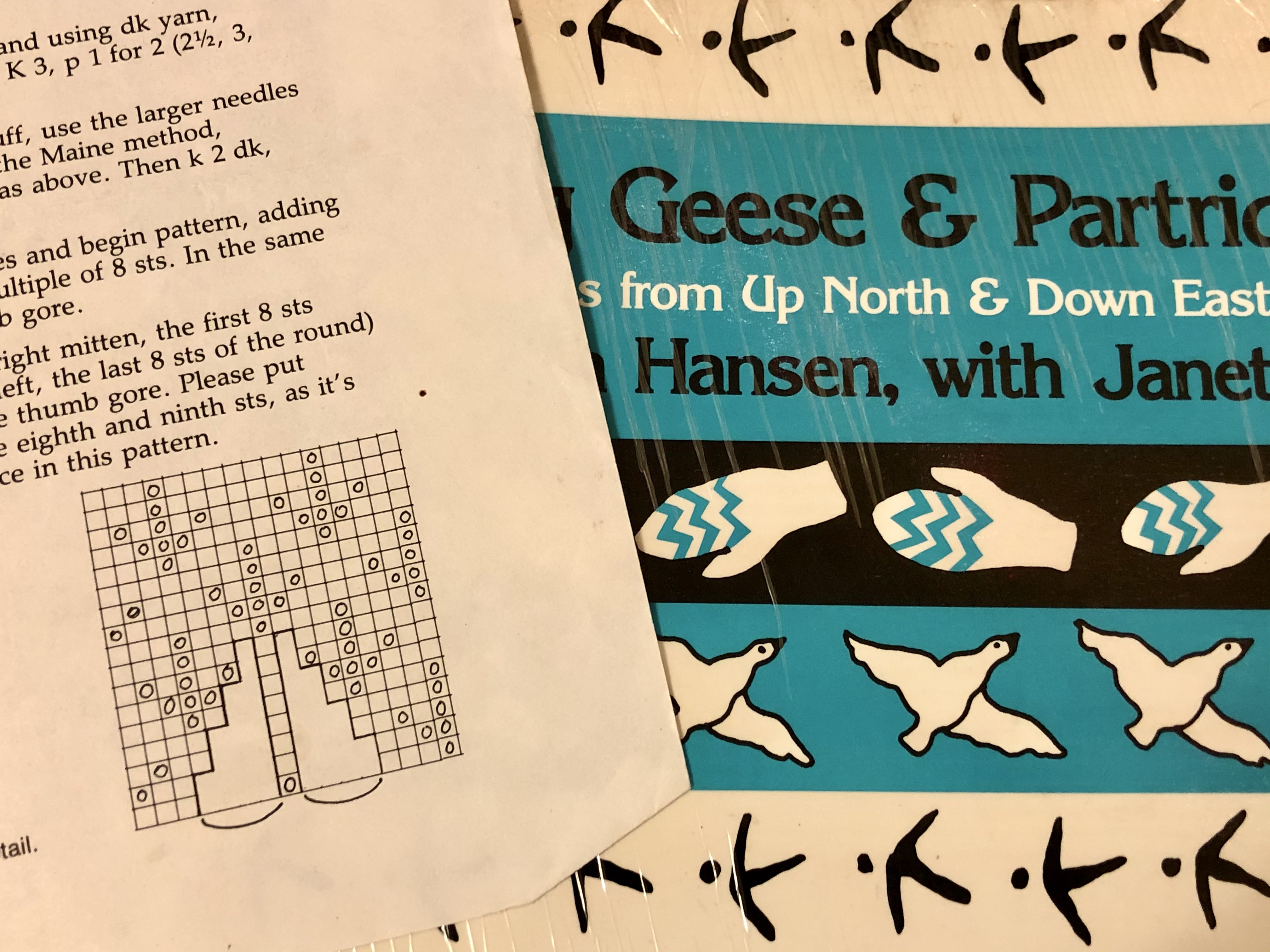
When my youngest daughter was a toddler, one winter I cracked open a knitting book my mother had given me from her stash and taught myself to knit two-stranded mittens. In those days of diapers and playdough and winter isolation, I experimented with yarn weight, needle size, and colors. The prettiest mittens I knit had one cuff gnawed by mice when I left the pair overnight in our sugarhouse.

When we moved from one house to another and we jettisoned so many belongings, I considered that particular knitting book before I packed it in a box. At that point, I wasn’t sure I would ever knit another pair of mittens, but I packed the book, more out of sentimental affection than anything else.

This morning, I pulled the book from the bottom shelf of my bookcase. I was looking for a pattern after offering to knit my brother a pair of mittens. In the center of the book, I found pages of one daughter’s artwork. She had a set of Noah’s ark stamps as a little girl, and had carefully stamped and colored a scene.

This daughter went through a period when a hand-me-down paperback Noah’s ark book was her favorite bedtime tale — all those animals and Noah’s family cozied in a handmade boat, first having a party, then enduring through a tediously long journey, with the rewards of the olive branch, the dove, dry land, and the rainbow at the end.