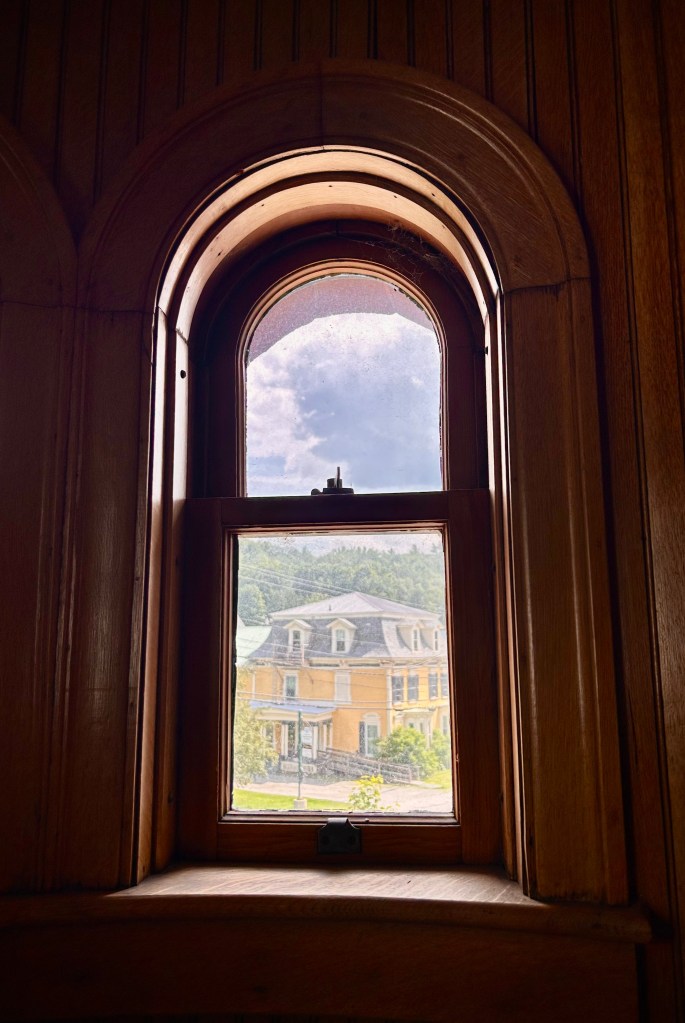
Lucky.

August is exceptionally hot this year, the rivers so low they can be crossed by foot. In the woods, streams have dried to rock beds. In Montpelier, the state’s tiny capital, I walk by a store with bright bowls in the window and think, My mother would love this store. She passed over a year ago, and yet I still catch myself thinking that she might appear around a corner, her purse tucked under her arm, amused at me. Of course I’m not gone…

My father, the physicist, schooled his three kids early on about entropy. In a week where things repeatedly broke — the hot water heater leaking, the Jetta refusing to start in the rain — he made jokes that we were in a High Entropy Zone. So, this lovely August, with the chorusing crickets and the waning red moon — I’m determined to suck each day to its marrow. Sandwiched around work and the steadiness of washing dishes and so on, I’ve pushed aside space for swimming and ice cream, for lying under the apple tree and studying a spider spin her web. The entropy of living keeps on, as it does.

In the years when I was raising my own young daughters, our days zigzagged from bowls of blueberries to bath time. The days were endless, and the years rushed by. Now, my girls newly grown, I relish the silence and crave their company. Lucky I am, so lucky, to be alive this summer, this month, these days. All day long, I walk around with my tender heart cradled in my hands, wounded and raw from cancer, from weeks of hospitalization, from the knife of mortality pressed against my windpipe. August: the season of great loveliness, the intimation of winter. The reminder to love where and what we are.

Hitch Hiker at a Truck Stop

The hitch hiker asks to look at

the palms of my cold hands

and thanks me for unfolding them

on the frost-edged

picnic table between us.

While I look at his downcast eyes

trying to see if he sees,

nearby truckers stare

at his narrow face,

long blond hair.

He asks me if I garden,

rips a scrap of newspaper

and folds it up

into a tiny origami

package for anise seed.

Here, he says,

seed I gathered in Oregon,

plant it in Colorado.

I always have a garden, he adds,

I plant and leave to others.

He tells me he has no sex;

when you ride in the righthand seat,

you have to nod your head

without listening.

Face pressed to the window,

he can see the lacquered edges

of the earth.

So I imagine him 

practicing calligraphy

on truck windows,

recommending honey and vinegar

in a glass of water

every morning.

Mad, mad, mad.

A yellow warbler,

the moon at the bottom of the stream.

Out on the highway

he is raising his thumb again. ~ Mary Crow

Keeping Company. Neighbors.

A friend mentions her mother has an art opening that evening in the sprawling building that was once the village inn. We’ve just returned from a walk and stand in a field where, 25 years ago, she sold homemade pies and I sold maple syrup. We each held a nursing baby, in those years.

Her mother lives beside me, so about eight o’clock, the time I’m usually brushing teeth or walking around the house putting water glasses and cat bowls in the kitchen sink, I pull on a sweater (hello, Vermont July) and walk downtown. Monday, hardly anyone is out this evening, as the sunset does its peach-and-rose watercolor magic along the mountains.

I’m amazed, again, at my neighbor’s talent, her unique vision a mixture of O’Keeffe and Cézanne. I stand holding her hand and talking, this woman who lived plenty of lives before I met her. When I weed my front yard garden, she’ll sometimes lean out of her door and holler, “Hello, neighbor!” her hair in plastic curlers.

I walk the long way home through neighborhoods where the children have been called in for the night. Stray teenagers are out; no one else. There’s no glimmer of moon, but the stars are winking into their nightly places. I take an extra loop, and the darkness folds around me.

I’m in this odd place where people I hardly know touch my shoulders, rub my growing-back hair, as if to confirm that, yes, I’m alive. Or I’m looked at silently, uncertainly. The cancer’s made me rougher and gentler. Disinterested in cattiness, willing to visit a neighbor when my body aches to lie down.

At home, I linger on the house steps, the tree frogs serenading. These summer days are long, long, with some hours of work. More than anything, I’m determined to finish a draft of this third novel, determined to sell this book, too. Stubborn my mother would tell me. You’re so stubborn. By now it’s dark, the scattered village lights cupped in the town’s narrow valley, the Milky Way a silent celestial river. My mother despised my stubbornness, this trait that mirrored her. Or maybe I’m completely wrong about that.

I water the hanging plants, and yet I’m not willing to go in for the night, lie down and read, sleep. Last November, I was sitting on these steps in the darkness, the news of having cancer fresh and raw. A different neighbor appeared and sat with me. We talked about opioids and THC. She told me about her husband’s death. In the chilly November, we sat in our coats, a quiet between us, she keeping me company.

“The purpose of poetry is to remind us
how difficult it is to remain just one person,
for our house is open, there are no keys in the doors, 
and invisible guests come in and out at will.”
― Czesław Miłosz

In the great [and holy] darkness.

In these sultry July days which I love, I walk in the evenings. Wildfire smoke from Canada renders the sun bloody. In the heat, there’s few folks out. I often follow the trail along the river to the pastures where cows graze. The air, fat with humidity, is redolent with wet earth and cowshit. The smell reminds me of those childhood camping trips and those journeys in my twenties when we explored the West, driving around with Rand McNally and pitching a tent in a forest or farmer’s field.

The world indeed might be going mad, the planet hurtling into fire and heat. On these July evenings, though, it’s me and those cows and the wildflowers blooming rampantly. In the night, rain patters. I leave the cats sleeping in their hot fur and slip outside. It’s so far along in the night that this village is sleeping, too early yet for milk trucks, too late for teenagers. I sit on the steps in the tiny cool bits of raindrops, tree frogs and crickets chorusing.

I’ve posted this poem before, but Hayden Carruth is always worth reading again, and this remains one of my favorites.

The Cows at Night

The moon was like a full cup tonight,
too heavy, and sank in the mist
soon after dark, leaving for light

faint stars and the silver leaves
of milkweed beside the road,
gleaming before my car.

Yet I like driving at night
in summer and in Vermont:
the brown road through the mist

of mountain-dark, among farms
so quiet, and the roadside willows
opening out where I saw

the cows. Always a shock
to remember them there, those
great breathings close in the dark.

I stopped, and took my flashlight
to the pasture fence. They turned
to me where they lay, sad

and beautiful faces in the dark,
and I counted them–forty
near and far in the pasture,

turning to me, sad and beautiful
like girls very long ago
who were innocent, and sad

because they were innocent,
and beautiful because they were
sad. I switched off my light.

But I did not want to go,
not yet, nor knew what to do
if I should stay, for how

in that great darkness could I explain
anything, anything at all.
I stood by the fence. And then

very gently it began to rain.

Mad World, Abundant Wildflowers.

For no particular reason, I walk on the path along the river which leads to the road where I once lived. In the meadows and beside the trail, the wildflowers blossom abundantly: yellow toadflax and pink asters, bluets and Black-eyed Susans, cinquefoil.

I dawdle at the dirt road. At a turnout, long ago I had a carpool meeting spot. Over the years, my daughters and I passed hours there. In the afternoons, I lingered with my friend, the girls lingered with their friends. The girls played in a brook. The fields have been used for hay, vegetables, seeds, THC. In the past few years, the flooding river dumped sand in these acres. Burdock and thistle claim this terrain now. These fields are for sale again.

A few pickups zoom by. When my ex and I were splitting up, we’d meet here, too. I’d run down the mountain road and leave the girls at home, baking cookies or riding bikes. In my then-husband’s truck, we’d argue about our lives. That autumn as an early dusk washed in, I leaned my head against the truck window and watched two coyotes running across the field. He kept talking and talking and I kept thinking about our daughters who would be hungry for dinner. Someone else lives in that house now. Our lives have long ago moved on.

A friend pulls up, and I get in her car. We talk about kids and aging parents, about money and oranges. The world around us is falling apart. What we see now might be just the cracks of a shifting society. Yet, our lives spin on. My friend and I keep talking and talking. Children grow up. The fields’ bounty changes. I no longer live a few stones’ throws down an empty road from this friend, but how I love her.

I walk back slowly on that trail, under the cool shading trees. Chicory, knapweed, Canada lily. In the covered railroad bridge, I pause in its interior dimness, light at either end. There’s no one around at all. I soak it in.

The heart’s actions
are neither the sentence nor its reprieve. 

Salt hay and thistles, above the cold granite. 
One bird singing back to another because it can’t not.

~ Jane Hirshfield

Small Kindnesses.

Writing a novel, you pay attention to action. What are the characters doing? And why? At the midpoint, the action often switches; the protagonist ceases to react and, instead, acts — and not without mishap, without complications.

I’ve long thought of labor as a metaphor. The mother’s cervix dilates (helped, sure, by walking, by receptivity), followed by the uncertainty of transition just before the mother engages in the pushing phase, the brief or lengthy or sometimes stigmied phase of bringing this child into the world.

I’m in the transition phase again in my life, beneficiary of cancer treatments and so much medical care. Mornings this winter when I woke, I began each day with a survival mindset; I would endure my body’s illness. Now, June, the birds wake me, the feathered creatures intend on nest-building, procreation, survival, maybe the joy of communal singing. In the garden, the tithonia abruptly deepen their green, expand their leaves. The hydrangeas sprawl into a fortress.

At my desk, I lean into my day’s work, hours and hours unspooling.

Late afternoon, my friend arrives with her little girl, and the three of us walk in the cool town forest. The child removes her shoes and runs over the pine-needle-spread paths. She buries her bare feet in the shallow stream’s mucky mud. Yes, June…

Mostly, we don’t want to harm each other.

We want to be handed our cup of coffee hot,

and to say thank you to the person handing it… 

We have so little of each other, now. So far 

from tribe and fire. Only these brief moments of exchange.

What if they are the true dwelling of the holy, these

fleeting temples we make together when we say, “Here,

have my seat,” “Go ahead — you first,” “I like your hat.”

~ from “Small Kindnesses” by Danusha Laméris

“Quite Serious”

My neighbor runs out his back door, shouting and waving his arms. I’m working on my upstairs glassed-in porch. He cranks up the volume on VPR’s Morning Edition. I’m guessing he hopes the young woodchucks burrowing beneath his deck aren’t NPR fans.

Like my neighbor, I am a VPR fan. This morning, news of Iran dominates the air. As I labor to join noun to verb, I notice my heart beating at Steve Inskeep’s words. Eventually, I leave my cat sprawled on the windowsill and head downstairs to wash the dishes. I’ve listened to NPR my entire life. Heck, the radio was probably playing when my parents brought newborn me home from Presbyterian Hospital in Abuquerque. Little these days is good news.

This winter, I’ve written in this space about my obsessive struggle to remain among the living on this planet. Only now—two surgeries, six rounds of chemo, 11 hospitalizations later—do I realize the diciness of my determination to live. A few weeks ago, driving with my daughter, she showed me a lawn where she cried on a bench because I believed my mother would die. Every day now, as I begin by feeding my two cats and drinking coffee, I carry this winter, those months of spitting distance from my grave, within me. As at the beginning, my greatest worry was/is my daughters. So many months later, I understand how my life is connected intrinsically to so many others. That what lies before my eyes are the twig tips of stories.

In my younger, brasher years, I might have written about politics and conflict, but the Mideast is a place I’ve never been, with people I’ve never met, for whom I will never speak. Too, I’ve knocked around this planet long enough to know that violence changes the world, irredeemably. That the combination of deceit and anger and hubris wrecks destruction. And that cruelty wrought can never be undone. We hurtle onward. I keep listening.

June, and pink roses bloom against my house, planted by someone I never knew, perhaps the woman known as Grandma Bea buried in the adjacent cemetery’s crest. My daughters climb a mountain with a view of Vermont’s shimmering Lake Champlain and the emerald patchwork of farms stitched together. They return with a gift for me, a thorny rosebush with fragrant blossoms that fill my cupped hand. In the evening, shortly before dark, I walk in my bare feet, the long grass already cool with dew. High heat is predicted, the planet is surely burning up, but this ruby-and-gold sunset drags in a coolness. Lush, so lush this month. The butternut tree I planted stretches towards the apple someone else carefully cultivated and noted in pencil on the barn’s bottom wall. A record someone held dear.

In 1956, Allen Ginsburg wrote: “America this is quite serious.”