A retired man shows up at my job, looking for a little info and then stays to talk, sitting in a chair while I lean against one of the cement posts that hold up the ceiling, and the building overhead.
A former landscaper, he’s survived numerous joint replacements, an overseas war as a young man, and he’s holding cancer at bay, for now. He’ll succumb to the cancer, he says, at some point. But for now, he tells me how much he savors that first slurp of hot tea every morning.
I have plenty to do, but for that time, I might as well, really, have nothing else to do. He tells me about a double blossom primrose flowering in his garden. Another spring, he says.
Blue squill reappears in our front yard and over the hill behind our house, in the thickets of wild raspberry canes — tiny flowers that sprinkle color in our landscape that is otherwise brown dirt and gray mountain.
In the rough patches of roadsides and rocky ditches, coltsfoot springs up. Along the brick school gymnasium, I discover blooming dandelions.
These tiny flowers, some no larger than my thumbnail, are mighty tough. There’s a lesson here, I know, as I crouch in that tangle of thorny vines, admiring a clump of starflowers. That lesson might be as simple as the determination of the world’s beauty. Who planted these flowers, I don’t know. But every spring I’m grateful for that gardener who lived here and who so loved these spring gems.
The temperature weirdly shoots up to 70 degrees. 70 degrees in Vermont in early April! For anyone who doesn’t live here, know that this warm, daffodil-growing weather makes our world a communally happy place.
While my daughter plays soccer, I take a walk, then spread out my work on a picnic table. Three geese fly overhead, making a honking racket. On the other side of a school building, I hear the kids laugh. Two dads roll up on bikes and stand in the parking lot, chatting.
Another parent I haven’t seen for a long time appears and stands at a distance. We talk and talk, about how our work has changed, and what’s happening with our kids, and even more, about each of us might want this summer — happiness, in some small way. Listening, I think, of all the many things we’ve learned this year, surely valuing the connection between us rises high. How little that might seem, and how infinitely valuable.
My daughter returns with a blister. At home, the carpenter has just finished repairing the porch railings broken by falling ice. We stand for a bit, talking and waving at early mosquitoes. He admires the view of the village below us and asks how I like living beside a cemetery. I like it just fine, I tell him.
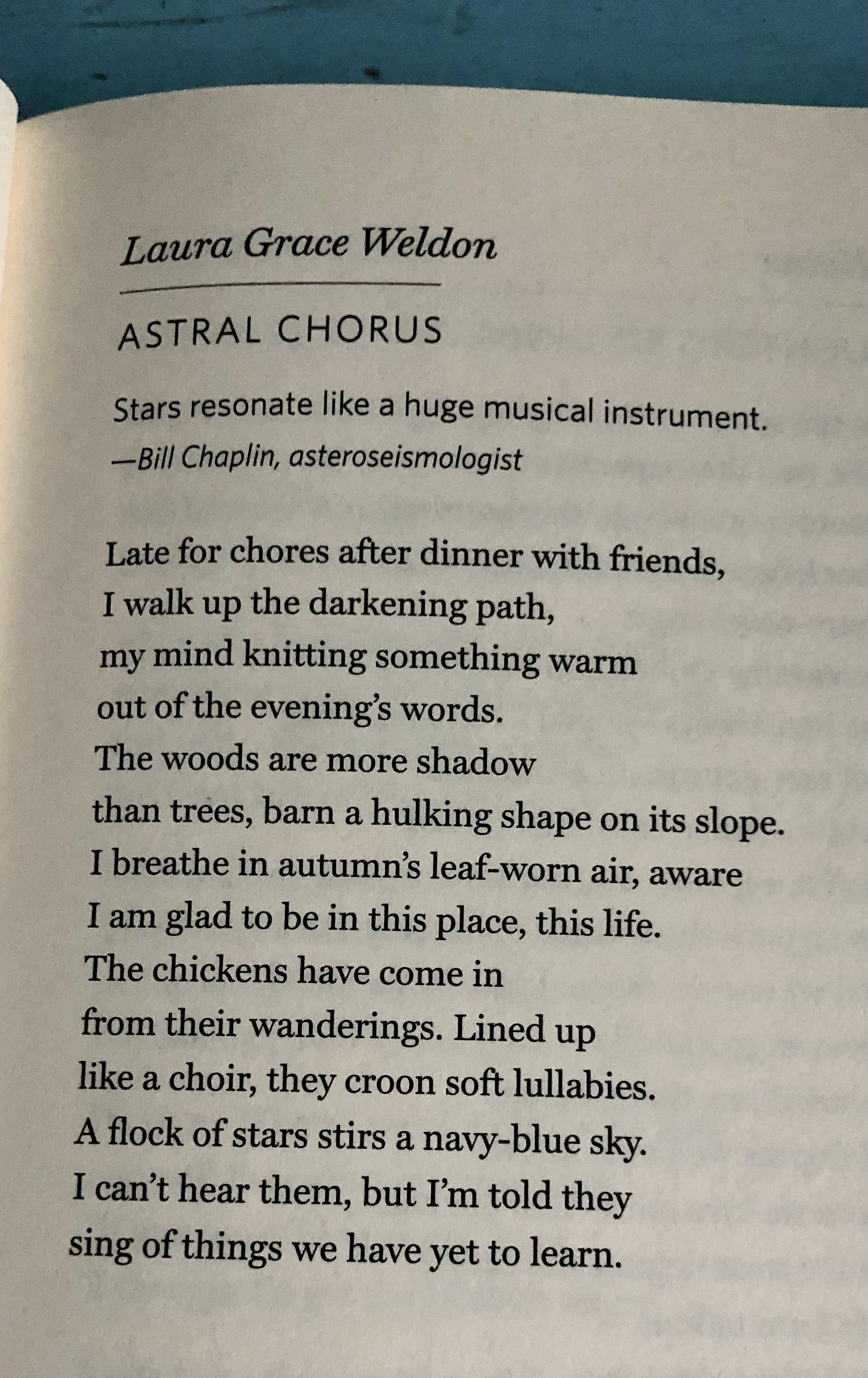
Don’t talk to me about the stars, about how cold and indifferent they are, about the unimaginable distances. There are millions of stars within us that are just as far, and people like me sometimes burn up a whole life trying to reach them.
Every morning when I wake in the dark, I think, I’m not sick, a revelation that begins the day. Although I’m not headed out of the house, for any number of days, I’m up especially early these days, thinking of Salinger’s Zooey telling Franny not to fritter away the best part of the day, buddy.
It’s all jumbled up here, even more than the past year. I am so grateful my daughter isn’t sick, that she’s counting down her quarantine days not with pleasure, but with her trademark resolution, her will do, but I’m plotting my summer plans….
For me, it’s wait and watch, a negative test followed by another test, results in 36-72 hours. Over us hovers the thought: which way will this go?
I set up work on the kitchen table, then move to the back porch in the afternoon. My daughter disappears on a long walk through the woods. At the tail end of winter, we haven’t pulled any outdoor furniture from the barn yet, so I sweep the boards and lean against what remains of the railing broken by falling ice.
In the late afternoon, I’m painting the interior windows of my upstairs office when I see the town librarian walking up my road with two books she’s leaving for me. I holler down, Thank you! We talk for a moment through my screen, and then she’s on her way again.
Like the rest of the world, I keep listening to the trial in Minnesota. My daughter appears and leans in the doorway, watching me. I tell her I’m going to savor this quarantine with her, that we’ll be talking about it someday, years hence, when she has twins and a baby and I show up to change diapers.
That’s wonderful, she tells me, and you have paint on your elbow.
Thank you so much, my readers, for writing in. It means the world to me.
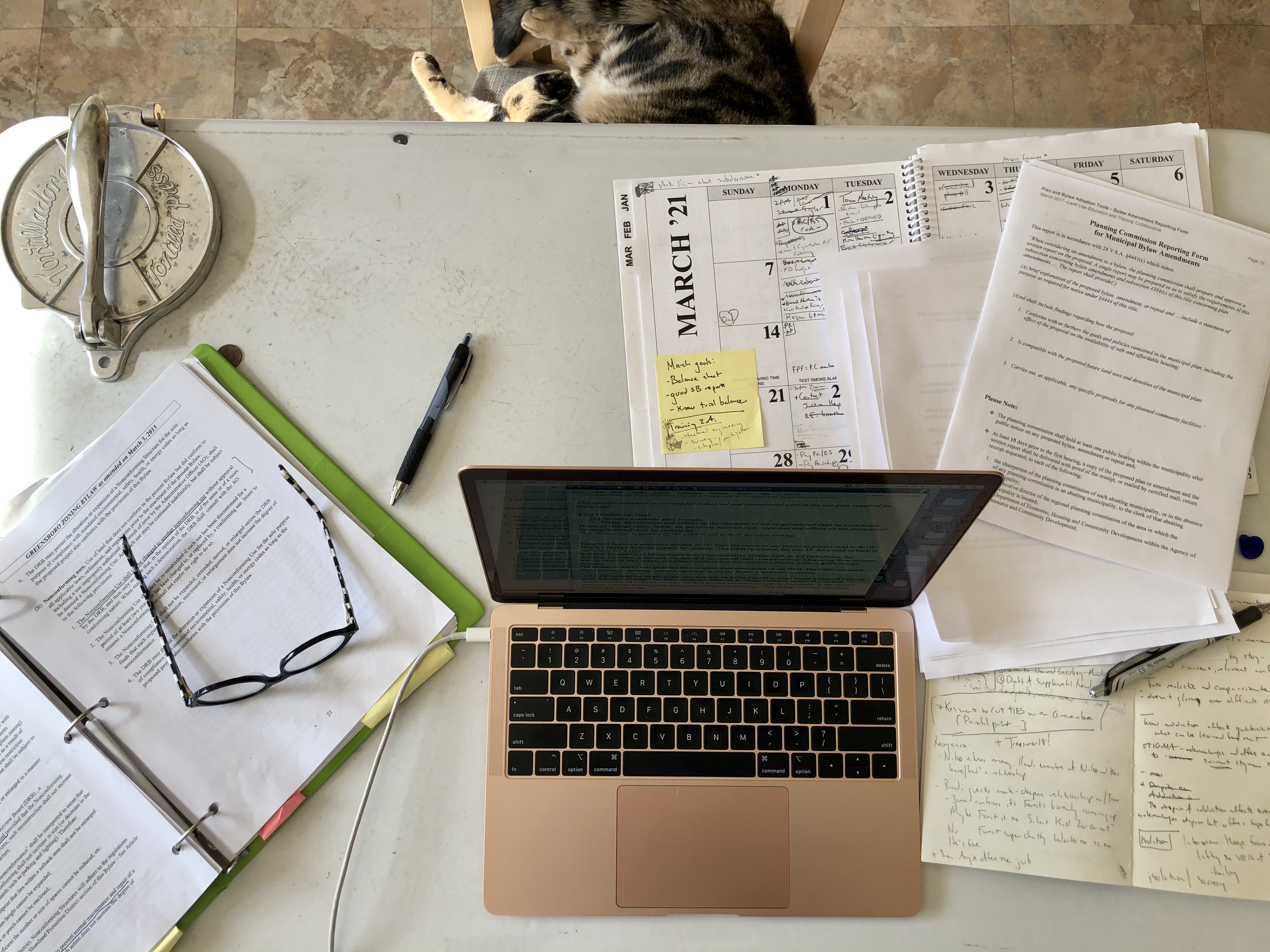
Kitchen office, complete with (working) cat and borrowed tortilla press.
Sunday afternoon finds me talking to the Vermont Department of Health contact tracer about my daughter’s positive Covid test. My results, he determines, haven’t rolled in yet.
I’m at the dining room table, chipping wax off a candlestick, doodling on a piece of paper. He asks where she’s been, and I answer honestly, school, home, and the woods.
Through the window, I see a cold rain falling. He tells me about the potential for what seems to me an incredibly long quarantine period for myself, if I don’t test positive. If I do, well, that’s a different kettle of fish so to speak, he says.
What you’re saying, I clarify, is that there’s no good options here.
He pauses.
I apologize immediately. The good thing has already happened. Covid has washed right over my daughter with the lightest touch. My other daughter is vaccinated.
I answer all his questions. Then I ask, Wait and watch?
It’s maddening, he says, but yes. That’s where you are.
The wind bends the pear tree in our front yard. We’ve endured plenty. Our house is warm, stocked with firewood and food. And so it goes.
I’m working at home on a Friday afternoon when an email pops into my inbox from the librarian in town. He writes my interlibrary loan book is in, and would I like to come get it?
Indeed, I would. I pick up the book, wrapped nicely in a white paper bag, with my first name, Brett, written in black marker. I stand there in the sunshine, holding this book like some kind of present.
Go read it, too. The book embraces the hammer and chalk line, the beauty of wood, the functionality and satisfaction of making things with your hands, all antidotes to this virtual world. Even more, the book embraces being a woman and a working woman.


 Stony Soil Vermont