This afternoon, I tore through my bookshelves searching for a paperback copy of Hermann Hesse’s Demian, a book I first read in high school. The book above — brand-new, Harley Rustad’s Lost in the Valley of Death — reminds me of Demian. Like so many other people, in some ways reading Hesse as a young woman shaped my life, every one of my years off the well-trod path. Demian has reappeared at certain keys points in my life, always rising with a strangely mysterious power. At the end of a very long winter, that book returns to me like a breath of spring air.
Fittingly, perhaps, I’m unable to find my copy. Maybe that hardly matters. For the first time in months, I take a long hatless walk, listening to the singing birds, remembering the unstoppable power of spring, and that the world wraps around us in ways we understand, and in ways we’ll never comprehend.
On this sunny Sunday in Vermont, here’s a few lines from the incomparable W. H. Auden on the nature of war. For more about this poem, the New York Times has an essay today.
About suffering they were never wrong,
The Old Masters: how well they understood
Its human position; how it takes place
While someone else is eating or opening a window or just
My teen and I are in an office filling out paperwork and the last question asks her how apprehensive she is about dental work.
She stares at me. “Why on earth,” she asks me in her reasonable way, “would I reveal anything like that?”
I note it’s a standard question. Her answer: that’s a ridiculous question.
It’s another cold afternoon — a mostly sunny day in Northern Vermont — in a winter where cold has now dragged on well beyond its welcome. We’ve driven a little distance and taken a detour along a river whose middle has thawed. Only its shores are frozen.
A couple of decades now into parenting, I’ve observed children are formed by their parents’ lives — and not, too. She’s driving, and I seem to have taken up residence permanently in her passenger seat — a place I inhabit uneasily and definitely gracelessly. We drive and talk. Youth, I think, repeating the word soundlessly, like a mantra; I’m drawn to its utter ebullience and brashness, like the sunlight we all desperately need.
We remark on the price of gas. Our sheer luck at the happenstance of living in the Shire of Vermont right now. Of the war in cities and villages and homes on the other side of the globe.
At our house, the icicles on our covered porch are exceptionally skinny and long this year. In the early morning, the ice begins falling in spires that break on the wooden porch. So many questions, and my answers are so poor. Keep asking.
In what could be called Yet Another Phase of Life, I meet my oldest daughter at her apartment, and we take the dog for a walk up a dirt road where I’ve never been. It’s rural Vermont, and the road bends away from the river valley and winds steeply up a hillside. It’s sunny and cold, and there’s absolutely zero traffic on the road. The weather had turned warm a few days ago, rutted up in a foretaste of mud season, and now is frozen in deep ruts.
The trees end at a stone wall and a sprawl of farm fields, with an incredible four-story 19th century barn. Whoever lives here appears to be hosting a kids’ sledding party. The homeowner appears on the road, with his black dog, who coincidentally shares the same name as my daughter’s dog. We speak pleasantly for a few moments, and it’s clear not many strangers wander up this road.
My daughter snaps a photo of a dripping icicle from one of the little outbuildings.
The kids’ party slowly heads back to SUVs and station wagons, the kids red-checked, in snowsuits, carrying small white paper bags. The adults wave and smile at us.
A little later, I drive home through that river valley I’ve driven countless times now, alone or with kids or sometimes with friends. The road switchbacks through the shadowy Woodbury gulf, and shortly after that, I’m home again, feeding the wood stove and cats, then on the couch with my laptop and work, listening to the litany of reporting from the Ukraine. I remember clearly when I was 23, too, living in Vermont, and it seemed utterly normal to have strangers ask, out of curiosity and nothing more, where do you live and what’s your story?
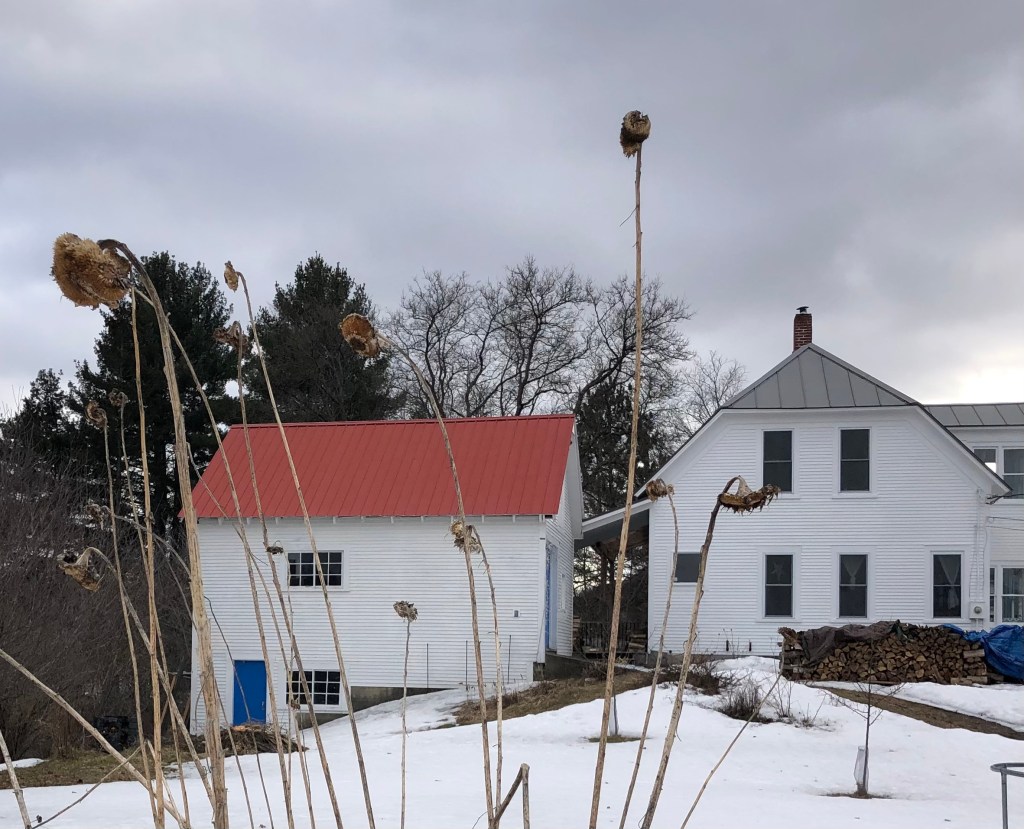
I sweep up the stove ashes and bring in more wood. The night promises more cold. How much I’d love to put my hands on sun-warmed soil and plant a garden of sunflowers.
On a rainy day last week, I parked on a Montpelier side street and walked into town to attend an opioid summit as a writer.
The last time I had been in the conference space in the Plaza Hotel was nearly precisely two years ago, when I attended a conference as a journalist, charged by my editor to “make connections,” and spent most of it drinking coffee and eating sugar cookies and talking with a para-educator at my daughter’s high school about his experiences. Like darn near everyone else in Vermont, he has a side gig for income, and runs a seasonal bakery.
I sat at a table with people I admire who I’ve met through writing. For those few hours, I had the nearly heady experience of meeting new people; I had remember that deep pleasure. Years ago, I traveled on a train from Charlottesville, VA, to Chicago, and sat beside a man from West Virginia. We talked off and on for those hours. It’s been so long since I had that experience of just listening and talking with people.
For a few hours, I listened to stories about addiction and struggle, about suffering and redemption, about profound loss and grief. Listening, my heart grew full. Our stories and words, the act of telling and listening, of sharing the hard and the beautiful things in our lives, bound us together. The summit began and ended with singing. I’ve never been one for group activities, for open sharing, but at that moment, I utterly understood; I got it. The melody of our language and experiences pulled us together, acknowledging both the beautiful and the terrible about human life, and made our world shine brighter.
…. Grateful to have a terrific piece about Unstitched run in the Brattleboro Reformer and the Manchester Journal by Gena Mangiaratti. And The Rumpus included my essay about the backstory of Unstitched in their Voices On Addiction column this month.
In my morning coffee and reading this morning, I read Tobin Anderson’s Guest Essay in The New York Times about the Black Plague, Covid, and working.
Working has been a steady source of conversation in our house for this past week for a complexity of reasons. As Anderson writes, human lives are caught up in the sweep of human history — at this particular time, a decidedly less fun moment in history. Nonetheless, our individual small lives matter. (See enchanting tiny landscape above, in the granite block.)
Given where we are right now, it’s worth paying attention to the chain of events that led, link by link, from pandemic to panic to bloody uprising.