Still on the Installment Plan.

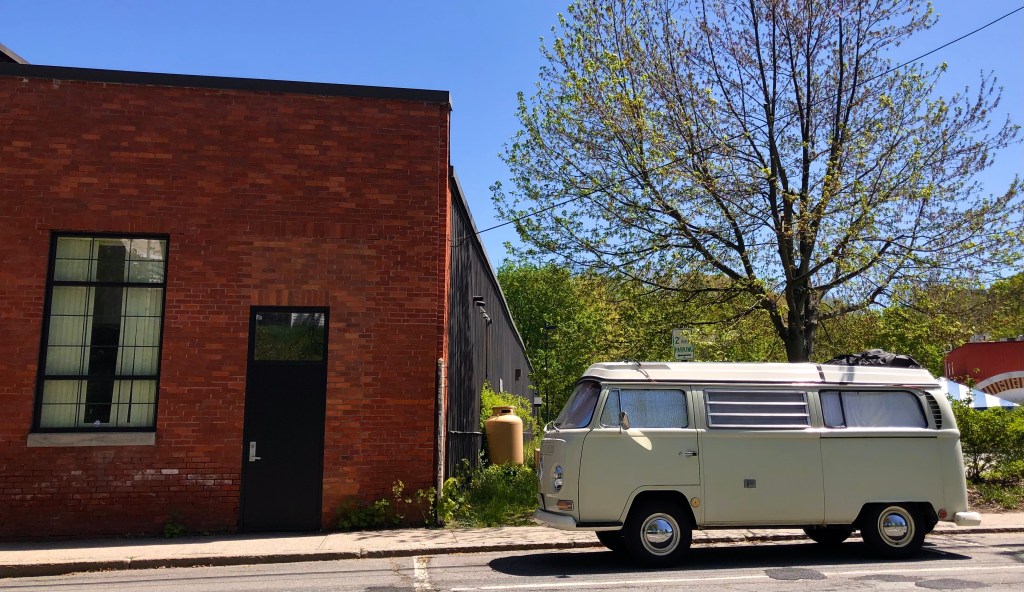
A woman I’ve never met starts speaking to me on a street corner in Brattleboro. I’d been staring across the street staring at windows on the second floor above the Shin La Restaurant where I lived when I was 20. On my 21st birthday, I walked down the street, drunk, to visit two friends. They lived in a house just a few blocks away. I was sleeping with one friend, in love with the other. The man I loved has long since died. His housemate has disappeared back into his moneyed world of investment banking and whatever that might mean. He was a decent guy, and I hope his life has gone well.

The woman says she sees a break in the traffic, and we should cross together. I tell her I’m a confirmed jaywalker. She tells me that she is, too, but not alone. “I like to cross with someone.” She’s about my height, which is in the Land of the Little People at around five feet.

On the other side, she heads one way and I go the other. It’s brilliant May, and hallejulah for this. Birds sing in the many trees. Lilacs and fruit trees bloom. For a moment, my body feels light — as if I leaped across a stream. Thirty years have passed since I lived in those rooms. Here I am again, in all this sunlight, remembering with what I joy I read Céline for the first time in that apartment. I was a philosophy, not a literature student; I was reading Heidegger and Kant and furiously writing. The apartment’s previous student was a lit student drop-out, and he had left shelves of books in the closet. Death on the Installment Plan? Good lord — no one has ever written a better book title. I read the book in a few long gasps.

“In the whole of your absurd past you discover so much that’s absurd, so much deceit and credulity, that it might be a good idea to stop being young this minute, to wait for youth to break away from you and pass you by, to watch it going away, receding in the distance, to see all its vanity, run your hand through the empty space it has left behind, take a last look at it, and then start moving, make sure your youth has really gone, and then calmly, all by yourself, cross to the other side of Time to see what people and things really look like.” 

― Louis-Ferdinand Céline

Where We Are.

Mackville Pond, Vermont

My daughter and I drive around in the evenings. It’s a teen/parent compromise I suppose — a walk in the town forest where I gush over blooming trout lilies and spring beauties and trilliums as if ephemerals have never done this amazing show before. My daughter is cool and tough, utterly on that rugged cusp of childhood and womanhood. It makes my heart ache. It makes my heart swell.

We drive around in what might appear to anyone else as aimless nothingness, checking out geese and listening to the peepers. In our driveway again, I slip off my sandals and lean back in the carseat. Goddamn, I could sleep in her car, that the slip of moon would rise over us, and then we’d just begin again in the morning. Maybe we’d drive to Nebraska. Maybe to her high school. Maybe we’d just keep sitting here, talking, or not.

Meanwhile — spring goes on. Leaves unfurl.

My wrists and eyes and heart are baggy with wrinkles. That is how old I am. Meanwhile, I keep thinking of a line about doubt by Søren Kierkegaard. As a young woman, I thought this doubt thing was for the weak and the foolish. I believed in striking out, holding firm, sucking up the consequences of my actions. Now, it’s a koan that keeps rattling around in my late night, my early morning, my stray driving thoughts: “Doubt is conquered by faith….” I think, take heart from from that. Then, when I look up the line, I realize I’d forgotten the second half: “… just as it is faith which has brought doubt into the world.”

I think, Go listen to the peepers again.

Daffodils: Verb?

I’ve been a patient at numerous Planned Parenthoods, in three different states, since I was a young woman. These days, I keep remembering a nurse practitioner I met in Bellingham’s Planned Parenthood. I had waited a long time. It was a very hot afternoon. Dust blew in through the open window. She apologized as she washed her hands and simply said it had been a busy day.

I was in my early twenties, had brought a book to read, and I didn’t care.

The staff at Planned Parenthood gave me information I needed when no one else did. This was information and advice that shaped my entire adult life. I was never turned away — even when I had nothing to offer as payment — never denigrated, never treated coldly. My oldest daughter is now the age I was that afternoon. In those young optimistic days, I believed inherently in progression. I didn’t see then that history repeats itself, turns back and bites the same wounds.

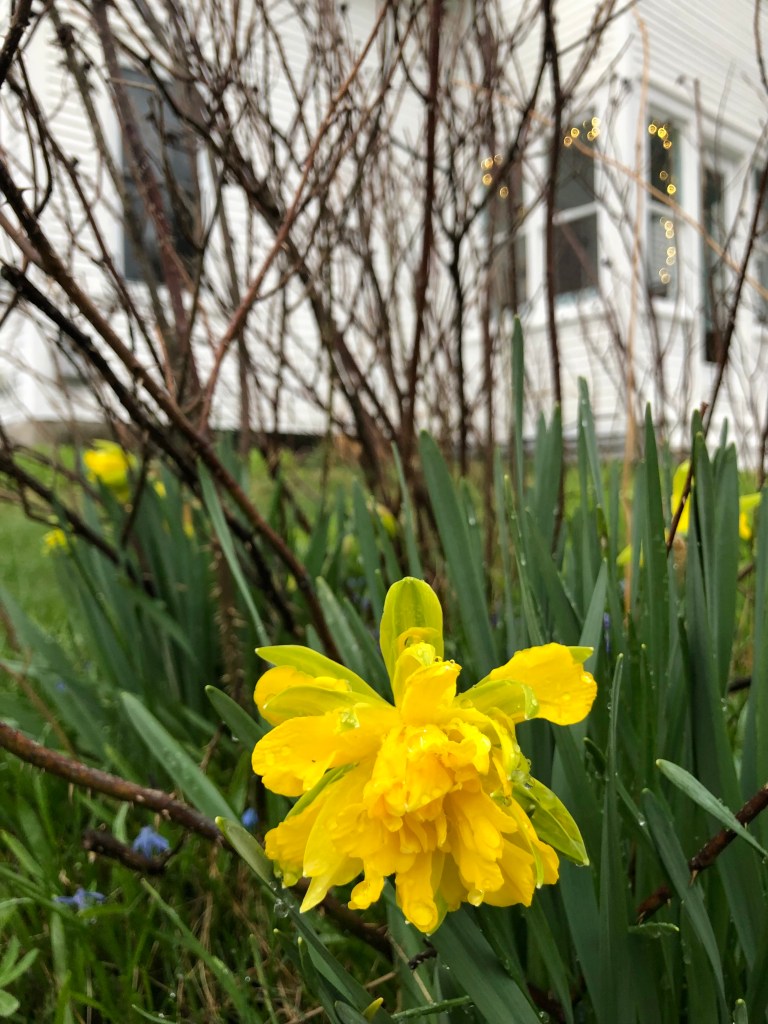
In this sunny, hopeful month of May — daffodils. Maybe I’ll think of this as a verb, not a noun: daffodilling.

Running.

Fisher Railroad Bridge, Wolcott, VT

Twice in one Friday, I’ve met acquaintances from long ago — the first at the coffee shop, the second at the transfer station. Now, having lived here for thirty years, I run into people who I’ve known in the past — maybe not well — but I know deep parts of their stories. I wonder what parts of my life they remember — and if I remember my story as they do.

On the way back from the transfer station, I stop along Route 15 and admire the Fisher bridge, the last of the covered railroad bridges in Vermont. Such effort went into building this infrastructure, and it was used for such a comparatively short time.

Because I’m wearing my running shoes, I follow the graveled rail bed. I cross the highway and follow the former track bed behind the lumber yard that smells sweetly of sap and freshly milled boards. There’s no one around on the rail bed at all. I run on the path right beside the river. The river is wide and slow moving, relatively tame for April. We’ve had little rain and less snow. I chance upon a pair of nesting ducks, and the mallard leads me away. I imagine in the heat of July how lovely it might be to swim across this water.

I stop to catch my breath. It’s me and the glossy mallard and the breezy cold afternoon. I wonder if we’re pulling out of the pandemic, truly. The brisk late afternoon takes my wondering and tosses it downstream. Eventually, I turn around and head back to wherever it is I need to be.

“It’s lovely to live on a raft. We had the sky up there, all speckled with stars, and we used to lay on our backs and look up at them, and discuss about whether they was made or only just happened.” 

~ Mark Twain

Mudding Nests.

Heavy snow falls this morning. My little cat sits at the back door, staring up at flakes swirling down through the porch light. The snow is dense and sopping wet and won’t last long. It will drive out the green that is already bursting through the tips of branches. Nonetheless, the damp eats into us. I’ve foolishly let the wood stove go dead. When I kindle a fire, the cats return, satisfied again.

Around us, there’s a raging dissatisfaction. The pandemic continues to unwind, and war rages overseas in the most sickening ways. My teenager asks with adolescent scorn what’s up with the human race, anyway, as if I’ve had a major role in shaping eons of stark unfairness. I toss the conversation back to her: you’re a piece of this human pie, too.

I long for heat and beach sand.

In the meantime, the great world spins on. The snow will melt by midday. We keep on.

Nature teaches nothing is lost.

It’s transmuted.

~ Laura Grace Weldon

Not Rabbits, Hares.

Robin songs come through my open window this morning. Although I’m still keeping the wood stove at least tepidly warm, we leave the bedroom windows open all night. In this corner of Vermont, we’ve had Easters of snow, others of hot sun.

After dinner last night, we started talking about what this holiday is about anyway. My teenager pulled her sweatshirt hood over her head and scooted down on the couch. Unintentionally, she looked like a little kid again, listening to the chat around her and diving in at times.

I remembered the Easter she was four or so, and her friend from down the road came to play. The girls ran around under the giant spruce tree in our scrappy yard. When I stepped out of the kitchen to sit on the porch and talk to the girls, the little children were running around with two large snowshoe hares that were molting to brown. The girls asked me what was wrong with their fur; it was so patchy and strange. They were worried the hares were injured.

Our house was surrounded by thousands of acres of wilderness, but we had never seen hares, only their tracks all through the woods. The hares stayed for a visit that morning, running between the girls. Delighted, the girls kept calling, “rabbits! rabbits!” I moved on, distracted by whatever chore I was sure I needed to do. When I returned, the hares had disappeared. We never saw them again.

This morning, my alarm buzzed before dawn, and I lay there, wondering if I really needed to keep on with what I’m doing. Indeed, apparently, I do, although I often feel like a molting hare. The robins sang sweetly, actually for dear life. I got up to feed the cats and make coffee.

It’s been a very long two years. Savor whatever birdsongs or sweetness or coffee comes your way.