Wet Gloves, Grievances, Blessings.

It’s been awhile since I did a carpool or handoff along the road — once a mainstay of my life. Seems like I spent hours of motherhood waiting at some designated place. I leave early to have this little pocket of time, a few minutes, no more, to watch the sky darken. I bring a book, too, more out of habit than anything else.

Vermont highways are lonely and busy, with stretches of time where you can walk down the center line, and then times when you risk your life (actually) to walk those yellow strips. The girls are laughing when they arrive. I hand over my daughter’s gloves, warm from my car heater as I tried to dry out the wet remains of yesterday’s skiing. I stand talking, shivering in my sweater. I’m sweaty from skiing, and I’ve forgotten my coat. The girls are busy, busy, happy in a plan of their own, my daughter’s hair still in the braids I wove for her this morning.

The girls drive away. I head back to my car, sliding in my plastic-soled ski boots, and someone I’ve known for years pulls over and asks if I need help. Good lord, I laugh. Because our kids played together as toddlers, I feel I can start right in and so I do. I begin with the bathroom sink drain that I need to take apart, and how does anyone endure the college app process, and am I ever going to remember to clean the inside of my windshield, save for when the sun hits it and blinds me?

I’m really laughing by then, and she is, too. I lean against my car — again, shivering, shivering — while we exchange the usual kid and life updates of people who know each other but sometimes go years without talking. The cold air comes down in this sweet-spot crepuscular moment as the night slowly floods in. She leaves, and I stand for a moment, looking up for the first stars. Such little cares I’ve listed, the stuff of living, blessings more than grievances.

And then I’m on my way, too, leaving the river and road, at least for now.

Laughter. Moonbeams.

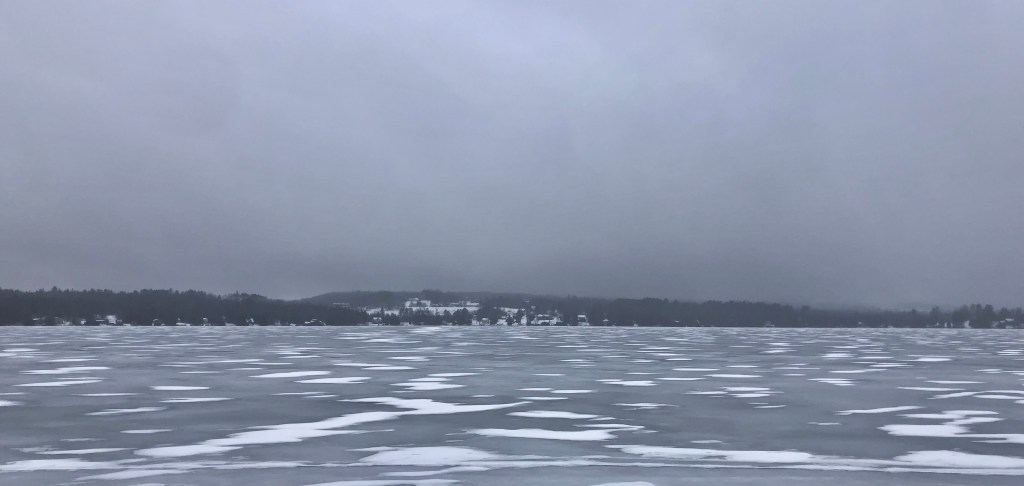
Ice Fishing, Caspian Lake

A profound cold stills our world for a few days, narrows our lives. All night on Friday, the wind screams and howls. By Saturday afternoon, the wind drops. I ski out to the river. The air is broken glass, so sharp breathing hurts.

To celebrate my oldest daughter’s birthday, we eat at a little restaurant/bar in Plainfield where I haven’t been in fifteen years. We’re at a back table so cold that the other three keep on their jackets and I note the usefulness of my handknit sweater. This observation impresses no one except myself. My daughter orders a drink with a lemon peel. The food is scrumptious, rich with garlic.

In their zipped-up jackets, side by side, my daughters talk and laugh with their ongoing story that includes frozen pipes, getting lost, a red prom dress, what happens when a car is started at 27 below zero, and the IRS. Outside, a round moon is ringed with yellow luminescence, so brilliant the sky around the moon is blue, surrounded by night’s black. Our boots crunch over ice as we list the moon’s might: tides and weather, childbirth and madness, the beauty of moonbeams.

In writing you work toward a result you won’t see for years, and can’t be sure you’ll ever see. It takes stamina and self-mastery and faith. It demands those things of you, then gives them back with a little extra, a surprise to keep you coming. It toughens you and clears your head. 

— Tobias Wolff

Today…

All week, people have been dropping in at work, with ideas and needs and so much school board talk. A stranger dropped in yesterday and mentioned she expected to become a grandmother that day, possibly the next. Candlemas, the ancient festival, forty days after Christmas and its official end. February 3 marks my own holy day, the day my oldest joined us in the world and I crossed over into motherhood.

In labor, I walked outside in Birkenstocks and stared at the melting snow that was running in sunny trickles. Just days after she was born, a fierce cold sunk in to stay. The neighbors brought a blueberry pie. As a toddler, I called this child a wildcat. Now, all grown up, she’s still a cat, with a cat’s complexities — half-feral and blissfully domestic, fierce-clawed and loving.

With worry edging her voice, the stranger told me she expected her family’s birth to be healthy. These usually go well, she noted. I agreed, and we walked out together. The wind carried dry snow over the parking lot. She disappeared in her car, but I stood for a moment longer, remembering my daughter was born shortly before midnight. My long labor ended with a surgeon who held my vernix-smeared baby in his gloved hands so I could see her. Her eyes were wide open, and she looked directly at me.

listen,
you a wonder.
you a city
of a woman.
you got a geography
of your own.

— Lucille Clifton

Light Turning.

Walking into town, I pass a house that has been abandoned for the five years I’ve lived here. Last winter, a vehicle skidded off the road and smashed through the front window. Since then, plywood has covered the front.

There’s a few houses like this in that neighborhood, the paint gray, the windows filthy, tiny yards gone over to weeds or dirt. In the pandemic’s craze, people moved back into a few of these, converting abandoned places into homes again. The driver of a fuel truck stood outside this house yesterday with a young couple, the three of them talking seriously, nodding heads. Sheets of foam insulation leaned against the house. On the side wall, someone had ripped off the dirty plastic and exposed a large square window, its top edge red and blue stained glass. Without stopping, I wondered what else was inside the house.

End of January — and suddenly the sunlight returned in full force. Today may be cloudy, tomorrow, too, maybe for days to come, but the earth is tilting. Slow as spring is, we’re leaning that way.

Don’t say my hut has nothing to offer:

come and I will share with you

the cool breeze that fills my window.

— Ryōkan (trans. John Stevens)

A Little Poetry.

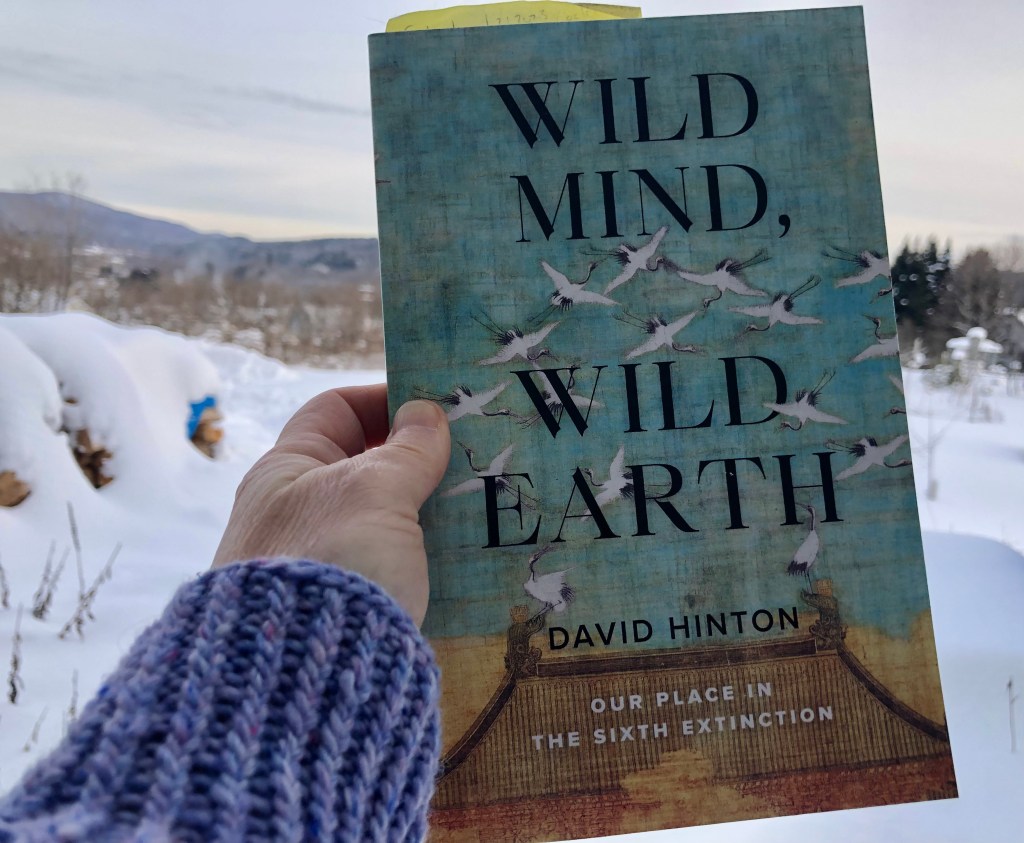
Wild Mind, Wild Earth — David Hinton’s book is exquisitely beautiful and certainly not a feel-good book. It’s a book where poetry is motion. On this cold January day, snow begins falling midday, little bits, then steady showers as dusk filters in. I stand outside the library, my head tipped back. An acquaintance, on his way in, pauses. “Remember this?” he asks. “It’s winter.”

Robes of snow, crests of snow, and beaks of azure-jade,
they fish in shadowy streams. Then starting up into

flight, they leave emerald mountains for lit distances.
Pear blossoms, a tree-full, tumble in the evening wind.

Tu Mu, “Egrets,” translated by David Hinton

Midwinter.

On a Wednesday washed out of color, this mid-January has the taste of February, wet, the wind wicking up wildly then dropping down again to the sodden snow. January is the season of work, of leaning in hard to a task at hand, for pleasure, for wage, for cleanliness, for the way work sweeps us out, makes something new. In its own way, winter’s short, pinwheeling along to spring, to the radiance of summer.

Here’s a perfect poem for today.

To go in the dark with a light is to know the light.

To know the dark, go dark. Go without sight,

and find that the dark, too, blooms and sings,

and is traveled by dark feet and dark wings.

— Wendell Berry