Travels through Time. Along the River.

Write a novel and, at some point, you’ll start henscratching or typing notes about when the protagonist moves from reaction to action. Why not think of your life as a novel you’re writing?

I drove down the long center of my Green Mountain State yesterday to return to Brattleboro, where I lived for years as a college student (so long ago). I bought my first car for $500 in Brattleboro.

For the drive, I had one rule: stay off the interstate. I began through the chain of towns I know, Montpelier and down through Northfield and Brookfield, along the Dog River. I headed up through a pass where the snow returned in clots along the road, and where trailers were surrounded by old cars and pickups, the kind of stuff that someday might be used. The forest flattened and gave way to fields where barns were built nearly in the fields. I drove through upscale Woodstock and the burned-out industrial buildings of Springfield.

Southern Vermont was like a magical dream — sunlight streamed over blooming daffodils, forsythia spread bright yellow, emerald green paired with black earth.

I met an old college friend who works at Everyone’s Books on Elliot Street. Thirty years ago, I lived right near that bookstore, and I spent a lot of time there. We exchanged thumbnail stories about our lives and kids and work and exhusbands and books of course. My book was in the front window of the bookstore, and she told me it “had been selling like hotcakes” — utterly gratifying.

In a park, I pulled out my laptop and wrote up a few notes. As I headed back to my Subaru, my friend Sean Prentiss walked towards me. He lives just a handful of minutes from me and was meeting his lovely family for a few days in Brattleboro.

I went to Brattleboro to meet friends from my past, and I met a friend from my present. Put that in as an interesting plot point.

On the way home, I listened to This American Life about babies switched at birth. I’m an TAL devotee, and this episode is especially fascinating.
Breaking Ice.

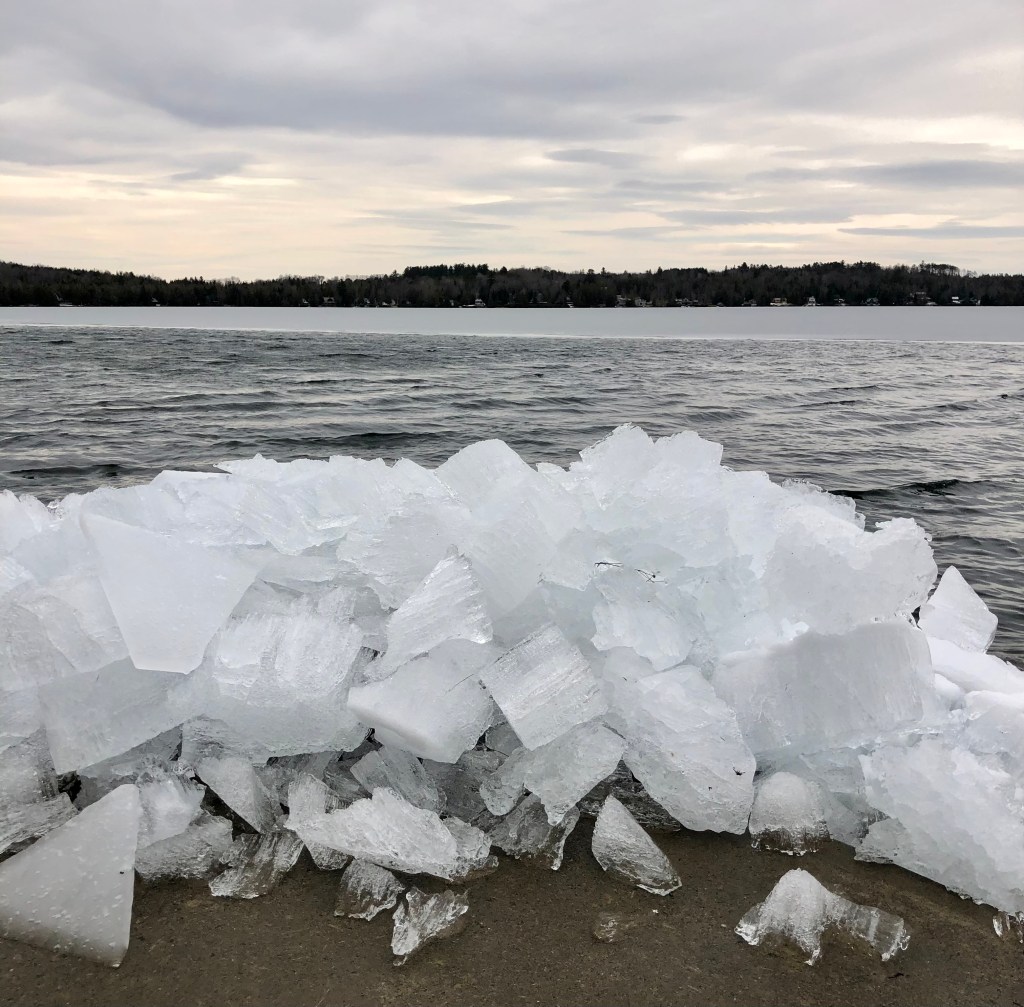
On a midday walk around the lake, I hear bits of breaking-up ice crash against a cement pier. Vermont spring — ice and green shoots, rain and rouge snow and sometimes sun.

This time of year — school break and tail-end-of-winter doldrums — many folks have flown to warmer and sunnier climates, seeking the old stand-by of the geographical cure. Around the lakes where summer folks own the large houses, hardly anyone is there, save for carpenters and roofers and painters, their pickup trucks clustered in driveways.

But the lake keeps on with its own steady world, the fierce ice gradually giving up its ghost. By the time these summer folks return, the water will have warmed again. For now, though, ice clinks as it breaks apart.

I tie my long hair back with a rubber band I found in my coat pocket. The breeze carries the damp scent of the earth, the dream of unfurling leaves, the memory of children crouched among the cedar tree roots, playing.

“The sun was warm but the wind was chill. You know how it is with an April day.”

~ Robert Frost

Mudding Nests.

Heavy snow falls this morning. My little cat sits at the back door, staring up at flakes swirling down through the porch light. The snow is dense and sopping wet and won’t last long. It will drive out the green that is already bursting through the tips of branches. Nonetheless, the damp eats into us. I’ve foolishly let the wood stove go dead. When I kindle a fire, the cats return, satisfied again.

Around us, there’s a raging dissatisfaction. The pandemic continues to unwind, and war rages overseas in the most sickening ways. My teenager asks with adolescent scorn what’s up with the human race, anyway, as if I’ve had a major role in shaping eons of stark unfairness. I toss the conversation back to her: you’re a piece of this human pie, too.

I long for heat and beach sand.

In the meantime, the great world spins on. The snow will melt by midday. We keep on.

Nature teaches nothing is lost.

It’s transmuted.

~ Laura Grace Weldon

Not Rabbits, Hares.

Robin songs come through my open window this morning. Although I’m still keeping the wood stove at least tepidly warm, we leave the bedroom windows open all night. In this corner of Vermont, we’ve had Easters of snow, others of hot sun.

After dinner last night, we started talking about what this holiday is about anyway. My teenager pulled her sweatshirt hood over her head and scooted down on the couch. Unintentionally, she looked like a little kid again, listening to the chat around her and diving in at times.

I remembered the Easter she was four or so, and her friend from down the road came to play. The girls ran around under the giant spruce tree in our scrappy yard. When I stepped out of the kitchen to sit on the porch and talk to the girls, the little children were running around with two large snowshoe hares that were molting to brown. The girls asked me what was wrong with their fur; it was so patchy and strange. They were worried the hares were injured.

Our house was surrounded by thousands of acres of wilderness, but we had never seen hares, only their tracks all through the woods. The hares stayed for a visit that morning, running between the girls. Delighted, the girls kept calling, “rabbits! rabbits!” I moved on, distracted by whatever chore I was sure I needed to do. When I returned, the hares had disappeared. We never saw them again.

This morning, my alarm buzzed before dawn, and I lay there, wondering if I really needed to keep on with what I’m doing. Indeed, apparently, I do, although I often feel like a molting hare. The robins sang sweetly, actually for dear life. I got up to feed the cats and make coffee.

It’s been a very long two years. Savor whatever birdsongs or sweetness or coffee comes your way.

Wildflowers. String.

Five Aprils ago, I was looking for a house for my daughters and me. In a nearby town, on a weekday afternoon, I climbed over a chainlink fence separating an empty house from a town cemetery. The fence spikes ripped the back of my leggings. I was on my way to the library where I was working, and I wore those torn leggings for the remainder of the day. I still have those leggings. I wear them when I paint, and they’re now stained with patches of lemon yellow.

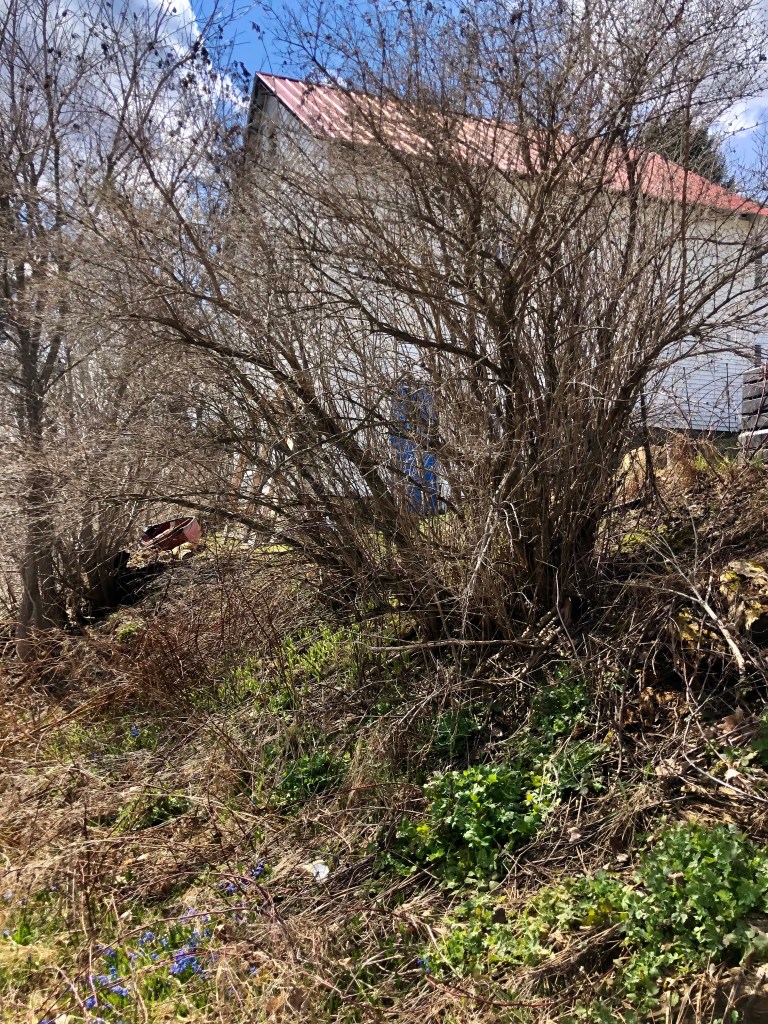
When I walked behind the house, I discovered tiny blue quill — spring flowers I didn’t know. The house was surrounded by those flowers and the promise of profuse lilacs in June.

I bought the house in 2017, although it wasn’t until the pandemic nailed down that the house began to feel truly ours. We are not a rowdy family of nine. We are a family of three and now two housecats.

The thing about spring is — turn around and it’s there, quietly, blooming in some unexpected way.

Look at the silver lining, they say.

But what if, instead,

I pluck it off

and use that tensile strand to bind

myself to those things I do not 

want to lose sight of.

“Notions” by Paula Gordon Lepp

First Things.

My daughter asks me if I’ve ever almost died — or at least thought I was dying.

She’s lacing her shoes, about to head out for a run. The day has been remarkably warm and beautiful, reaching above fifty degrees.

Three times, I answer: almost drowned when I was a teenager on a canoe trip, your father averted us from a pile up in Seattle, and the anesthesia went awry at your birth.

Later, I walk up to the high school and wait for her. I sit at a picnic table behind the school. It’s the first of all kinds of things again — the first time sitting at a picnic table outside since winter, the first time this spring I’ve seen grass that appears really green. An acquaintance stops to talk, and we swap stories about the school and board, new hires. Her grown son appears, and I can’t help but remember when he was just a little kid, and now he’s all grown up.

When they’re gone, I walk around this building that has meant so many very different things to so many people. Such a long and complicated story, a microcosm of this great big world. At this moment, she and I are both a piece of this story.

My daughter returns. On our drive home, I ask why she wondered about my near-death experiences. She shrugs. Just thought I should know, she answers.

I have the odd feeling she’s gathering intel about me.