On this balmy October morning, the cats and I woke up early to read Katherine Dykstra’s What Happened to Paula. In book’s midpoint, the word “possibility” appears, the same word that appears in my book Unstitched.
As the mother of two daughters, there’s so much conversation in our house about women’s bodies in this world — what keeps us well, what feeds our souls, and, inevitably, how women and men have a different experience in this world. Dykstra’s book is a narrative about a long-unsolved murder of a young woman, but also the story of women’s bodies and souls in our nation. Dykstra writes: “There is rarely physical equality between men and women.”
I’ve been on a reading binge on the Anthony Swofford/Christa Parravani husband and wife author duo, jumping around their memoirs. I picked up Parravani’s most recent book, Loved and Wanted, and then interlibrary-loaned others. Swofford wrote Jarhead — the marine memoir that just about everyone was reading a number of years ago, and I never did.
Yesterday morning, my oldest daughter got up at three to make her flights to visit my parents in New Mexico. In those murky depths of the night, I got up at three, too. When she left, a cat and I lay on the couch, reading Hotels, Hospitals and Jails. Ending with a father and son RV journey, the book’s ending did that miraculous thing, spinning not just that book but how I look at literature in a wider, more powerful light.
Hotels ends with the beginning of the couple’s marriage. Parravani’s Loved and Wanted takes place years into marriage and baby-raising. That, perhaps, is about all I’ll say about that.
My papers and notebooks were scattered around the couch from the virtual select board meeting I attended the night before. Nearly four hours long, the Selectboard discussed darn near everything in town, from federal Covid money to the sheriff’s update regarding a shooting to whether the board should consider moving a road. While democracy may be struggling in much of the country, in rural Vermont, messy democracy still rules.
I pause my afternoon run when a couple waves me down in a little memorial park in Hardwick. I’m guessing they’re looking for directions, maybe a suggestion where to eat an early dinner or the road to another town. Instead, they’re curious as heck about Hardwick.
What drove the economy in the 1800s and 1900s? When was the beautiful granite town office building constructed? Do I know the population?
Weirdly, I know the answers to all these questions, and ask a few of my own. Where are they from? Where are they headed?
They’re from the northern shore of Lake Champlain — St. Albans — a town where I once bought a sizable (and expensive, oh, was it expensive) piece of maple sugaring equipment.
We stand beneath a gold-leafed maple, talking about this and that, and I share my speculations about what living in Hardwick might have been like in the early 1900s. It’s all speculation, as my daughters would readily point out.
At the end, just before we part, they ask if I know someone who lives in town. He’s a high school teacher, and I met his family over twenty years ago. In fact, I live beside his mother-in-law.
We laugh. How little separates us. Then they get in their car, and I head off on my run.
Sunday afternoon, the board of the local food co-op hosted a meeting, posing the question: buy a building a few blocks down and encumber the co-op with a million-dollar debt, or stay in the tiny, owned-outright space? Philosophically and financially, the debate was heated.
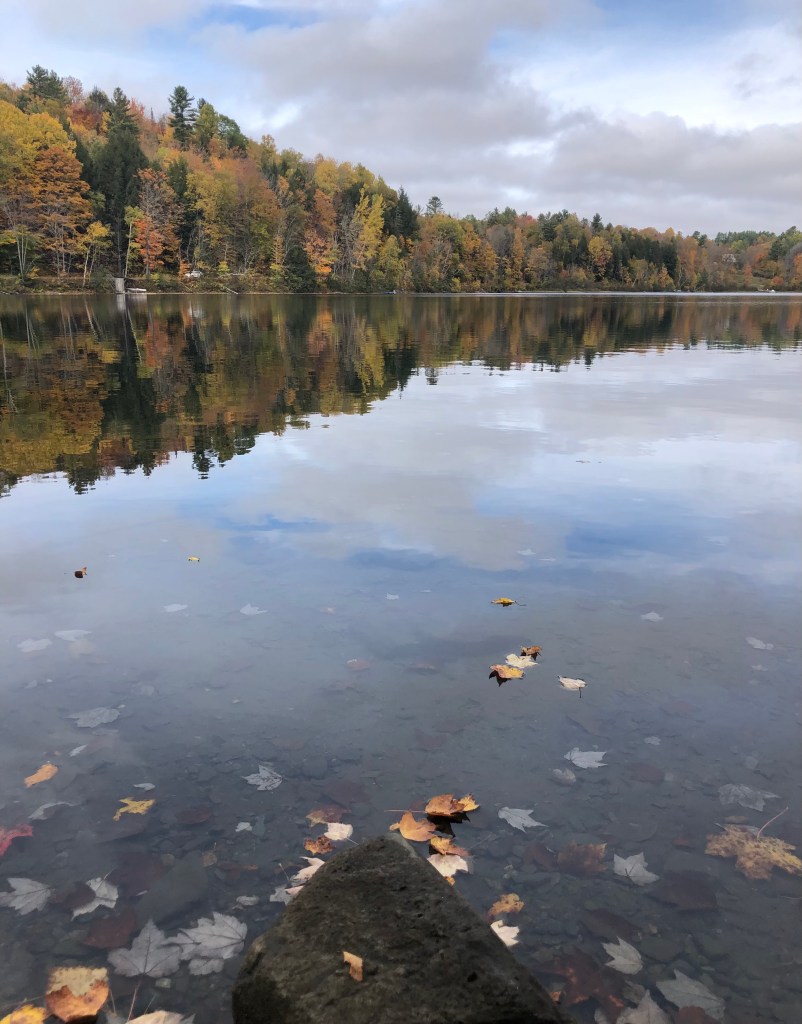
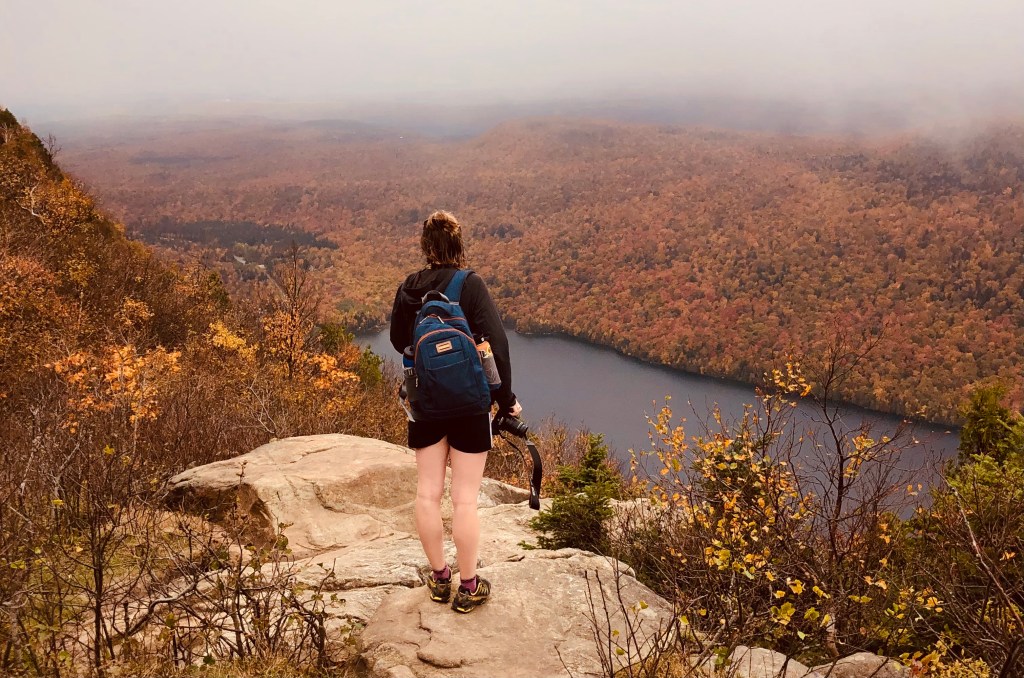
I leaned against the pavilion’s post, listening, drinking my tea. Around us, fallen leaves rustled across the grass. My cheeks burned with windburn from that morning’s hike with my daughters. We climbed to a cliff and looked down at a glacial lake, the surface choppy with white caps. On our way home, we stopped at the beach of this enchanting lake, mountains rising steeply on either side. A bald eagle dove into the wind, its head and tail whiter than snow.
Before the meeting ended, I packed up my knitting and headed home, still thinking about that eagle.
From one of my childhood favorite reads — and from a paperback still on my shelf…
The maple tree in front of the doorstep burned like a gigantic red torch. The oaks along the roadway glowed yellow and bronze. The fields stretched like a carpet of jewels, emerald and topaz and garnet. Everywhere she walked the color shouted and sang around her … In October any wonderful unexpected thing might be possible.”
I knock off work early on Friday afternoon and head west with a friend to our daughters’ soccer game. There’s only so many high school soccer games I’ll attend in my lifetime; I’ve missed plenty this year.
It’s October but feels weirdly like July, with 75 degree temps, sunlight on foliage that’s at peak color. As I drive towards Lake Champlain, the terrain flattens. At the game, where we meet another mother and sprawl on the grass, seagulls swoop low. Flocks of geese fly overhead, forming Vs. At the end, despite the loss, our girls are smiling, hugging us in their sweat-soaked jerseys.
As the sun slips below the horizon, I drive back along that same route, retracing our blue highway journey from flat farming land through the green mountains and along the winding Lamoille River. I keep on through the twilight. A crescent moon hangs to our right. We talk and talk, about the complexity of being teenage females in our world, and then beyond that, too, how the past steers our own lives, hammering through generations.
As I drive, my headlights cutting through the darkness, I keep thinking of Joseph Campbell, whose voluminous writings on myth shaped my thinking since I was a teenager. “Life is, in its very essence and character, a terrible mystery—this whole business of living by killing and eating. But it is a childish attitude to say no to life with all its pain, to say that this is something that should not have been.”
At my house, we stand for a moment beneath the starlight. In my house, our upstairs glass-in porch glows, where my older daughter is taking notes, her laptop streaming a class. My friend drives away, back to her house, but I stand there for a moment longer. I’ve long resisted what I’ve seen as the superficiality of Be Here Now, as though the past doesn’t matter. Suddenly I see I’ve looked at what time means all the wrong way. Be here now with the past — another koan.
I walk up the back steps and flick on the porch light for my youngest child.
….. A few last things. Here’s a New York Times piece on IG and teen girls. Rick Agran of Bon Mot, a show about poetry and the literary arts, on the local Goddard College radio, will broadcast my Galaxy Bookshop event this Sunday, October 10, at 5 p.m.
Last, the Children’s Literacy Foundation hosts a virtual Book Club for Grown-Ups I’ll host, next Friday, October 15, at 7 p.m. The Waterbury Roundabout has details. I have a particular soft spot for CLiF — an organization that gives free books to kids in rural New Hampshire and Vermont. How cool is that??
Late afternoon finds me running along the former railroad bed in a rare kind of October sunlight — a gift of warmth and honeyed autumn light. I stop where I always do, where the transformation from railroad bed to trail hasn’t happened yet. The rusting iron bridge is covered with boards, and I’m careful there.
Where a giant hole gapes with a view of the Lamoille River below, someone has spray painted You Die Here and an arrow pointing down, as if the passerby couldn’t put that hole and a potential demise together. I stand there and affirm, Sure, that would be a bad fall.
An otter runs along the riverbank, slips beneath the water, and surfaces again. Two ducks glide slowly. I crouch at that edge for a good long while, in no particular rush to head back on that trail.
In the end, of course, there’s nothing else to do but tighten my laces. My feet crunch through the fallen leaves that are piling high, releasing that inimitable scent of broken leaf and moist soil — the smell of a New England childhood.




 Stony Soil Vermont