Why the World Never Ends.

In a light rain and pitch dark, my daughters and I arrive at Montpelier’s Hubbard Park for the annual Enchanted Forest. Masked, spread out, bundled up, I have the strange sensation that the three of us are alone, and yet not alone.

The forest path winds along lit jack o’lanterns and burning torches, and among live musicians and giant puppets. Near the crest of the hill glowing paper lanterns decorate a giant oak tree.

The climax of the walk is a creation story re-enactment of a very old woman. Her black dog unravels her weaving as she tends to the changing seasons. As the rain falls more steadily, I realize the story is the tale of my life, as a writer and a mother — the story of the tension between order and disorder and the human longing for order to reign. Yet total order, total perfection, is impossible in this earthly realm.

We walk back through the mud puddles. Before heading home, my oldest pulls into a convenience store. Under a well-lit overhang, I stand outside, watching a man pump gas into an enormous SUV. He’s with a woman wearing a coat that falls to her ankles, a pretty garment with leaves and vines. I’m too far to hear what they’re saying, but I see his hand reach out and slip the top button closed on her coat and smooth the collar over her clavicle.

Through the plate glass window, my daughters stand at the store’s counter, buying hot chocolate. They’re wearing masks, so I can’t see their mouths, but from the way they look at each other, I know they’re laughing.

November looms tomorrow. Our New England darkness. Tighten your coat collar.

Hardwick, Vermont

Invisible Child.

Everyday, the light shrinks a little, contracts inward. My oldest daughter and I take a walk after dinner in the inky dark. A cat crosses the street and disappears into the night. This time, too, will pass. We who live here know this — have no other option, indeed, but to endure this — but the short days contract us, too.

In the night, I wake and read before the wood stove with the two blissful cats. Page by page, I work through Andrea Elliott’s Invisible Child, a brand-new copy from the library. Save for the clicking of our wood stove as it heats and cools, expands and contracts, our house is utterly quiet at night. Narcotized by the heat, the cats sleep too deeply for purring. I’m working the next day. A list in my poor handwriting awaits me in my notebook, the tasks I’ll diligently accomplish, one by one. Some are tedious — chores I’ll reluctantly do. But I cleave to that list, my daily rod — bread and butter and bacon for my household, and my soul, too. Around us, chaos and Covid. But for this time, cats, warmth, and words.

In self-defence, you know, all life eventually accommodates itself to its environment, and human life is no exception.” 

― Jacob Riis, How the Other Half Lives

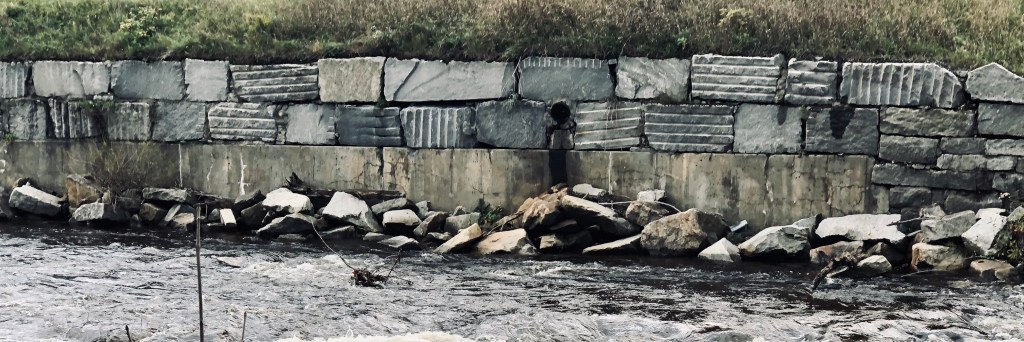
Lamoille River, Hardwick, Vermont

Kicking Up Leaves.

My daughter and I are standing on a street corner in Montpelier, Vermont, talking about some little thing — maybe the mighty silver maple on the library’s lawn and how those leaves are always the last to turn gold. How I remember this every year at the same annual mark, and then forget this for the rest of the year.

While we’re talking, I keep thinking of this lovely library, and how I took my daughters there as little girls. Later, I often worked all day in the upstairs reading rooms with views of the trees. Not so, anymore, in our pandemic world.

Across the street, a couple kicks fallen leaves at each other. I stop talking, thinking, Oh, no, what fresh hell is this? when the couple begins laughing. They’re each holding white paper cup, and he has a paper bag that might be full of sweet delicious things from a nearby bakery.

That moment — that tiny joyful moment — opens up our day. Sweet normalcy. Oh, yes. Bring that on.

One of my most favorite autumn poems:

on a withered branch
sits a crow
autumn nightfall

—Basho

We’re Geese.

Saturday afternoon, I’m walking with an acquaintance on the trails behind the high school, talking about public education. How is education changing? What’s happening?

Beneath a maple, we stop and talk for a little. I tell her about my youngest daughter, who’s 16 and at a place of reflection, asking, Who am I? Where is my life going? Writing made me realize how easily we drift into one life or another, drawn along by circumstances and the people surrounding us. How easily we fall into what seems like a good idea, a fad that might define us.

What seems like a hundred years ago when I was an undergraduate at Marlboro College, someone painted Know Thyself on the sidewalk beside the dining hall. Listening to my daughter as I go about doing my same old things — washing dishes or making dumplings or knitting a hat for a Christmas present — I realize I’m witnessing her small adolescent pack struggle with this same old question made completely brand-new for each of these young people. I’m riveted.

On the trail, a flock of geese flies so low I hear their wings flapping. On our way back to the school, I keep thinking about those geese.

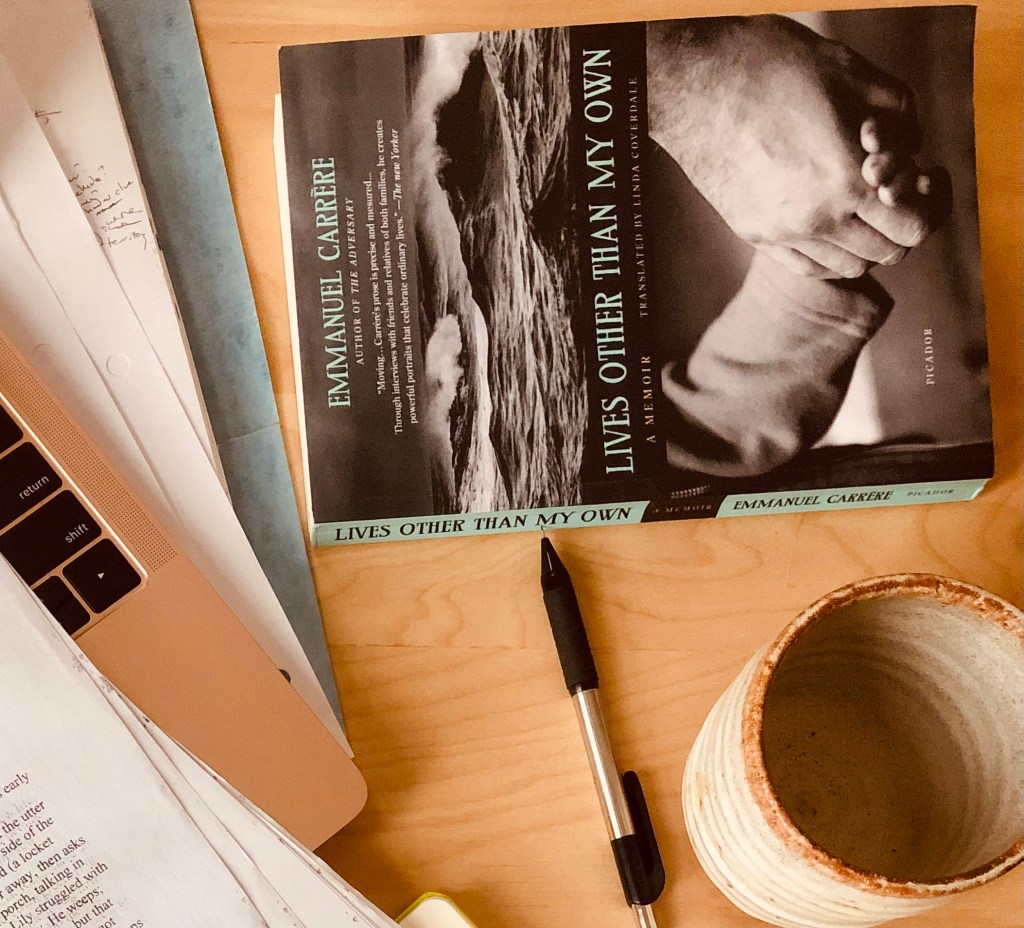
One can claim that growing up… means abandoning magical thinking for rational thinking, yet one can also maintain that nothing should be abandoned, that what is true on one floor of the mind may not be true on another, but that one must live on every floor of the mind, from the cellar to the attic.”

— Emmanuel Carrère, Lives Other Than My Own

Fall.

The moon is a perfect circle of cream.

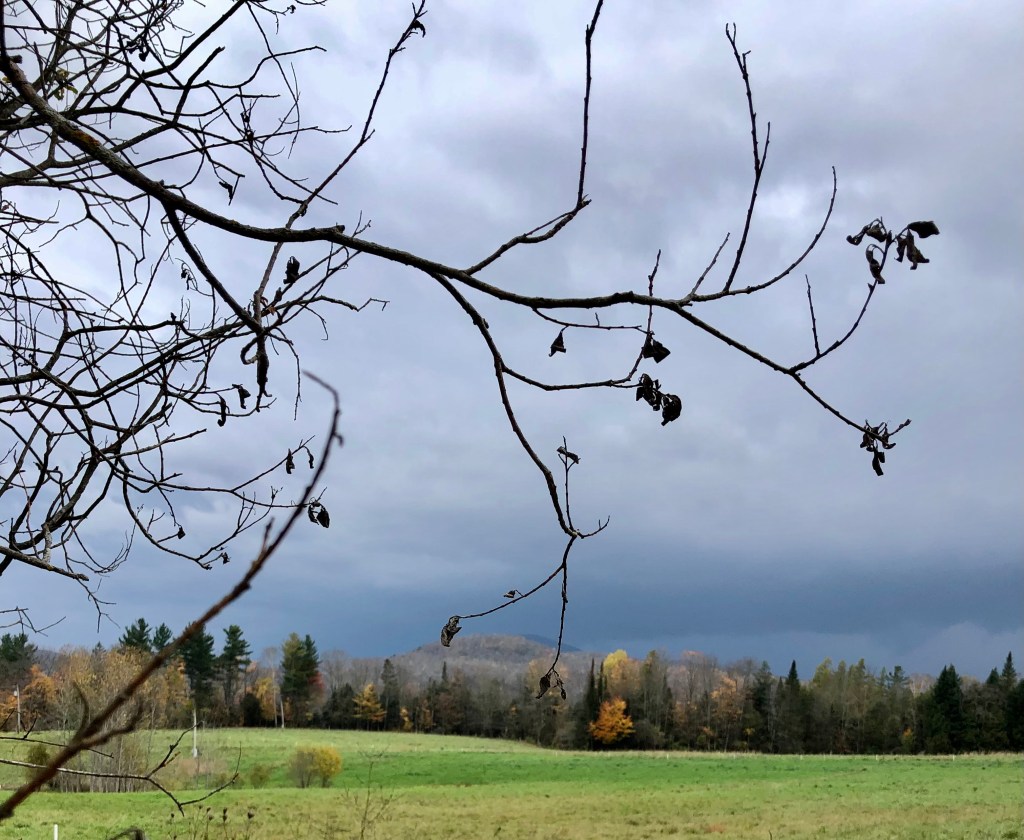
In the dark, we walk downtown and leave letters in the mailbox. Through the valley’s mist, house and streetlights glow. November looms. Poet Thomas Hood described November: “No dawn — no dusk — no proper time of day.”

The news around us is of two, unrelated homicides, neither far from our house, in our rural state with scant violent crime. In the dark, I bring in an armful of wood and pause for a moment. Across the valley, I see a pair of headlights crest a dark hillside and begin a descent, slow to my eyes through the mist.

Through the house windows, I see my daughters before the wood stove, our walls painted butter-yellow. The crickets are gone. Late fall pushes in. Every year, the darkness enfolds us again, inescapable and mysterious.

Over my shoulder there’s that moon.

Hardwick, Vermont

Driving Dream. Daughter.

In a dream, my daughter drives along an interstate and rounds a curve. A semi spreads across the road, its back-end across our lane. In a fraction of a moment, I predict we’ll hit the truck. Before I can speak, my daughter steers to the right, and I have a sickening foreboding that she’ll hit the truck and I, on the right, will emerge unscathed. I’m not afraid really; it’s grief that nails me.

She steers us around the truck, over the grass, back onto the road, and keeps driving. My heart hammers.

In the dark, I lay awake. There’s a lesson here, I counsel myself.

On this rainy October morning, here’s a few lines about parenting from Anne Lamott and an excerpt of my book in The Fix.

…one of the worst things about being a parent, for me, is the self-discovery, the being face to face with one’s secret insanity and brokenness and rage.” 

― Anne Lamott, Operating Instructions: A Journal of My Son’s First Year
Greensboro, Vermont