Disparate Pieces

The December my younger daughter was two, snow fell every day. To see out the kitchen windows, my 8-year-old and I stood on the chairs to peer over the mounds of snow that had slid off the roof.

This year, we’ve had a long dry span with little snow. My brother, a brewery owner in New Hampshire, calls and complains, Bad for business. For all those years we depended on maple sugaring for our livelihood, I worried about  temperature and precipitation, fretting over one forecast versus another, keen-eyed on a degree or two of temperature change.

In the dark, I lie awake, imagining snow accumulating on our roof, over our lilies and lupines, their dark roots buried silently. The cats nudge me, and in our quiet house, the daughters sleeping, I pour these purring creatures a bowl of milk. At the window, I see across the cemetery a single patch of glowing white light, as if someone left an enormous floodlight on all night. Otherwise, the town is mostly dark, with a few small porch lights here and there, the glowing amber lights of the high school on the hill muted through the falling snow.

That patch is different from the usual spread of lights I see. What’s up, I wonder? What is someone looking for in that falling snow?

(The Province Land Dunes in Provincetown, RI, resembles….) New Mexico, where recently a man who had once been and will probably be again the governor of Nambé Pueblo told me that he had found seashells in the dirt where he is irrigating, a thousand miles from the ocean.

Cynthia Zarin, An Enlarged Heart, 2013

IMG_1084.jpg


Four Maples

A friend from my high school years (which, my daughters remind me, were literally in the last century) sends me an email, and I email back from my car, in a gray parking lot beside even grayer Lake Champlain. I remember canoeing from Burton Island to the mainland on a bright, balmy morning last July, and then waiting on a high point on the mainland, watching the ferry traveling across the lake with my 12-year-old daughter and her friend. When the ferry docked, I ran down to meet them, the girls glowing and happy with their adventure.

This friend writes about taking his kids swimming, and I wonder, pond or lake, river or pool? It’s been so long since I’ve seen him I would pass him by on the street, and not recognize him.

Finished, I fold up my laptop. I nod goodbye to this polluted and yet gorgeously beautiful lake and head towards a building where I’ll be blind to the lake all day, but I think for just one more moment of that town where I grew up. Along the square of lawn that my sister and brother and I wore down through endless kickball games stood four giant sugar maples, so tall their lowest branches were high above our heads. I wonder if there’s any chance those maples are still there, haven for songbirds, their leaves lifting up and ruffling over in approaching summer storms.

Once there was a tree….
and she loved a little boy.
And everyday the boy would come
and he would gather her leaves
and make them into crowns
and play king of the forest…

— Shel Silverstein

IMG_1066.JPG

Where we are now

Winter’s Grass-Is-Greener

Driving down the Woodbury gulf in the twilight, staring at the road — snow-crusted, ice packed, with two curving black lines of asphalt worn through winter — I remember all those years of driving mountainous Route 9 in southern Vermont and wonder, What if I’d stayed in Brattleboro? What if my kids went to school there? I made soup with my publisher and used the Brooks Library with their enormous windows? What if I lived on Elliot Street again?

That’s January thinking.

My gaze lifts from the treacherous road to the gray and white mountains folding around that narrow valley, with the waterfalls and the rocky cliffs high overhead.

Trouble follows you anywhere. I know that. The last time I was in Brattleboro, itinerancy surprised me, the darker threads of our society thickening. I was glad I hadn’t stayed, that I had swapped a larger town for a smaller one. In the end maybe, it’s all Vermont roads, with those mysteriously beautiful mountains always greater than us, rising silently.

The winter wind flings pebbles
at the temple bell

— Buson

IMG_0912.jpg

Store Window Art, Hardwick, Vermont

21º Below Zero

January.

I’m naturally a sweater knitter — not a sock creator like my sister. Likewise, I’m inclined to the lengthiness of novels, but more and more I admire the uses of brevity. Such as…

January 2.

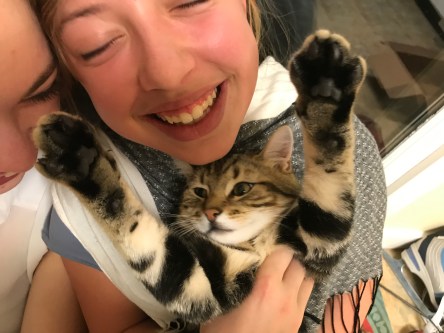
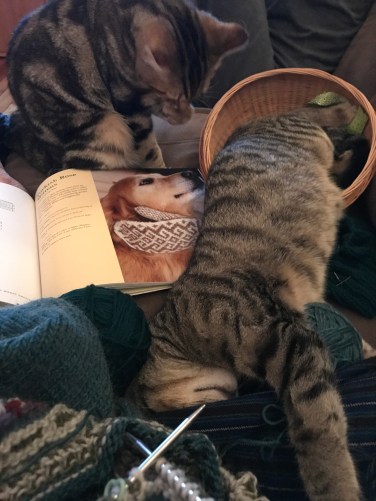
Kittens, yarn. Piles of work. Stacks of library books. Friends on the calendar. Winter, Vermont-wise, has barely commenced.

When the winter chrysanthemums go,
there’s nothing to write about
but radishes.

— Matsuo Bashō

IMG_0799.JPG

Levity

My daughters and I drove north over snowy roads to have dinner with friends who were staying for a few days at a house built by a ship captain in the 1800s. The house is on exquisitely beautiful Lake Willoughby, deep into what I consider “way out there” in Vermont — but that’s all in one’s perspective, isn’t it?

I would have walked around that three-story house for a day and a half, just looking at room upon room, like an enormous treasure or jewel box. Fortunately, my friends know me and were nonplussed when I rubbed my hands over the peacock tails in the downstairs wallpaper. My teenager sprawled before the fireplace and said, We’re not leaving.

An oak table spanned the length of a long room that must have originally been a veranda. At dinner, the kids filled their plates and sat in a row on one side. I walked around the table and sat with my back to the wall of windows. It’s December and darn cold, and the kids, being kids, had likely sized up the draft on that side and chosen the warmer one. Or maybe they just wanted to be closer to the berry pies…

My friend’s elderly father sat beside me, and, after precisely cutting his meat, said very pleasantly, A bit of air conditioning tonight, isn’t there?

Driving home in the dark, around Runaway Pond, through the Bend, past dairy farms hazily illuminated by the moon darting in and out of scudding clouds, I thought of all the stories that house must contain, how all our lives are clumsily packed sieves of so much jumbled living — radiant happiness, crushing misery, sometimes dullness, aching and unmet desire — and then the levity of that sweet sentence rose again into my thinking.

One terrible thing about divorce is losing the person who holds the other half of your shared secrets. That highway north was studded with memories from the very earliest days of my marriage. Driving north, I passed those places and said nothing, knowing the only way to continue is to create.

So when my daughters asked why I was laughing as I drove those final miles home, I told them I aspire to have that gentleman’s light grace when I’m a little old lady, with — God willing — many more miles traveled.

I have one of those very loud, stupid laughs. I mean if I ever sat behind myself in a movie or something, I’d probably lean over and tell myself to please shut up.

— Holden Caulfield

IMG_0727.JPG

Daughter at work, home, Hardwick, Vermont

Hardwick Postcard #5: Wear a Hat

Mexican hero Emiliano Zapata insisted, The land belongs to those who work it with their hands. With the snow here to stay, I’m already dreaming of star-shaped potato blossoms, the first tender snips of garlic shoots, rain-drenched rows of glossy greens.

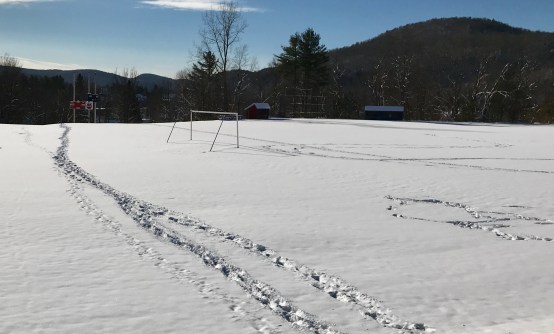
Meanwhile, my daughter – far more interested in eating than agriculture or politics – claims her territorial lines. At 12, she walks. A few years from now, like all the other rural Vermont kids, she’ll finagle a vehicle or rides from friends – opening up an entirely different landscape for her – but for now, she learns her path to middle school footfall by footfall, first over the cemetery fence. She turns to wave goodbye to me and hurries off to meet her friend.

To reach the school, she and her friend walk down the hill into the valley where Hardwick village lies along the Lamoille River, then up the hillside where the standard brick middle/high school sprawls. The entire walk – past the dead, the elementary school with its crossing guard, two auto parts stores, a busy diner, a few storefronts, a laundromat and a library – takes less than 20 minutes.

December’s lesson: wear a hat and mittens. The walk is cold.

At the risk of seeming ridiculous, let me say that the true revolutionary is guided by a great feeling of love. It is impossible to think of a genuine revolutionary lacking this quality.

– Ernesto Che Guevara


IMG_0576.jpg

Hazen Union, Hardwick, Vermont