Bog Trip

No school for 13-year-old, day off for 19-year-old, no snow yet, and November’s scant light: I fold up my laptop and, impromptu, declare we’ll visit Chickering Bog.

We follow a path through the woods, our boots brushing through fallen maple and ash and cherry leaves, then through a stand of tamarack where the dirt path is scattered with tiny gold needles. On the easy walk, the girls chattered, moving quickly against the damp, the three of them in their black down jackets and myself in turquoise. We’re not far from the world from houses and cars, yet the forest folds around us. I’ve been walking in various New England forests since I was a child, and although this particular path isn’t familiar, the woods are — filled with both that allure of what’s around that next bend or behind that glacial erratic? and, simply, the woods’ loveliness.

The path leads up to what’s more properly a fen. The boardwalk takes us near the middle where the girls find cranberry-red carnivorous pitcher plants. Beneath our boots lies the thousands-of-years-old mysteries of peat. And over our heads, all that sky.

A lake is a landscape’s most beautiful and expressive feature. It is Earth’s eye; looking into which the Beholder measures the depth of his own nature.

— Henry David Thoreau, Walden

IMG_3897.jpg

Calais, Vermont

When In Doubt, Do Handwork

My 19-year-old, pondering what to do with her life, buys fat skeins of yarn and begins knitting a blanket. The metaphor of comfort consoles me, too.

I just read David Grann’s The White Darkness, about Henry Worsley, descendant of Frank Worsley, of the Shackleton Endurance expedition. It’s hard to imagine a more manly man than Henry Worsley, who ultimately perished from complications of his solo South Pole trek. Yet Worsley sewed to calm his nerves. He was skilled at needlepoint. He volunteered to teach tatting — yes, tatting — to London prison inmates. How cool is that?

Shackleton… sought recruits with the qualities that he deemed essential for polar exploration: “First, optimism; second, patience; third, physical endurance; fourth, idealism; fifth and last, courage.”

State 14 ran the first of my monthly Postcards From Hardwick. Check out terrific Vermont voices here.

IMG_3837

#10 Pond

Why Love Cats

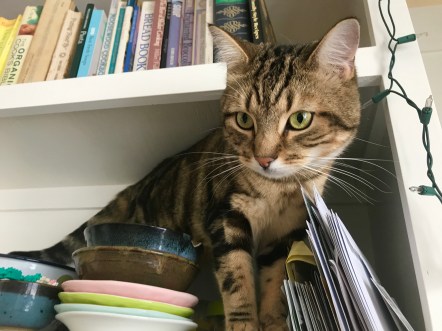
My daughters’ cat and I are listening to Chris Hedges lecture about the collapse of the American Empire — extremely serious and unfunny — when the cat falls off the hutch and splashes into my pan of lemon-yellow paint.

The cat probably yowled; I certainly shouted. The creature scrambled through the dining room to living room, through my study, into the kitchen, where my daughter grabbed the paint-soaked cat. While she cleaned paint from the cat in the basement, I washed wet paint from our floors on my hands and knees.

We’ve lived in this house not much more than a year. While I love the maple floors, I generally don’t spend much time mopping.

While Hedges kept talking, I realized some of the narrow boards were birdseye maple. Through the closed basement door, I heard my daughter murmuring, comforting her beloved cat.

Whoever laid the floors in this house passed from this life decades ago. I thought of these slender, hard boards in a carpenter’s hand, his sight appraising the grain.

The decision by the ruling elites in ancient Rome—dominated by a bloated military and a corrupt oligarchy, much like the United States—to strangle the vain and idiotic Emperor Commodus in his bath in the year 192 did not halt the growing chaos and precipitous decline of the Roman Empire…. Trump and our decaying empire have ominous historical precedents.

— Chris Hedges, America: The Farewell Tour

IMG_3819.jpg

The Larch Season, November, Vermont


My Long-Ago Mentor

The children’s librarian in the town where I grew up — Goffstown, New Hampshire — not only offered me first dibs on brand-new books (I began reading Judy Blume’s Deenie while walking home), she also came to my wedding. Every summer, I fill the glass purple vase she gave me for a wedding present.

So, when we were talking about the Giving Back issue at Kids VT — the magazine where I’m on staff — I wanted to write about Betsy Elliott. We aspired to write particularly about a few of the many people who give so generously, so meaningfully, without any expectation of return — maybe a kind of antidote to our troubled world. Here’s my short essay.


uyw

Digging Deeply, Vermont Cold Soil

Returning home in the dark, much later in the night than we usually do, my 19-year-old grabs her camera and insists on walking through the dark. She wants a picture of the little white lights she sees from her window at night — where, she’s not exactly sure.

All afternoon, we’ve been in and out of the house and barn in the thin autumn sunlight, shoveling compost and carrying buckets of potatoes and beets. The 13-year-old and I played soccer in bare feet on the cool grass. The 19-year-old baked a cake. Her younger sister gave her curious cat a bath in the kitchen sink.

Like many people I know, my life is jammed with scrawled lists, with dates on the calendar, with attention given to work and money and house and cars — with gardening, with worrying about kids, seeing friends, making sure my desk has a pile of library books. Much of this is pleasant and joy-giving, and some of it — particularly the middle-of-the-night angst of what the hell am I doing with my mortal life — just erodes your soul.

As an antidote, simply this.

In the late afternoon, I snap off kale leaves. Overhead, geese honk — eight birds, followed by five more — calling, arranging themselves in flight, flying so low I hear the whoosh of their wings, as they press on their journey, south and away.

Listen. Slide the weight from your shoulders and move forward. You are afraid you might forget, but you never will. You will forgive and remember.

— Barbara Kingsolver

IMG_3672.jpg

Driving, Dancing, Sometime in October

The past few days — as though the deepest part of winter has set in early — I come and go in the dark, leaving early while my daughters are sleeping. When I return, I step out of my car and stand for a moment and gaze up at the inky sky, with that sprawling morass of glittering stars.

To break up the interstate’s monotony, I take Route 2 back to Montpelier from working in Burlington. Blue highway Route 2 follows the Winooski River — native name for wild onion — and cuts through small towns and sprawling farm fields. The corn fields, harvested for the year, are harrowed up, open earth against the mountains shouldering this river valley. Autumn opens up the landscape, sheds the leaves from the trees, and reveals more clearly where we are.

Where we are is the first scattering of snow on the ground yesterday morning. Soup simmering on the stove with what I’ve pulled from the garden — carrots, sage, beans, kale. Driving home, I switch off NPR and empty my mind of the day’s talk at work, of midterms and opioid use, of struggling to use writing to make sense of the world.

In our kitchen, my 19-year-old cooks bacon. I ask how the day’s gone. She says her ears are throbbing. The 13-year-olds had a dance party.

Rock on, I think. I close the curtains and ask if the chickens are shut in for the night.

We climbed stiffly out of the car.
The shut-off engine ticked as it cooled.

And then we noticed the pear tree…
and we each took a pear,
and ate, and were grateful.

— Jane Kenyon, “Coming Home at Twilight in Late Summer”

IMG_3701.jpg