Pre-Election, Pause.

In the late afternoon, I walk down to the post office and empty my box of election flyers, adding to the recycling boxes in the lobby. The lobby’s a shabby space, with a metal Christmas tree strung with pink lights for Breast Cancer Awareness month and a box on a counter for respectful flag disposal. A few summers ago, the postmaster planted a garden in the strip of soil outside the squat brick building. In a weird kind of way, this seems like a micro collage of this country. That midmorning, when I arrived at the town clerk’s office, she’d received FBI warnings about election security, so many concerns about the grid going down.

The season’s first snow layers in among the remains of frost-killed summer. The light now is late fall — unfiltered by leaves, without the warmth of summer, but clear, penetrating. One of the autumn’s beauties are lingering twilights, the slow unfolding of the day into night.

Recovering, bit by bit, from a summer mold toxicity, I walk home the longer way, through the neighborhoods where kids have decorated houses with orange lights and ghosts on broomsticks. I pass the Legion and the gun store, and then walk along the river for a bit. I stop to talk with a dog walker about the declination of light. Do people do this in other parts of the world? Surely they must. We muse about the summer and fall — like a rare gift this season has been, suffused with growth and sunlight, as if in defiance of the human world.

And a relevant line from Ben Shattuck’s The History of Sound: “History is personal, even when it isn’t.”

A Handshake and a Promise.

I leave dinner with neighbors and friends and walk home, down through the village. It’s late enough that the few restaurants in town are closing down, a few lingerers at the bars while the waitstaff wipes down the tables, doubtlessly thinking of their own homes and nights ahead.

Knowing I would savor this walk, I brought my hat and a coat, and the night is warm enough. I’d been offered a ride — “it’s dark!” — but me who is afraid of so many things (rushing semis, rats) has no fear of this autumn dark, this small town. I pass no one, not even a dog walker.

End of October, and I labor through the daily chores, now shoveling ashes from the wood stove, putting away the summer’s chairs and garden tools. My daughter phones with a homework question. Over us, the ineffable holiness of the passing of both of my daughters’ grandmothers this year, the old women who had distanced themselves from their granddaughters. What will this mean for my young women? At dinner, whisperings about the election. Which way will this split?

Just beyond the village, a U-Haul idles, lights on. As I walk nearer, I squint in the brightness. U-Haul, those rental trucks that have appeared intermittently in my life. The last time was that sleety winter day when a couple loaded up barrels of syrup from our sugarhouse driveway. I was in a desperate time in my life then, selling what I could to pull up stakes with my daughters and light out for new territory. I took a chance on this couple, watching them head down the slushy road with our liquid gold with nothing more than a handshake and a promise between us.

As I walk by, the U-Haul driver doesn’t look up, reading his phone, maybe a map, maybe a love note. I keep walking. As for that couple, the handshake and promise were gold. A week later, the check arrived in the mail.

Rowing in autumn…

In a cold rain, my friend and I set off walking. It’s a joke between us. When we were neighbors, I would call and ask her to meet me for a walk.

It’s sleeting, she’d say.

Only a little.

Invariably, she’d join me, gung-ho.

The rain lets up, though, as we walk up a muddy path, cross streams, pause to admire where a view might be through dense mist. The woods are gold and black, redolent with the humus-y scent of fallen leaves, this summer’s bounty already turning back into the damp soil. I remember her oldest son, now a teacher himself, standing on a chair in my kitchen, rolling out dough for sugar cookies, happy. Rain or snow probably fell then, too.

This is familiar forest to me, as I lived here for so many years. But I grew up surrounded by New Hampshire forest, and the exquisite beauty of New England fall, its sharp bite reminding us of winter, is as familiar to me as the backs of my hands. While the greater political world is utterly unfamiliar — which way will this go? — this path, our conversation, is balm for my soul. Both our lives have gone rocky ways, and yet here we are in rain, pressing on, pocketing especially pretty leaves.

On my way home from our soggy walk, I stop at the coffee shop and spread out my papers and laptop on a table. I’m standing there, thinking (or maybe dreaming), when a long-ago acquaintance appears. We sit and talk for a bit. There was a quarrel in the past between us. As she speaks, I feel the blood quickening in my rain-damp flesh, from my cheeks to my sodden toes. Here it is again, how experience shapes and changes us. Our culture pushes us, pushes us as women, to smooth the edges, say all’s well, be polite, diminish ourselves and pretend we’re still in the land of childhood, when the grownup woman world is a vast sea of star and moonlight, treacherous waves, radiant beauty, and the great unknown. At the end of our conversation, there’s no conclusion, no tidy wrap-up, just the two of us rowing together for a bit, handing the oar back and forth.

“The real, long history of this place…”

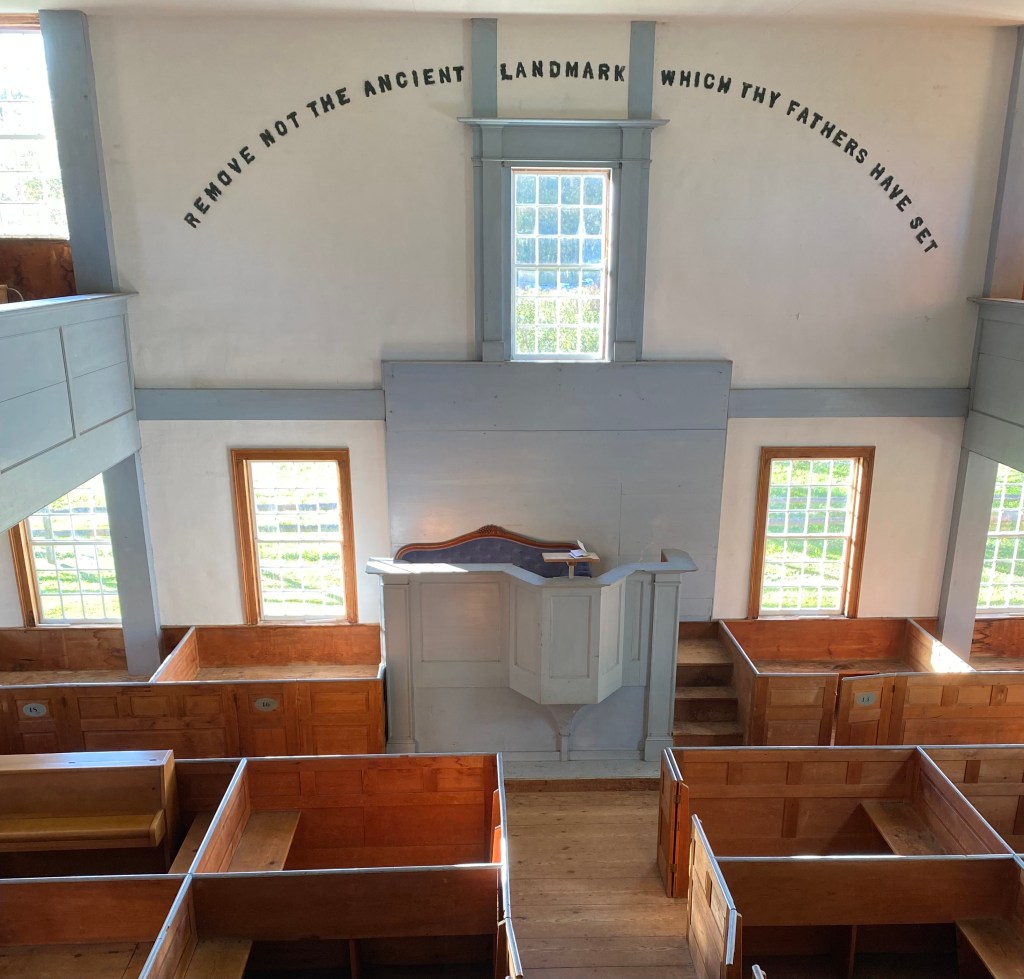
Old West Church, Calais, Vermont, 1823…. The fieldstone foundation was laid 200 years ago. I’ve been tossed a lucky bone, and I’m reading here this afternoon. Recently, I swung by with a friend to check out the acoustics and ended up sitting and watching the sunlight shift through the space. The structure remains in the 19th century with no electricity.

In an interesting way, it seems fitting to do these things in the autumn when the light in our northern realm is shifting so rapidly. On each side, the days shorten. What began in April as a sprinkling on the forest floor of hepatica and trillium and spring beauties has flourished all summer in such a lush and lovely summer. Strangers remark, “What a summer of growth!” as if to make up for these past few years of soddenness, of rain and wildfire smoke from faraway (but apparently not that faraway) places.

At the transfer station, I pull up with my hatchback crammed with that metal lidded can of cat food cans, my bins of used paper and things I no longer want in my house. I’ve been coming here for decades now. On this peach of a September afternoon, the owner and I stand outside his office, our faces up to the sunlight and a circling hawk. I mention that I’d take a month more of these days, but I don’t want to be greedy. He looks at me and says, Let’s just be greedy and want that, anyway.

Autumn is the long weeks of the growing season’s finale, the landscape gold and crimson. But within the landscape are the tiny places where we walk and live: my garden’s pink glads, the neighbor’s blooming roses, the gold flush of the butternut tree I planted as a bare root stick, seven years ago, and the girls laughed at me. The tree stretches far above our heads now, and my girls marvel. Have faith, I remind them; beauty thrives from where we least expect it….

From Carolyn Kuebler’s gorgeous essay about Vermont:

The real, long history of this place goes even further
back, to the beginning of this landform as we know it, about twelve
thousand years ago when the glaciers drew back from the land and
various species, including humans, eventually moved in.

Koan answer.

It’s dark in the mornings now when I wake, the light silently seeping over the hillside, creating a new day. Late afternoons, I swim after work. Ten geese accompany me. The next afternoon, I swim towards two young boys fishing from the bridge. Their line holds the sunlight, a line thin as a spider’s web.

Late July, I’ve been here before, the garden wealthy in basil. July: the season to relish the fatness of hydrangeas, cucumber vines gone rouge among the onions, ice cream made on a nearby farm. The overcast sky touches the line of trees, the green fields. As my friend and I talk, a hawk circles low over the field. Our conversation winds back to that question I keep asking these days — where to find solidity in a time that increasingly veers to stridency, to a yawping against a fracturing world.

The hawk dives and nabs its meal, then vanishes into the treeline.

Rain begins to patter. All this past month, as I’ve been traveling across the country and then working with a Vermont Selectboard, listening to the news and following the storylines of those around me, I keep thinking of Yeats’ famous line that “the worst/Are full of passionate intensity.” An ordinary late July early evening, the swallows dipping in and out of the treeline. I stand for a moment, watching. The boys’ fishing line shone like the thinnest rod of light, vanishing into the dark water. The two children stood on the bridge, chattering and pointing. Perhaps the answer to my koan.

A stranger appears at our house…

A stranger appears at our house while I’m watering one night, the little drink I offer my tomato plants on hot days. Her grandmother lived in this house, an old woman widowed now in another part of Vermont. I let the stranger in. She’s mystified that a tiny pantry in the kitchen was removed. I can answer some of her questions — that the four tiny bedrooms were changed to two tiny rooms and one larger one, that the downstairs walls were painted yellow by me.

Someday, I say, someone will knock down a wall and change this, too.

Outside, in the evening light that’s storybook shades of peach and lemon and lime, I tell her the soil is sand. She remembers the ants who bit her as a tiny child, and she remembers the lilacs. We stand talking a little about our lives — how I came to live here, where she’s now. I ask, Who planted the roses, but she doesn’t know.

Just before she leaves, she looks at the foot-wide strip of cement that surrounds the house. “My sister and I used to dress up in my mother’s old clothes and high heels. Everything was too big for us, so we scuffed the heels around the house.”

She gets back in that rusty mini-van, waves, and heads off. A few days later, she sends me photos, 1960s-style, of kids in what’s now my living room. And the wallpaper? She remembered it indelibly and wanted me to see it, based on some notion that pineapples and giant leaves were a fine addition to the walls of a small Vermont living room.

There’s one last thing, though. She even wanted to see the basement. As we stood looking at the stone walls and the rough-hewn floor joists, we wondered about the housewrights. How well-built this house is, tucked on a hillside in a place that seems both part of the village and not. My days, too, are numbered here. I’ll die here, or I’ll move elsewhere. All these stories are pieces of this house — these little girls, sixty years ago, in too-big shoes, hands pressed against this house for balance, giggling.

July, it’s worth noting again, July July July, month of growth, today own parents’ anniversary. Each of these July days…. Savor in some kind of way.