Mad World, Abundant Wildflowers.

For no particular reason, I walk on the path along the river which leads to the road where I once lived. In the meadows and beside the trail, the wildflowers blossom abundantly: yellow toadflax and pink asters, bluets and Black-eyed Susans, cinquefoil.

I dawdle at the dirt road. At a turnout, long ago I had a carpool meeting spot. Over the years, my daughters and I passed hours there. In the afternoons, I lingered with my friend, the girls lingered with their friends. The girls played in a brook. The fields have been used for hay, vegetables, seeds, THC. In the past few years, the flooding river dumped sand in these acres. Burdock and thistle claim this terrain now. These fields are for sale again.

A few pickups zoom by. When my ex and I were splitting up, we’d meet here, too. I’d run down the mountain road and leave the girls at home, baking cookies or riding bikes. In my then-husband’s truck, we’d argue about our lives. That autumn as an early dusk washed in, I leaned my head against the truck window and watched two coyotes running across the field. He kept talking and talking and I kept thinking about our daughters who would be hungry for dinner. Someone else lives in that house now. Our lives have long ago moved on.

A friend pulls up, and I get in her car. We talk about kids and aging parents, about money and oranges. The world around us is falling apart. What we see now might be just the cracks of a shifting society. Yet, our lives spin on. My friend and I keep talking and talking. Children grow up. The fields’ bounty changes. I no longer live a few stones’ throws down an empty road from this friend, but how I love her.

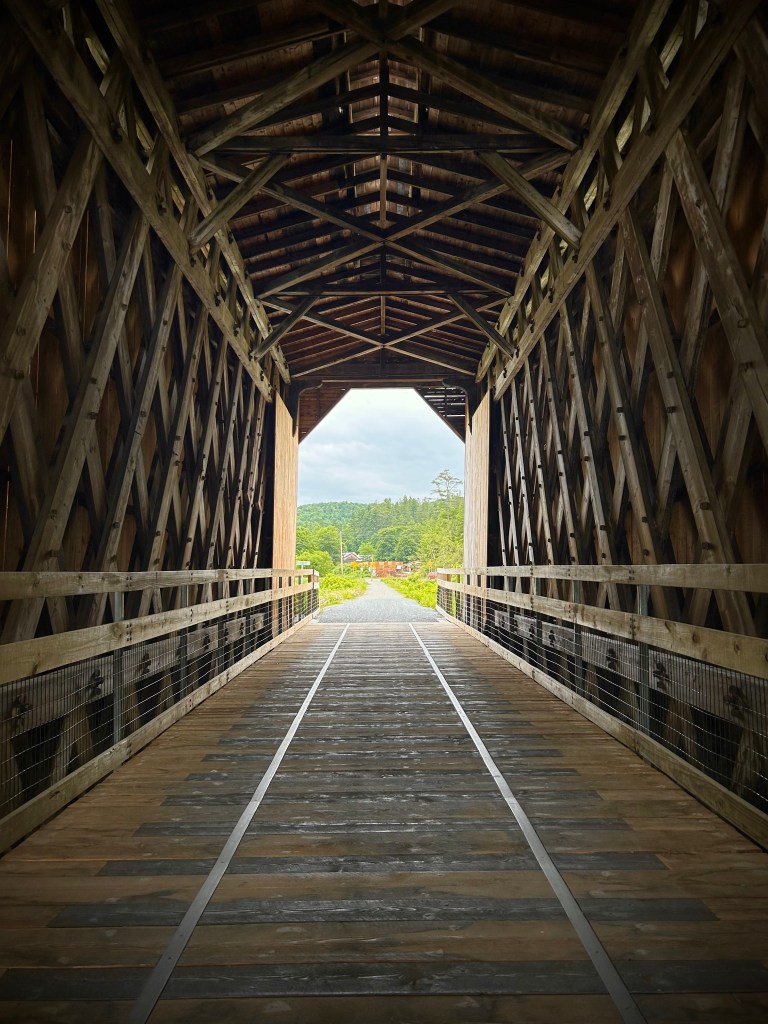
I walk back slowly on that trail, under the cool shading trees. Chicory, knapweed, Canada lily. In the covered railroad bridge, I pause in its interior dimness, light at either end. There’s no one around at all. I soak it in.

The heart’s actions
are neither the sentence nor its reprieve. 

Salt hay and thistles, above the cold granite. 
One bird singing back to another because it can’t not.

~ Jane Hirshfield

The contours of your heart…

Not February, a long time ago, at our house…

Prying an aluminum safety-seal off a bottle, I remember drinking a tiny plastic bottle of cherry-red juice as a girl when a soft piece of aluminum was the top: once you peeled it back, you were committed to drinking the whole thing. In our sugar-free house, we rarely drank sweet things. This was somewhere in that vast expanse of the Midwest, land of a long-ago sea. In our parents’ green Jeep, we hurtled along I-80, two kids in the back and another up front in the middle between my parents. The Jeep had no radio. In a fit of enthusiasm, my mother had bought a transistor radio that she insisted would work. My dad insisted it would not, despite my mother unrollling the window and jamming the antenna into the wind. (The radio did not, although she did play music at a campground picnic table. We insisted she turn it off: too suburban, mom…)

In the floor of the Jeep’s backseat compartment was a hole where a screw must have fallen out and disappeared. In these pre-seatbelt years, we sometimes lay on the hot floor and stared down through the hole at the interstate whizzing beneath the wheels. A steady blow of hot air blew upwards.

Midwinter now in Vermont, that eternal season of accumulating snow and intermittent dazzling sunlight. My parents, bickering or laughing in their front seat domain where the three of us kids were clearly only intermittent visitors, were enmeshed in their crazy lives, scooping us along in their journey. As for us kids, the void of that quarter-sized hole in our family car and the pleasure of those unexpected sweet drinks, the promise, perhaps, of a swim in a campground pool later that evening, defined those summer days.

Now, decades beyond that cherry drink, I see my own rugged journey spanning decades, my daughters always along and still along, as we’ve come together and parted and reunited with so many people over these years…. In the end, perhaps, what remains with a child might simply be that special drink, not the mighty panorama of ancient geology or the American landscape of truck stops and diesel fumes and KOAs, not even my parents’ own struggles to figure out their lives — where are we going? what are we doing? — that, in my parenting turn, I’m hammering out, too.

From the inimitable essayist Leslie Jamison: “Don’t assume the contours of another person’s heart. Don’t assume its desires.”

What’s at the heart of a story?

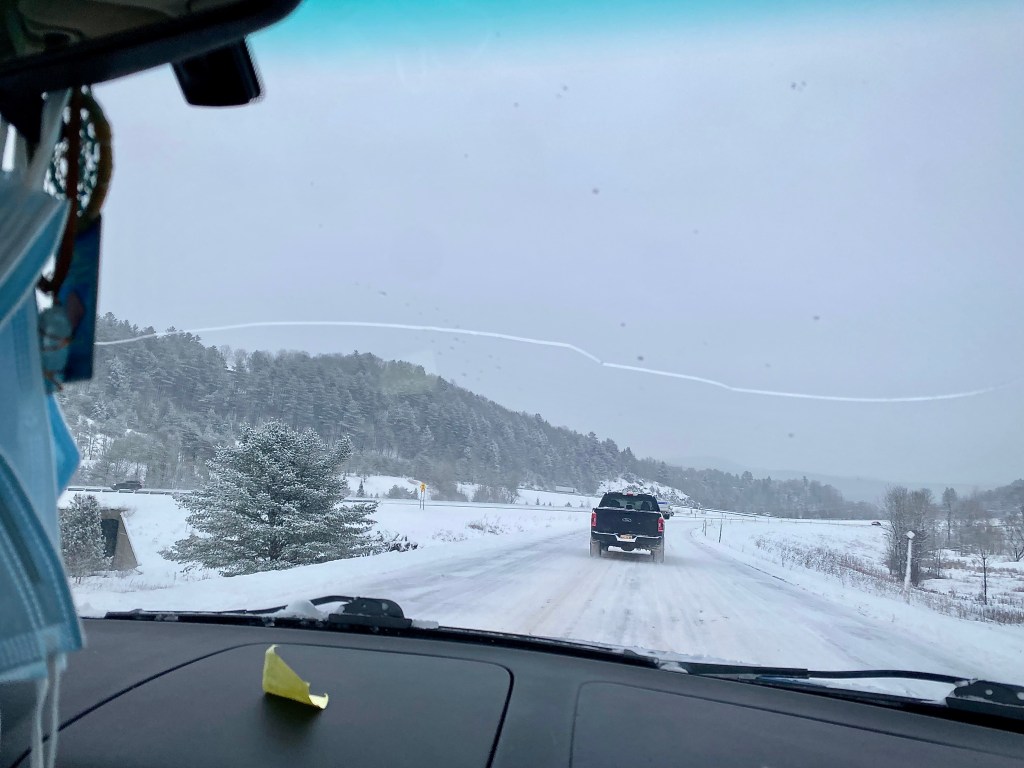
Crack in the windshield, the snowy interstate, the winter metaphor for this cancer journey.

25 hours. Here’s a smattering of highlights… A hard-knuckled drive on unplowed and marginally plowed roads, a side stop to avoid a collision on the exit ramp. Who knew these things gathered such snow? The town lights dimmed by snowfall. On a hotel’s second floor, I lay in bed talking to my siblings while my daughter ate chicken curry. In the bleach-smelling night, I limped up and turned off the heat, stood at the wide window looking out at the neon lights across the midnight-empty highway. The storm had ceased; the neon gleamed GARDEN, so brilliantly red and commercial that, in my sleep-addled mind, I couldn’t pair that word with loamy soil, coiled earthworms, the promising nub of May sugarsnap peas. Unable to sleep, I lay awake, parsing together a story: hook, conflict, and what does resolution mean, anyway? What’s at the heart of a story?

In the early morning, two full lanes of traffic streamed towards Dartmouth Medical Center. On the short cold drive, we drank hot coffee. From here, the story unfolds into the parking garage, blue paper masks, the complexity of so many stories, with so many words. The words alone are brand-new to me — Doxorubicin, Methotrexate— and I labor to learn these, to put pieces of what I can know of my story together. The wide halls in this building soar high, softening voices as the daylight falls down. Always, I hold in my body this conflicted and twisted sense of how much I do not want to be here and how immeasurably grateful I am to be here — but more, too, the profound and sacred sense of so many people, patients and families and the immense staff, each with their own mighty stories, living these stories, in pain and in joy.

In the infusion room, where I sleep and sleep, this time no longer needing small talk, I wake and watch the juncos and chickadees, the nuthatches, flitter in and out of the hydrangea bushes with their brown last-year’s blossoms, perch on the feeders the nurses fill and tend.

The interstate home is clear. The cats yowl for dinner. My house is warm, the dishes washed, the hearth fed. February. The story spins on.

Vessels, Rooms, the Unbounded Sky.

16 degrees on this sun-kissed Sunday, my cat considering the squirrels.

In cancer land, still putting my muscles together, I’m outdoors only with someone else these days, the long solitary walks yet a future promise, again. Early mornings, I brew coffee, fill the cats’ bowls with their breakfast. All day long, we’re filling and emptying things: water glasses and soup bowls and cat dishes (again), filling a notebook page with penciled words, a suitcase with my daughter’s clean clothes as she heads back to college, a new lightbulb in an empty socket.

Likewise, this disease has filled my body for months, now emptying; illness has slipped into every crevice in my family’s life, too, like the power of freeze in a river, rearranging the flow.

In a year that’s begun with so many families losing their homes on the other side of the country, the sunlight on this morning, a chilly walk this afternoon, the cold scraping at my cheeks – yes, yes – a scrap of gratitude for January Vermont sunlight. Here’s line from one of my favorite writers, Andre Dubus, who knew loss keenly.

“We receive and we lose, and we must try to achieve gratitude; and with that gratitude to embrace with whole hearts whatever of life that remains after the losses.”

In the cracks around kindness.

Thaw, on this New Year’s Day, hovering near freezing, my neighbor’s yard under her great pines exposed to soggy grass, the fields on the hillside across the village bare as late April.

I pull on my coat and boots and stand on my porch. The tree branches are festooned with droplets. Cold will press in again this week.

Wednesday morning, holiday, my scrawled list penciled on a post-it on my kitchen table, waiting. I perch on the covered sand bucket and sip the coffee, my hands wrapped around the mug. My memory wanders back to the Maine coast where we spread my mother’s ashes last June. My mother loved domestic spaces. She would have been enchanted by the colored lights my kids strung over my barn, along the porch roof over my head. Likewise, in my house, she would have admired our tree with the red star topper, the room illuminated with tiny lights. Nearly housebound with cancer recovery, my household has been blessed with gifts of candles, savory meals, foil-wrapped chocolates, fragrant rose oil from Bulgaria. All this, too, would have intrigued my mother.

My mother loved the wild, too, for much of her life quick to pack up the car and head for the open road.

In Maine, we parked near the shore. The sweetness of rugosa roses buoyed along the breeze’s brine. In the curving, layered landscape of rock and the rhythmic crashing pound of the ocean like the planet’s beating heat, we returned her remains to the immense wild, the mysterious territory where she had, after all, emerged from.

A crossing over.

This second memory, too. Later that summer, visiting my old father in New Mexico, my young woman daughter and her friend fried eggs and buttered toast for breakfast. In their strappy sundresses, they sat at the round oak table, sipping coffee. The friend had never visited New Mexico; her eyes gleamed. My father gave them his credit card and told them to eat lunch in downtown Santa Fe, in the courtyard which had been a family compound, 200 years and more ago. Later, the girls returned with leftover enchiladas and stories of flowering trumpet vines and singing birds. We must go into the beautiful mountains.

Yesterday, this daughter walked me around the high school, the beginnings of my strength returning. In the hidden back, a path leads into the woods. She held my hand, admonished, “Not yet.”

On this misty, rainy New Year’s morning, a prayer to cultivate patience and mercy for these interwoven journeys…

Before you know what kindness really is
you must lose things,
feel the future dissolve in a moment
like salt in a weakened broth.
What you held in your hand,
what you counted and carefully saved,
all this must go…

Naomi Shihab Nye

❤️

In the night, snow. My youngest ventures downstairs from her second-floor lair and feeds the wood stove, asks if I’m still reading, and don’t I think I should be getting some sleep… Around my knees, the cats yawn at her, nestling into their cat-dreams for a winter’s sleep. Outside, the town plow rumbles up our road, backs around, beeping, and disappears into the falling snow.

2024, a year that’s meant so much to so many. In our house, the year my mother died, the year I almost died, too. The inside-out year of reversal. In these quiet December days, getting better, getting stronger, getting weaker, moving along that jagged zigzag towards health, I’ve been lucky to read and think, to be warm and tended, to savor small sweets. Games of gin rummy. Poems Jo reads in her clear strong voice and sends every day. Brad’s photos of wintry Lake Champlain, luminescent portals of ice and drooping snow and runny sunsets. For so many of you, some whom I know well and have gone in and out of the depths of friendship and family, and some whom I hardly know, the circle around me has made all the difference.

When I first knew I had cancer, an acquaintance who had survived breast cancer told me it was the loneliest experience of her life. Like anyone, I’m well-acquainted with loneliness, have battled this shackled companion through divorce and betrayal. Where now has fate sent me? Illness was a forbidding shore where I never wanted to land my kayak, bend down in the cold murky waters and hoist my flimsy craft to safety. But illness is our common terrain, and those who dwell here – through happenstance or vocation – welcomed me in with compassion. As The Good Doctor told me, We are all patients. More plainly, perhaps, we are all mortal, conjoined.

Wishing you all some radiance from Vermont, prettied up this early morning beneath a downy snowfall….

“The Verge”

Reason is a fine thing, but remember there are other ways
to live: by instinct or passion, or even,
maybe, by revelation. Try it. Come around again to the verge –
that place of about-to-open, near where we comprehend
and laugh and see. Why shouldn’t something marvelous
happen to you? Take even an occasion like this:
A man reading at night looked up at the window to find
a moose looking in, interested and unafraid
with quiet dark eyes. He reports he has never been the same;
he finds the ungainly and miraculous everywhere.
He said it started the next night in the empty window
as he watched his reflection looking right back through.
He said he saw his own beauty, how even in his same old face
the quiet eyes were curious and ready to be true.

– Annie Lighthart