Every bird around us is singing this morning. The garden luxuriates in a clinging dew.
Unexpectedly, a woman I worked with for a number of years texts me with news she’s in town for a few days. We had last in early March, just before our world shut down.
We take a walk through the town forest and catch up on kids and work. Then, for a few minutes we stand in the parking lot, and our conversation branches a different way.
She asks about when my daughter and I were quarantining after my daughter contracted Covid. In those long days, waiting to see whether I (who wasn’t yet vaccinated) would contract Covid, too, I painted the window trim in our front porches, a blue light blue color called Innocence. While painting, I listened to hours of Derek Chauvin’s homicide trial.
So much of our lives, I muse, is simply circumstance — we’re white women, living in Vermont, with particular backgrounds and education. How much of our lives do we choose, and how smartly do we make decisions of what we do choose? It’s a question that’s been asked myriad ways in the past year, in innumerable ways.
Driving home, I keep wondering, what do we do with this now?
A thunderstorm rumbles in early Saturday morning, in that darkest spot before dawn. We’re nearly at the solstice, and the days are long and lovely, full of just the right amount of warmth. Our Vermont world is in bloom.
The rain this morning is welcome. When the downpour passes, I lie in bed beside the open window, listening to the pattering of a gentle rainfall on the leaves of the mock orange below my window. In bloom now, its flowers are white as snow.
In my memory runs a few lines from an Eric Clapton song. The day before, I had driven to St. Johnsbury, a road I had often driven when I was first married. As I crested a mountain, VPR cut out, and that song came over my radio, scratchy. Long ago, we had a second-hand turntable, and a few cast-off records, and that album we played over and over.
The thing is, I didn’t like the album much at all, but I gradually came to like it, maybe simply through habit. That one sweet song had always been my favorite. Now, over the radio, my past returned, fuzzy and unclear, but never forgotten.
A year ago, George Floyd had recently been murdered, his death replayed endlessly around the planet. Riots erupted around the country. Now, under a different administration, Juneteenth is honored.
So much. All that great wash of the past — from immense societal waves to the tiny trickles of our own lives — pushes us along. And yet, sweet rain on this quiet morning. Even the hungry cats press their whiskers against the screen, welcoming in the morning.
High school graduation this year is under an enormous white tent, surrounded by the community. Not everyone is pleased with the arrangement — that’s pretty much a given — but the tent looks regal, the weather is magnificent, and, well, we’re still pulling out of a pandemic.
I chose a seat in the sun just under the edge of the tent. The principal’s speech goes on and on, and I begin to wonder, where are you headed with this, David, when suddenly I begin to guess. He’s facing the sixty or so graduates, speaking directly to them, about the hard year and a half they’ve endured. A few months before the pandemic, a member of their class committed suicide. Shortly afternoon, the pandemic shut down our world.
Looking through the tent and over the soccer field, I see people I know in one way or another, and many more I don’t know at all. Listening, I feel the principal’s speech pulling us together, acknowledging the difficulty of these past 15 months without bitterness or regret, the layers of isolation and anxiety, of political division, of frustration with a world turned awry.
He asks us to breathe in deeply, collectively.
Around us, the sunlight sparkles on the grass. A tiny girl stands outside the tent, her long hair unbrushed, staring in.
The strange thing is, I can’t breathe in deeply; I’ve been holding my breath for so long. But looking around, I realize these friends and acquaintances and strangers are collectively here for one reason — to champion our youth forward — and for the first time, I begin to feel (not think, not believe, but feel) that the way forward is indeed opening.
Friday morning, I’m washing the breakfast dishes when warm liquid runs over my bare toes. For the briefest moment, I think I’m standing in the edge of a warm ocean, and then I realize my kitchen sink drain has broken apart. Gallons of dishwater flow over the floor.
I’ve cobbled the drain together before, but this time, I’ll actually need to fix it.
My daughter picks up a worried cat and assures him that, indeed, the drain will be fixed.
Midday, when I’ve finished work at my desk, I drive to the hardware store with a section of PVC. I’ve forgotten a mask; those cloths are at home, drying on the clothesline. I sigh, irritated. I have a six other things I want to do, besides drive around.
But the thing is, I see a huge sign outside the store: masks are no longer required for the fully vaccinated. For the first time in however long, I walk into a store without a mask.
This has been a week of chaos. We all have these days or weeks, or maybe even decades. Who doesn’t? We’re humans, who live in a material world that’s constantly shifting (even if only incrementally) from well-put-together to chaos. The flip side, I suppose, is that sometimes we manage to arrange chaos back to order.
As in my kitchen sink: after dinner, I wash the dishes, and no flood alarms the cats.
By evening, I haven’t bought to tickets from Vermont to New Mexico to visit my parents, as I’m unable to surmount the chaos of the airline world. I haven’t eradicated my fears about my 16-year-old, driving around, heading into the adult world in what’s practically a heartbeat. The woodchucks are still doggedly determined to rise up around my gardening realm.
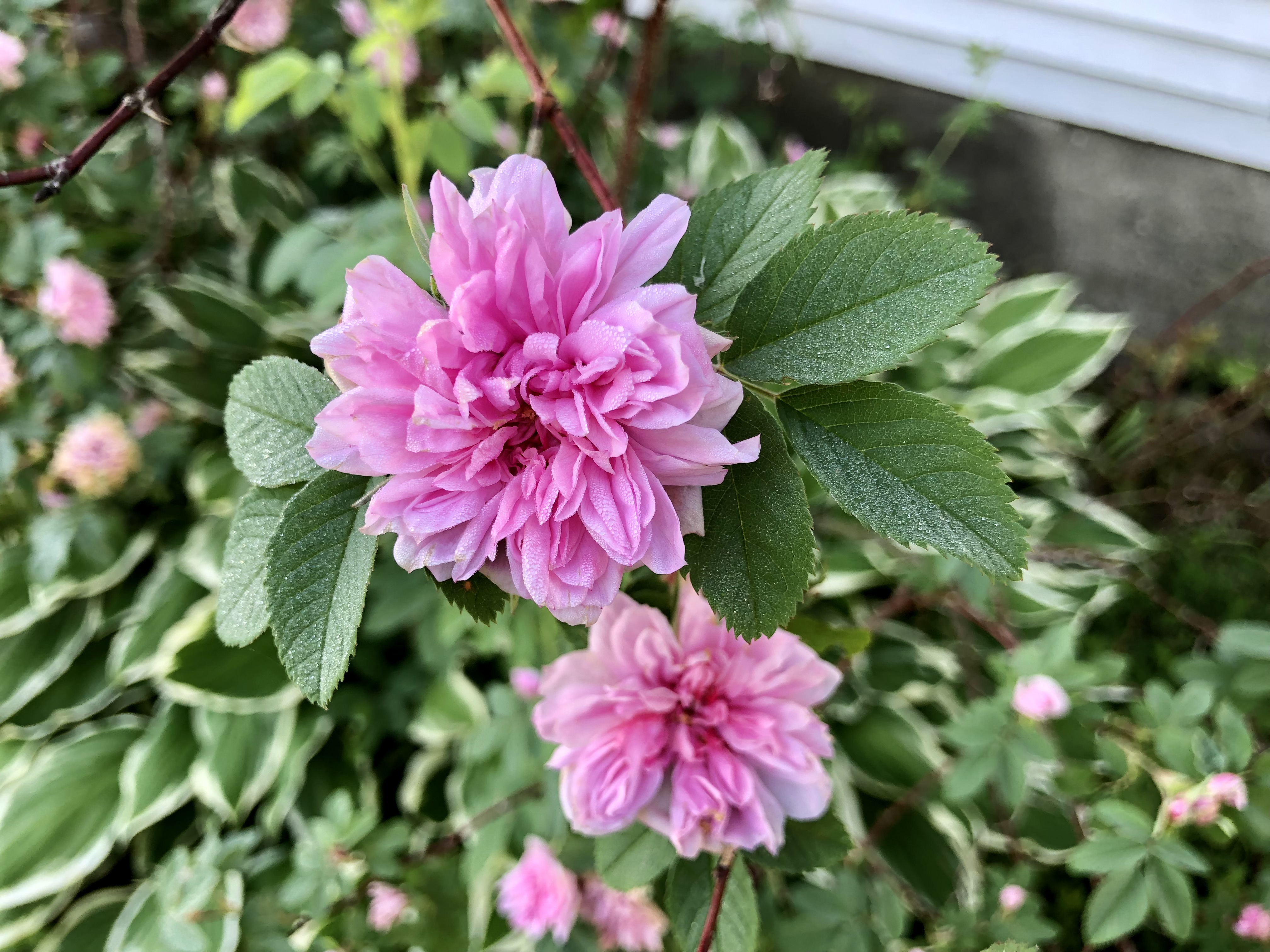
From the tangle of rosebushes someone planted long ago, I clip a single blossom. A thorn pricks my thumb, and a thin line of blood wells up. I touch the blossom to my blood and wipe my thumb clean.
Just before dawn, a brief thunderstorm breaks apart and cools our world, followed by a dawn suffused with rosy and gold light. Much of the town might be sleeping, but the birds aren’t.
The clouds move in again and swallow up the colorful dawn with gray.
The human world around us unfolds in its uniquely human way, clumsy and jerking as vaccination rates rises. There’s a larger story of who contributes to herd immunity and who’s riding unvaxxed along the vaccinated wave. It’s a very, very complex story, with outcomes that aren’t even approaching murky yet. At the heart of this is that eternal koan, How do we know anything?
A koan the pandemic hasn’t made any easier.
I open all our house’s windows and the cool, rain-washed air rushes through.
We pulled into the DMV exactly on time for my daughter’s driving test exam. I sped while driving there — lousy parenting example — but at the very last moment before we left, it seemed we needed my daughter’s social security card for her license — as if I knew where that was. So we left without it.
Driving there, I remembered the card is in her baby book, in the blue hope chest.
Fortunately, the DMV staff was cheerful on this Tuesday afternoon after the long holiday weekend. The missing card was glossed over; I produced her birth certificate; and then they asked me if I had a utility bill or a piece of mail with me. Weirdly, I had brought the electric bill that arrived in the day’s mail, so I could read it over while she took her road test.
When we finally walked through the doors to wait outside, my daughter and I exhaled an unintentional collective sigh.
For these 15 minutes or so, I had absolutely nothing else to do at all, but sit there — something that seemed unimaginable to me for so many years as a mother. I had things, of course, I brought with me to do — reading that electric bill, for instance. But for these moments, I slipped off my sandals and dug my fingers into the warm clover.
In the sunlight, I soaked up my gratefulness to live in gorgeous Vermont, one of the sweet spots on the globe. Sixteen years ago, as I was driven away from the hospital after a surgeon’s scalpel made this daughter’s life possible, I saw corn nubs emerging through the black soil. Corn! What a miracle!
Sixteen years ago, I never would have predicted that one member of our family of four would have absconded for another life, that the life I have with my daughters would evolve into a version of Elizabeth McCracken’s line, It’s a happy life, but someone is missing.
So much of this past year I often imagined myself in a twisted story, a freak Camus novel, but now here I was on the flip side. Meanwhile, my daughter channeled her life into literally her own hands. Sixteen years ago, I was still foolish enough to believe that my children’s lives could be buffered, that they could live in a make-believe world of no bad things. I was still naive enough to believe that was desirable.
My daughter passed her exam. On our way out of the DMV this time, we didn’t sigh. In the sunlight, we spoke of little things — what to cook for dinner, tomorrow’s plans — the stuff of everyday life that makes a life together.
…we barely know the world around us, even the simplest things under our feet..we have been wrong before and we will be wrong again…the true path to progress is paved not with certainty but doubt, with being “open to revision.”




 Stony Soil Vermont