In a dream, my daughter drives along an interstate and rounds a curve. A semi spreads across the road, its back-end across our lane. In a fraction of a moment, I predict we’ll hit the truck. Before I can speak, my daughter steers to the right, and I have a sickening foreboding that she’ll hit the truck and I, on the right, will emerge unscathed. I’m not afraid really; it’s grief that nails me.
She steers us around the truck, over the grass, back onto the road, and keeps driving. My heart hammers.
In the dark, I lay awake. There’s a lesson here, I counsel myself.
On this rainy October morning, here’s a few lines about parenting from Anne Lamott and an excerpt of my book in The Fix.
…one of the worst things about being a parent, for me, is the self-discovery, the being face to face with one’s secret insanity and brokenness and rage.”
― Anne Lamott, Operating Instructions: A Journal of My Son’s First Year
I pause my afternoon run when a couple waves me down in a little memorial park in Hardwick. I’m guessing they’re looking for directions, maybe a suggestion where to eat an early dinner or the road to another town. Instead, they’re curious as heck about Hardwick.
What drove the economy in the 1800s and 1900s? When was the beautiful granite town office building constructed? Do I know the population?
Weirdly, I know the answers to all these questions, and ask a few of my own. Where are they from? Where are they headed?
They’re from the northern shore of Lake Champlain — St. Albans — a town where I once bought a sizable (and expensive, oh, was it expensive) piece of maple sugaring equipment.
We stand beneath a gold-leafed maple, talking about this and that, and I share my speculations about what living in Hardwick might have been like in the early 1900s. It’s all speculation, as my daughters would readily point out.
At the end, just before we part, they ask if I know someone who lives in town. He’s a high school teacher, and I met his family over twenty years ago. In fact, I live beside his mother-in-law.
We laugh. How little separates us. Then they get in their car, and I head off on my run.
Sunday afternoon, the board of the local food co-op hosted a meeting, posing the question: buy a building a few blocks down and encumber the co-op with a million-dollar debt, or stay in the tiny, owned-outright space? Philosophically and financially, the debate was heated.
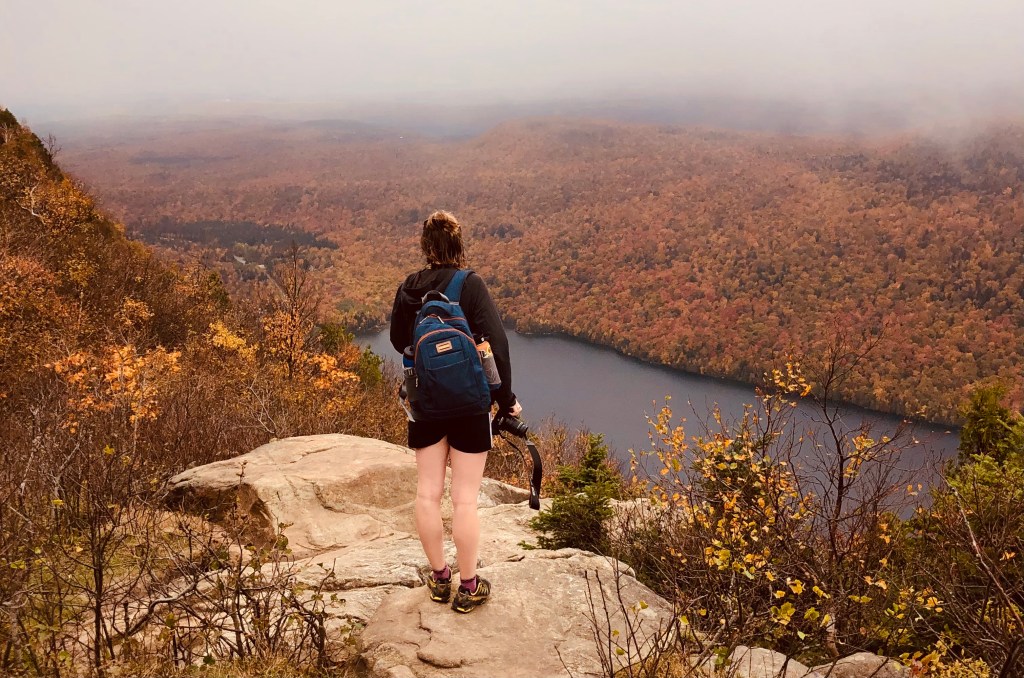
I leaned against the pavilion’s post, listening, drinking my tea. Around us, fallen leaves rustled across the grass. My cheeks burned with windburn from that morning’s hike with my daughters. We climbed to a cliff and looked down at a glacial lake, the surface choppy with white caps. On our way home, we stopped at the beach of this enchanting lake, mountains rising steeply on either side. A bald eagle dove into the wind, its head and tail whiter than snow.
Before the meeting ended, I packed up my knitting and headed home, still thinking about that eagle.
From one of my childhood favorite reads — and from a paperback still on my shelf…
The maple tree in front of the doorstep burned like a gigantic red torch. The oaks along the roadway glowed yellow and bronze. The fields stretched like a carpet of jewels, emerald and topaz and garnet. Everywhere she walked the color shouted and sang around her … In October any wonderful unexpected thing might be possible.”
I knock off work early on Friday afternoon and head west with a friend to our daughters’ soccer game. There’s only so many high school soccer games I’ll attend in my lifetime; I’ve missed plenty this year.
It’s October but feels weirdly like July, with 75 degree temps, sunlight on foliage that’s at peak color. As I drive towards Lake Champlain, the terrain flattens. At the game, where we meet another mother and sprawl on the grass, seagulls swoop low. Flocks of geese fly overhead, forming Vs. At the end, despite the loss, our girls are smiling, hugging us in their sweat-soaked jerseys.
As the sun slips below the horizon, I drive back along that same route, retracing our blue highway journey from flat farming land through the green mountains and along the winding Lamoille River. I keep on through the twilight. A crescent moon hangs to our right. We talk and talk, about the complexity of being teenage females in our world, and then beyond that, too, how the past steers our own lives, hammering through generations.
As I drive, my headlights cutting through the darkness, I keep thinking of Joseph Campbell, whose voluminous writings on myth shaped my thinking since I was a teenager. “Life is, in its very essence and character, a terrible mystery—this whole business of living by killing and eating. But it is a childish attitude to say no to life with all its pain, to say that this is something that should not have been.”
At my house, we stand for a moment beneath the starlight. In my house, our upstairs glass-in porch glows, where my older daughter is taking notes, her laptop streaming a class. My friend drives away, back to her house, but I stand there for a moment longer. I’ve long resisted what I’ve seen as the superficiality of Be Here Now, as though the past doesn’t matter. Suddenly I see I’ve looked at what time means all the wrong way. Be here now with the past — another koan.
I walk up the back steps and flick on the porch light for my youngest child.
….. A few last things. Here’s a New York Times piece on IG and teen girls. Rick Agran of Bon Mot, a show about poetry and the literary arts, on the local Goddard College radio, will broadcast my Galaxy Bookshop event this Sunday, October 10, at 5 p.m.
Last, the Children’s Literacy Foundation hosts a virtual Book Club for Grown-Ups I’ll host, next Friday, October 15, at 7 p.m. The Waterbury Roundabout has details. I have a particular soft spot for CLiF — an organization that gives free books to kids in rural New Hampshire and Vermont. How cool is that??
Like a quilt, the fall’s early darkness abruptly pulls over us.
Late afternoon, I swing by the library, then pull off my wool sweater and go for a run. The rain falls so hard I appear to be running through clouds. I’m on a loop, so I keep on — there’s no easy turning back to get home. At home, I feed the hungry cats and light the first wood stove fire of the year, just a small one, with a few handfuls of kindling. There’s no turning back for fall, either.
After dinner, the daughters sprawl on the couch. The cats, who didn’t care much for summer, anyway, curl in a laundry basket, utterly satisfied.
Again, I realize I’m looking at this the wrong way: there’s never any turning back, just going on.
The wonderful poet Kerrin McCadden will be reading and talking with me virtually tonight, hosted by The Norwich Bookstore. Check in, if you have time and inclination.
“To think in terms of either pessimism or optimism oversimplifies the truth. The problem is to see reality as it is.”
Running along the old railroad bed, I pause when I see a couple ahead of me. I know her as an acquaintance, and she’s walking and talking animatedly with a man I don’t know.
I linger behind, breathing deeply, just about near the end of my run anyway. They keep walking. Sunlight filters through the trees over the narrow path.
Then, abruptly, what I realize fascinates me so much is merely the carefree tone of their conversation. They keep at it, talking, their hands gesturing together. Sure, I overhear people; I’m not a shut-in. But I’m mesmerized for these moments by their unmasked and unguarded tone, or maybe I’m just happy to hear their laughter. I live in Vermont, where many people, including myself, are vaccinated and use masks; this makes sense to me. Maybe I’m just enchanted by the warm September sunlight, spilling down through the leaves that are golden and red and beginning to drift earthward.
I linger, following, until they go their way, and I go mine.




 Stony Soil Vermont