“beyond the face of fear”

I’m at the dentist for an X-ray of a front tooth that’s gone sour three times before — two failed root canals and one beastly apico — which also equals pain, more pain, and so many dollars. We compare the X-ray to the one taken six years ago, just before the pandemic, around the time when my brother and I were marveling at drone footage of empty cities in China. The tooth looks pretty darn fine. I explain that I recently endured chemo, and I’m off every which way. I no longer seem to know this body. Plus, the added layer of paranoia.

He says simply, Chemo will do that. He offers me antibiotics. I’ve had enough antibiotics in the past year to reasonably heal a village, or at least a hamlet, and I pass.

The very last day of December, the day is cold and sparklingly sunny. I work at my kitchen table for a bit, and when the sun shifts around, I drive to a nearby town to return library books. It’s the holiday season yet, and the library is nearly empty and quiet. The librarian and I have known each other for years now. We were once farmers market colleagues. Eventually, I buckle down and work hard for a good long while. When I leave, twilight is just beginning to settle in. The library is warm, and the staff is setting up chairs and cushions. Parents and little kids troupe in, their cheeks glowing with the afternoon cold.

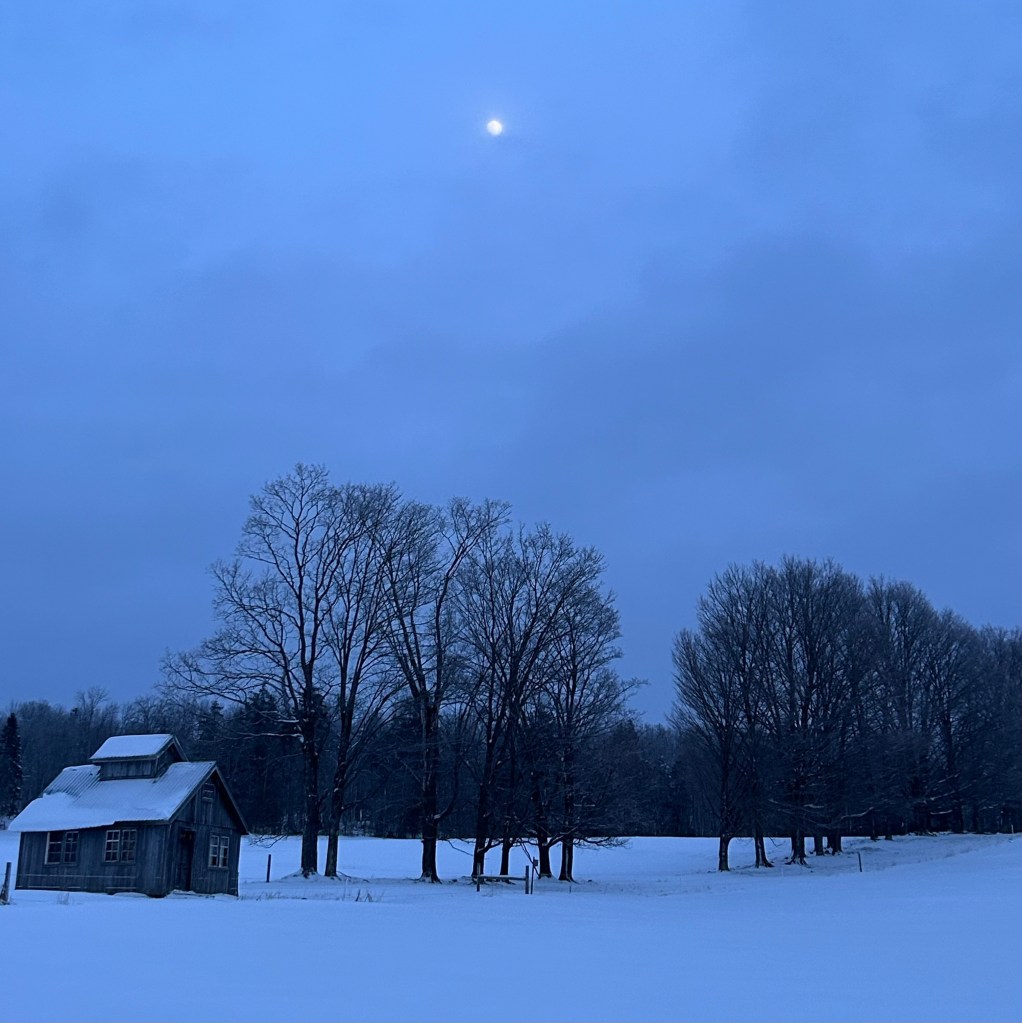
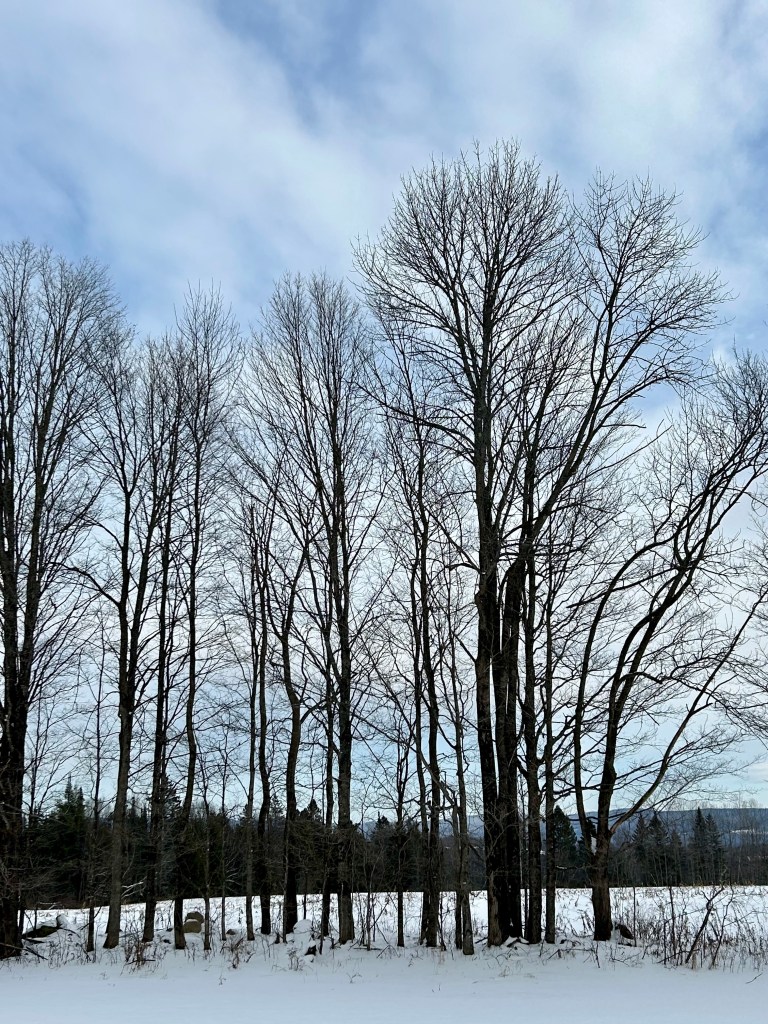
On my way home, I drive up to the ridgeline and take the walk I learned from my poet friend Mary. The cold sinks its teeth into me as I hurry along. The gibbous moon appears and vanishes in the scrim of clouds. All summer and far into the autumn I felt surrounded by a holy veil, a phosphorescence, trial by devastating disease and the violence of chemo and surgery, a trial I survived. I counted each moment as a lucky gem. Slowly, my pockets began to fill with the world’s detritus, with those nagging financial fears, the inevitable disappointment of relationships, the ever-present terror of relapse a knife against my gullet. In plain words, the stuff of living.

Walking, I studied the horizon as the blue deepened, pure ineffable winter, and the night cloaked me. I passed a few farmhouses with little twinkling lights. I was so cold and yet I did not turn back. Instead, the winter night flooded into my heart. My whole adult life I’ve been a crepuscular woman, seeking the radiant edge of sunrise and sunset, reveling in twilight, the majesty of the starry heavens. I’ve transformed grit and solitude into books. Enduring lymphoma made me wary of those recesses in my soul. I relied on others for sustenance and heat, for clean clothes, for glasses of water, in the way of very young children. Both my beloveds and strangers kept me alive. But slowly I’m beginning to admit that the coarser and rougher shades in my soul kept my body alive, too.

All of this is to say that a heartfelt seemingly casual chat and a walk into the cold night quelled my uncertainty, steadied me again. At home, I’d let my woodstove fire burn dead so I could unscrew the back plate and clean the ash-choked metal filters. My ruined hands could not hold the wrench. So I shoveled out the coals, set a match to birchbark, and lit a fire. Good enough for now. Soon, I’ll summon the energy to ask for stronger hands…..

Last and certainly not least, you readers have poured such love towards me this year. I’ve been sparse in writing here as I struggle to find footing in my changed world. Thank you for your patience. Thank you for reading. And may this new year shine joy for all of us, in the universe’s mighty and myriad ways.

A dear poem from Lucille Clifton:

blessing the boats

may the tide

that is entering even now

the lip of our understanding

carry you out

beyond the face of fear

may you kiss

the wind then turn from it

certain that it will

love your back     may you

open your eyes to water

water waving forever

and may you in your innocence

sail through this to that
Small Celebrations.

Each morning presents a new skein of yarn, knotted and jumbled as if carelessly carried in the bottom of my backpack, beneath leaking and softening apples, a sandwich wrapped in wax paper whose crumbs have escaped, the shuffling of notebooks, pricks of pens.

A friend asks me to xc ski this weekend. I pause and then warn her of possible abject failure. Can I balance? Can I even snap boots into bindings? Talking, I think of my ski boots in the upstairs closet. A year ago, a knitting companion asked to borrow needles: an inconceivability. A year ago, I couldn’t walk up my house’s wooden staircase, let alone swing open the closet door and shuffle through needles. I might as well have considered mining for gold with a plastic spoon. Pulling together boots, skis, poles: that alone would mark a kind of success. I am a lousy skier, but the glide of ski over fresh snow has given me so much pleasure. I imagine again stopping at the trails on my way home from work, how the cold winter twilight gleams on snow.

A theme that emerges in my writing over and over is order versus chaos. How laboriously I endeavor to keep the chaos from my life, from vacuuming the ashes and bark shreds around my woodstove to ordering my work life. Be productive. Get my work done…

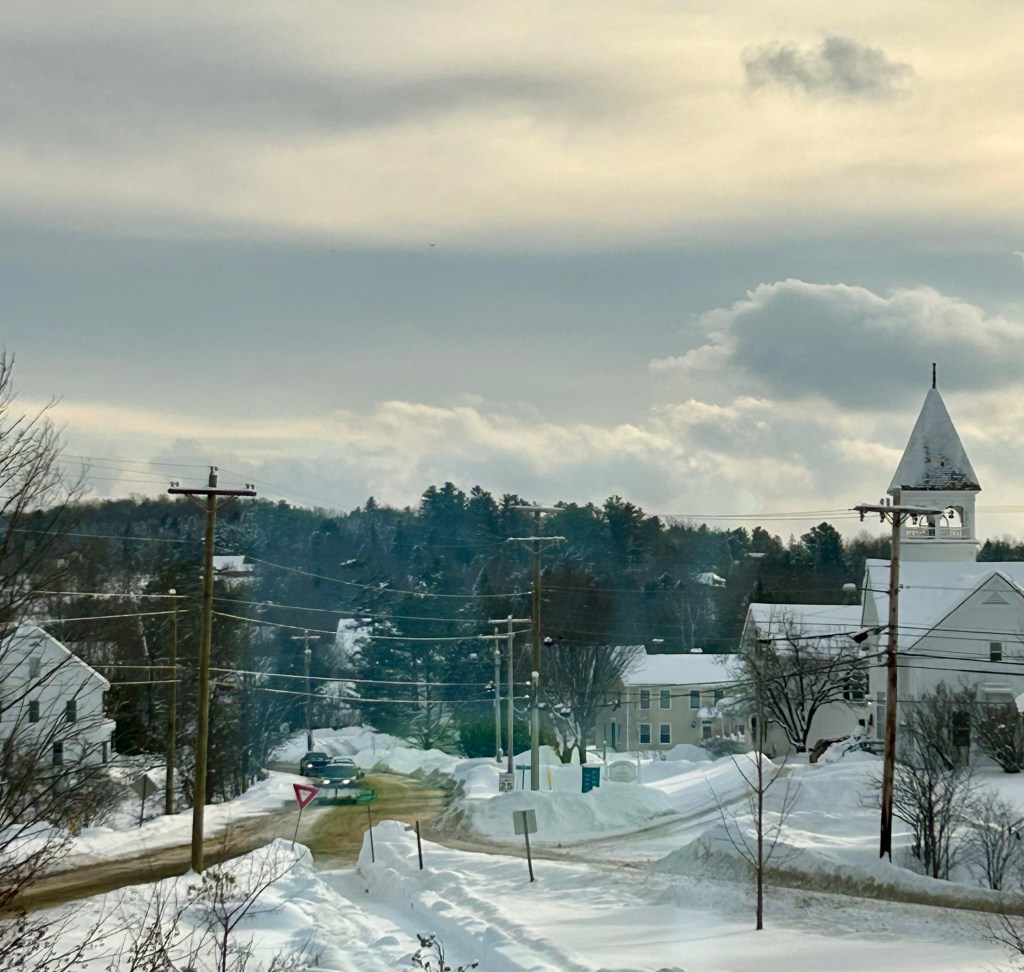
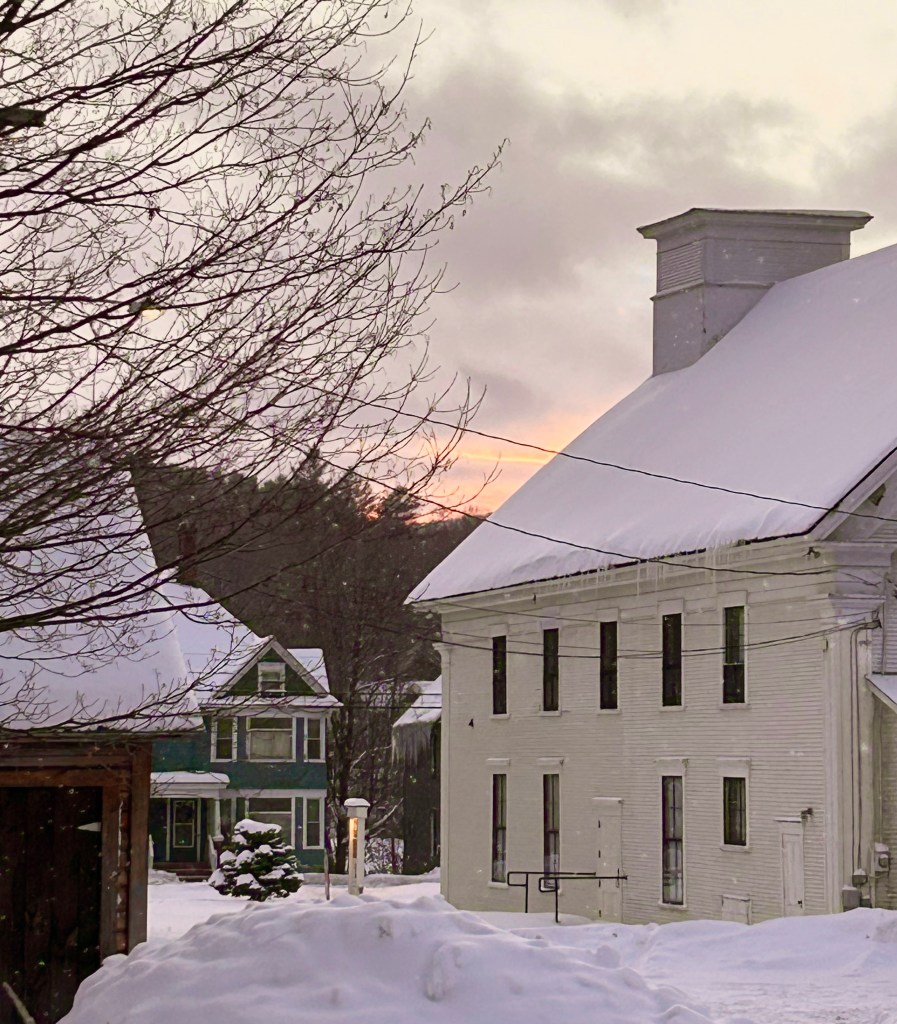
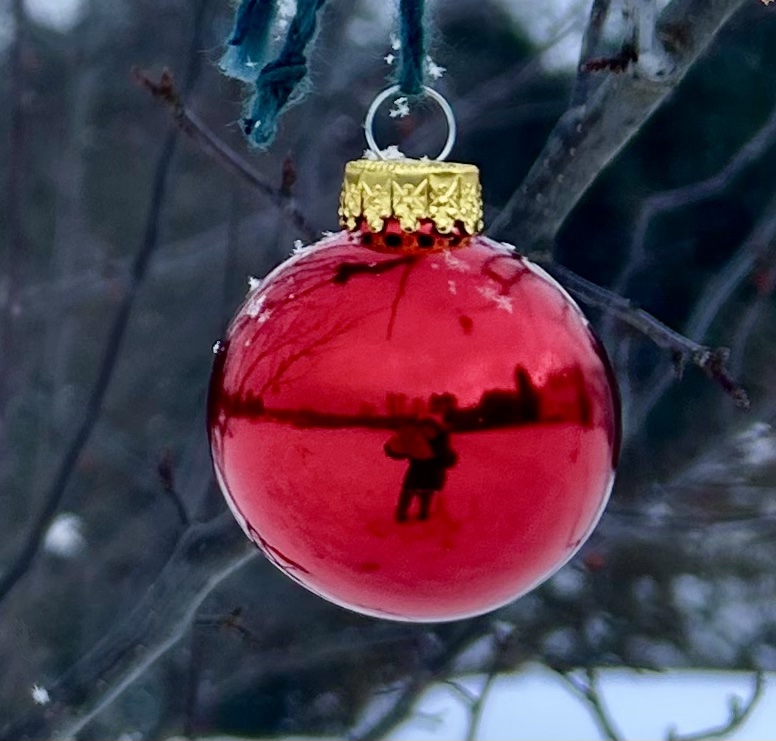
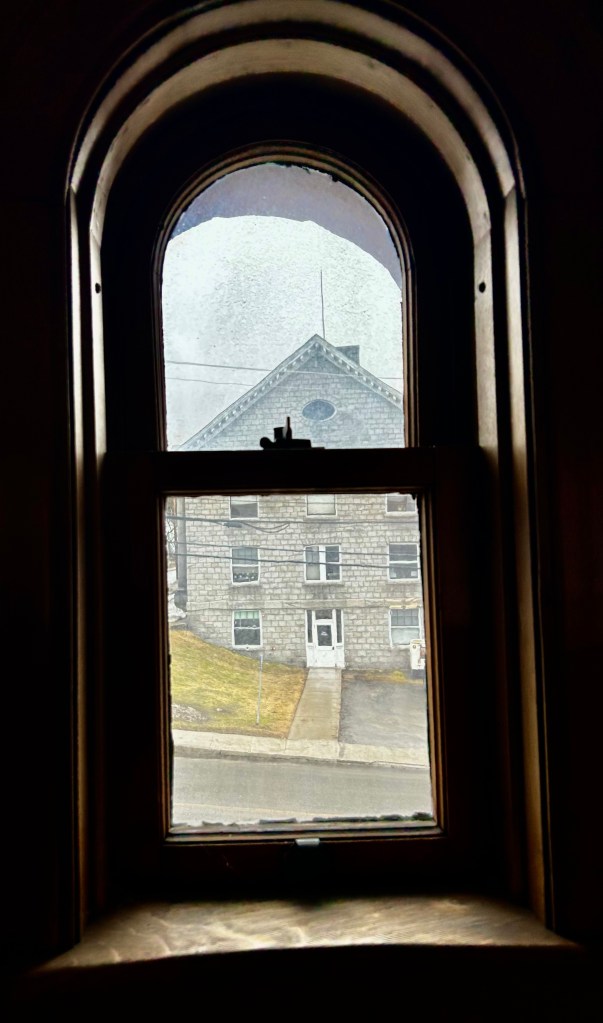
When I first emerged from surgery and chemo this summer, I flung myself into living with buoyancy and joy. Now, I am in the longer stretch — grateful to be here, but mindful of sinkholes. A longstanding quarrel in town rises up again and grabs at me. I remind myself, this was not my doing and not my requirement to undo. What I do, instead: I force myself up from the couch, lace up my boots, and walk. In town, I fill my backpack with library books, zip my coat against my throat as the gloaming sprinkles down. I take the longer walk home through the neighborhood built near the coal-dark Buffalo Mountain, these houses built for Hardwick’s granite workers, a hundred years and more ago, once filled with hardscrabble people from other places, seeking not a fortune but a livelihood. The kind of work where a slip or accident had horrible consequences. I pass a house with a family of small children, strung with glowing lights, sleds jammed in snowbanks. The empty house where the old woman with the two barking dogs disappeared in my illness, and another empty, for sale. On my road, I’ve strung red globes in an apple tree, bits of brightness, small celebrations, better than order.

The oncologist… “knows not to describe everything all at once.” — Marion Coutts, The Iceberg

The Scythe, the Past.

Twilight, 25 degrees yesterday, the temperature dropping, I’m walking back and forth by the town garage, a tumbling-down quonset hut beside the town’s towering sand pile. Such much winter yet to come. On the snowy road, I pace back and forth, watching the sky turn from blue towards black, the stars hidden behind the clouds, talking with my friend about family and politics. Listening, I remember the Christmas manicotti she brought me last year. My daughter and I ate that delicious meal at the kitchen table; through our glass doors, I watched the snow fall, wondering if I would live another year.

Another year is not a guarantee for a single one of us. Another lymphoma lesson. I’d woken that morning with that now-familiar fatigue, as though sandbags were tied to every bone in my bone, pulling me earthward. I fed the wood stove, drank coffee, rallied and did my writing, rallied again and pulled on my coat and boots and left the house.

Later, by chance, at an outdoor fair I see a woman I’ve known for many years, who was part of a trying time in my life when my daughters were young. She offers me a particular kindness, and I thank her, wondering what I’m supposed to say. She does not seem to expect the standard answer of all’s well, that’s over and done because of course any fool knows, once cancer has rooted profoundly in a body, the reaper’s scythe does not hide. By now, it’s not so much the scythe that frightens me, it’s the suffering to get there.

On my way home from the fair, I pull over and get out of my car. The sun shines brightly, but it’s freezing, and I’m shivering. I walk back down the dirt road that’s empty of everyone, not even a crow perched in a bare-branch maple. Far up the valley I see enormous white wind towers, the Lowell Mountain Project. To my left is a house where one of the leaders of a group that protested the towers now lives. When the tower project began, my then-husband joined that protest group. The experience broke my naive love affair with Vermont and my blind faith in that too-hard-used word community. Not so long after, the husband and I divorced. My life went on, and I became intimately familiar with my own fallibility, my own deep pockets of untrustworthiness. I devoted two years of my life to writing and publishing a book in atonement for my own callous actions. Which never changed the consequences but widened the story. Then, cancer — the plot turn.

Robert Frost, no stranger to suffering, famously wrote that everything he knew about life could be summed up in three words: it goes on. Standing alone on that roadside, I imagine myself as the mangiest cur, footsore, half-starved, near mad. Disease may yet be rising within me. If not now, perhaps soon, perhaps never. This hillside above the Black River valley will endure long beyond my bones and flesh, long beyond yours, too. The sun and wind cut into my eyes. Why do I refuse to remember my mittens? Rather than letting all this go, I stuff these stories back into my heart and trek back to the village. I’m not finished with any of this. I’m still following the strands of all these stories.

…. and last, Rick Agran of Bon Mot has kindly invited me to his radio show at 5 p.m. EST tonight…

Trainwreck.

On the year anniversary of beginning chemotherapy, childishly I crab at my siblings. It’s a small thing—a bad internet connection, a request to make a phone call that might have taken 10 minutes—and I’m angry as all get-out, fury galloping in my blood. The common lingo is that chemo equals nausea, like a bad flu. That is not true, or was not true for me. Enduring chemo was like lying between two burning rails while a train sped over me. I held myself still as could be to survive that months-and-months-long train (how could something be so large?) rattling over me. Sure, there’s a few moments where the train slows, and you think maybe I’ll survive this, but steaming metal rushes right over your face, your mortality far closer than spitting distance. While the rest of the world is immersed in meetings or drinking wine in Spain or skiing, there you cringe, the pain so intense in your bone marrow that morphine means nothing.

In the first round, I had a common and horrific reaction to one of the drugs, rituximab, which stole my breath and shook my bones so hard the bed rattled. The room filled with people in scrubs. I did not know one person’s name. They kept talking to me, and I could not understand a single word. I was under that train, remember, the wheels hammering on tracks.

I never considered myself a warrior battling cancer. But my body was a war zone between two matched enemies: would the chemo quell the lymphoma, or would all of us go down together? A year later, in remission, I’m suffused with gratitude for my life, for so many people who got the train off me. And yet, a year later, there are days I’m still turning the pieces of my life over and over, wondering WTF? Like anyone, jab a shovel into the soil of my life, and the layers appear infinite. Twenty-two years ago, I left my crying four-year-old (“I want to come!”) behind and drove to the airport with my brother in my sister’s time of need. I had left in such a rush that I’d forgotten my driver’s license. It was not long after 9/11, and I had to cry to get on the plane without ID, but I finangled it. Coming home, we hit a snowstorm. My friend and her four-year-old drove over the White Mountains in a white-out to bring me home. At the crest of Franconia Notch, she pulled over. I got out to clean snow from the windshield and lights. No one else was on the road. Snow billowed through a freezing wind. I looked through the window at her son in his carseat between us. I had bought him a little toy, a hexagon of blue fluid with a yellow fish, and he was turning it around and around in his hand, so the fish would swim. It seemed like we were the last three souls on the planet. Such a long and treacherous way home to my little daughter and her twiggy braids. But my friend drove carefully in her red pickup. That story shook out into all’s-well, something that needs no bow-tie of a moral. Simply, all were saved. Our lives went on.

So many pieces of a life. On this Thanksgiving morning, how grateful I am to remain yet here, disease-and-treatment battered, broken by fate and my own rough actions. The terrain of the living.

… And last, I’m honored to have been nominated for a Pushcart Prize (a secret dream of mine) by Under the Sun for my essay “Weeds.”

Habits of the Heart.

A radiantly sunny September afternoon, I’m at the northern edge of Caspian Lake, an afternoon with the slightest of breezes so the water shimmers and ripples. The summer people have all returned to other places, the local families at work or school, so it’s just me. For the longest time, I stand at the edge of the long dock and watch a bald eagle fly low over the water, then circle back and disappear into the woods.

Where do you find succor?

For years, with little girls, I spent hours with my friends at the public beach on the other side of the lake. Our worlds dispersed now, I haven’t walked there this summer. In no rush on a day that’s already been crammed with people and my to-do list, I take the longer trail back to the road. The usually wet forest is so parched the boardwalk bridges span over dry soil.

As the afternoon folds down, I take a walk along the river, the path I’ve been following all summer, watching the trout lilies give way to soapwort to the persistent asters. A pickup truck idles across the trail. A woman I knew years ago from a library kids’ group waits for me to pass, then ropes off the trail so she can move her cows from one pasture to another.

On my way home, I stop at the co-op for vinegar and coffee beans and cashews. A stranger says hello in the bulk aisle and reminds me he’d passed me on the trail, he on a bike and me walking in sandals. We talk about the moon and a star named Arcturus. When we part, he says, “See you on the trail — a metaphor for life.” Slow I am these days, as if I’m floating on my back in a warm pond, my eyes open to this flawless blue sky, the undulating water gulping in my ears. Autumn, this heartbeat of beauty, its own true metaphor.

… From this week’s New Yorker:

… what made America great—were “habits of the heart”: the everyday engagement of citizens that sustains institutions by holding leaders to account. Habits fade, but they can also be revived.

Survive, Thrive.

In search of a story about wool and weaving, about Colonial America and these sultry August days, I discover a trailhead for a nearby town forest. I return with my daughter. We drive on back dirt roads, the terrain unfamiliar to me. But the way the maples are nearly in the road, their leafy branches stretching over the road and touching, is the Vermont I first loved, so many years ago when I was 18.

We pass houses flanked by sunflowers and hydrangeas, gardens with six-foot high fences to keep deer from marauding the kale. Not so many decades ago, these were farm fields. In the forest, we follow a former road beside a stone wall. In New England, a forest moves in quickly, erasing the labor that once cleared this land.

August, the woods are quieting. In a break in the forest, we walk through a field of goldenrod, a strip of pink Joe Pye Weed at its edge. All summer, I’ve written sparsely in this space, intently picking up the stitches of my life: walking to mend lost muscle, relearning habits of sleeping and cooking and eating — such simple things I once did so easily. When an acquaintance’s dog leaped on me on a walking trail, I rushed deeper into the woods and wept. I’ve cried so little during this year of cancer, but there I was, ridiculously weeping beneath pines, so fearful of my own fragility, of breaking.

August, and I’d take a whole summer again, an impossibility. Instead, again, we’re in the edge between seasons, the days shortening, chilly at sunset and sunrise. My cats eye the unused wood stove and then eye me, wondering what my plans might be.

Survive, I think. I’m cooking fish and offer these plump tabbies a second course. Thrive, I add.

We must risk delight. We can do without pleasure,
but not delight. Not enjoyment. We must have
the stubbornness to accept our gladness in the ruthless
furnace of this world. ~ Jack Gilbert