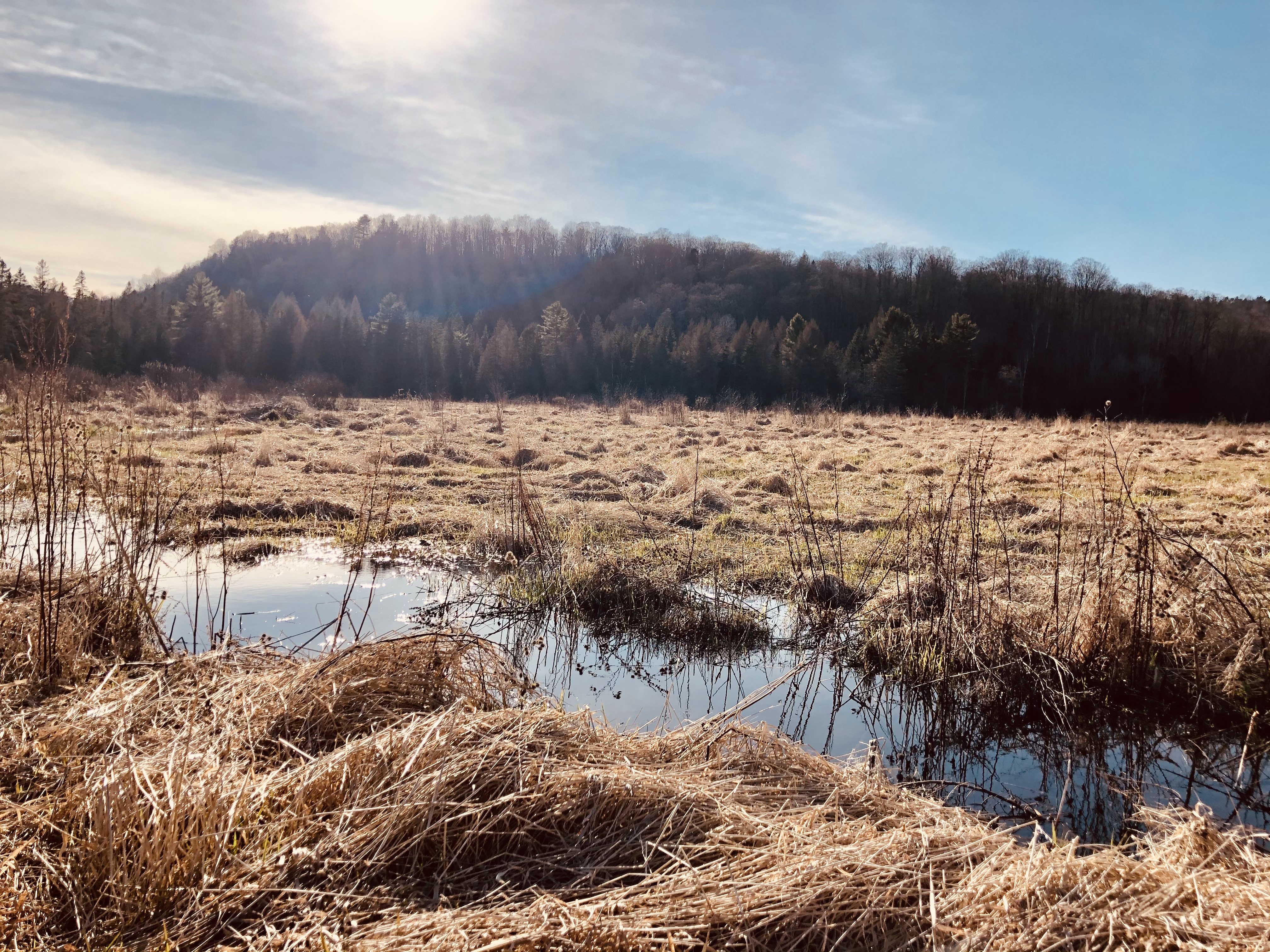
While waiting for my daughter to finish soccer practice, I wandered down the road and discovered three geese gliding through a wetland. I stood at the wetlands’ edge for the longest time, simply watching, as if by observing I can absorb some of their quiet certainty.
Everyday in Vermont, a few more strokes of green, a little more color.
“Empathy is more than putting yourself in someone else’s shoes; it’s using your power to fight for changes that don’t directly benefit you.”
I’m not a subscriber to so-called retail therapy, but I’m not averse to paint brightening up my patch of the world, particularly when I’ve chosen a light blue named Innocence.
My amusement mystifies my kids, and, honestly, myself, too. A better word to describe our life these days would perhaps be Koan. But try putting that on a paint can and marketing it. Who wants a little more koan, please?
Instead, I buy a used bureau from a couple who has seen far better days, or so I hope, and offer it to my daughter. From our basement, I pull out the can of yellow Little Dipper paint I used for our living room. She paints it on our back porch. I lean against the railing, looking at the trash that’s blown over the railing — junk mail, a used mask, a cardboard box I’ve used for kindling.
A sparrow sings in the box elders.
I turn around and watch her paint. What? she asks, looking over her shoulder at me.
Nothing, I lie. I reach for the quilt I washed that morning, hung over the railing, and fold it carefully.
I save my love for the smell of coffee at The Mill, the roasted near-burn of it, especially the remnant that stays later in the fibers of my coat.
Earth Day gives us snow in Vermont, that poor man’s fertilizer.
In a lightly falling snow, I lean against a school building, talking on the phone to my brother while my daughter plays soccer. Snow drifts in flakes about the size of a nickel, some melting on the pavement, others accumulating on tree branches and the toe of my boot.
The phone connection is stunningly clear — a surprise in rural Vermont.
As the snow falls, we wonder at the happenstance of circumstances — how the fall of a family member might have gone disastrously awry. Our conversation wanders beyond that, to the Chauvin trial, and the bystanders on that terrible day who, by happenstance, were present, and the teenage girl who pulled out her phone and shared her witness’s eyes with the world.
We’re in no hurry to hang up, and my brother suggests that, if Washington D. C. achieves statehood, the flag’s tidy stars will be kicked out of kilter. Vermont should succeed, he says.
After I hang up, I lean against that wooden wall. A fat robin lands in the snow, seeking a worm. My daughter and two friends walk across the parking lot, laughing, their braided hair damp with melted snow, their cheeks and bare knees bright red. It’s spring.
The temperature weirdly shoots up to 70 degrees. 70 degrees in Vermont in early April! For anyone who doesn’t live here, know that this warm, daffodil-growing weather makes our world a communally happy place.
While my daughter plays soccer, I take a walk, then spread out my work on a picnic table. Three geese fly overhead, making a honking racket. On the other side of a school building, I hear the kids laugh. Two dads roll up on bikes and stand in the parking lot, chatting.
Another parent I haven’t seen for a long time appears and stands at a distance. We talk and talk, about how our work has changed, and what’s happening with our kids, and even more, about each of us might want this summer — happiness, in some small way. Listening, I think, of all the many things we’ve learned this year, surely valuing the connection between us rises high. How little that might seem, and how infinitely valuable.
My daughter returns with a blister. At home, the carpenter has just finished repairing the porch railings broken by falling ice. We stand for a bit, talking and waving at early mosquitoes. He admires the view of the village below us and asks how I like living beside a cemetery. I like it just fine, I tell him.
Don’t talk to me about the stars, about how cold and indifferent they are, about the unimaginable distances. There are millions of stars within us that are just as far, and people like me sometimes burn up a whole life trying to reach them.
The wind chimes on our back porch tingle and clang all day and all night long. Spring pushes in not just with purple and pearl and gold crocuses, but with birdsong. 5 a.m., when I step out with a bucket of hot stove ashes, the robins are at it already, mating and nesting, busy with robin family-life.
I lie awake thinking of that window of time when my daughter contracted Covid, imagining when she might have let her mask slip, rubbed an eye with her fingers, the slightest of gestures she’ll never recall. Then I imagine the hours when she was contagious, before this gorgeous healthy teen said, My back hurts. I’m tired, and I closed my laptop, looked at her carefully, and began to worry suddenly, in earnest.
With my own two negative tests, the virus has (at the moment) passed over my body.
Snow falls, all day, on April first. We sleep with the windows cracked open, and I smell the particular damp scent of snow in the night. I lie there, thinking of the practical, mundane things of my world (as a single parent, could I get with it and write a will?) and the visible and invisible mysteries of this world. How I’ve tarnished and sullied the prayer of my everyday life, distracted by things that mean very little, while all along our days are unfolding, one after another, in their finite number.
The cats insist on breakfast. I stand at the back door, drinking coffee, watching snowflakes drift in a gray dawn, listening to NPR and a courtroom in Minnesota.
It’s another month. Despite the snow, spring edges in.
You’d better get busy, though, buddy. The goddamn sands run out on you every time you turn around. I know what I’m talking about. You’re lucky if you get time to sneeze in this goddamn phenomenal world.
Every morning when I wake in the dark, I think, I’m not sick, a revelation that begins the day. Although I’m not headed out of the house, for any number of days, I’m up especially early these days, thinking of Salinger’s Zooey telling Franny not to fritter away the best part of the day, buddy.
It’s all jumbled up here, even more than the past year. I am so grateful my daughter isn’t sick, that she’s counting down her quarantine days not with pleasure, but with her trademark resolution, her will do, but I’m plotting my summer plans….
For me, it’s wait and watch, a negative test followed by another test, results in 36-72 hours. Over us hovers the thought: which way will this go?
I set up work on the kitchen table, then move to the back porch in the afternoon. My daughter disappears on a long walk through the woods. At the tail end of winter, we haven’t pulled any outdoor furniture from the barn yet, so I sweep the boards and lean against what remains of the railing broken by falling ice.
In the late afternoon, I’m painting the interior windows of my upstairs office when I see the town librarian walking up my road with two books she’s leaving for me. I holler down, Thank you! We talk for a moment through my screen, and then she’s on her way again.
Like the rest of the world, I keep listening to the trial in Minnesota. My daughter appears and leans in the doorway, watching me. I tell her I’m going to savor this quarantine with her, that we’ll be talking about it someday, years hence, when she has twins and a baby and I show up to change diapers.
That’s wonderful, she tells me, and you have paint on your elbow.
Thank you so much, my readers, for writing in. It means the world to me.
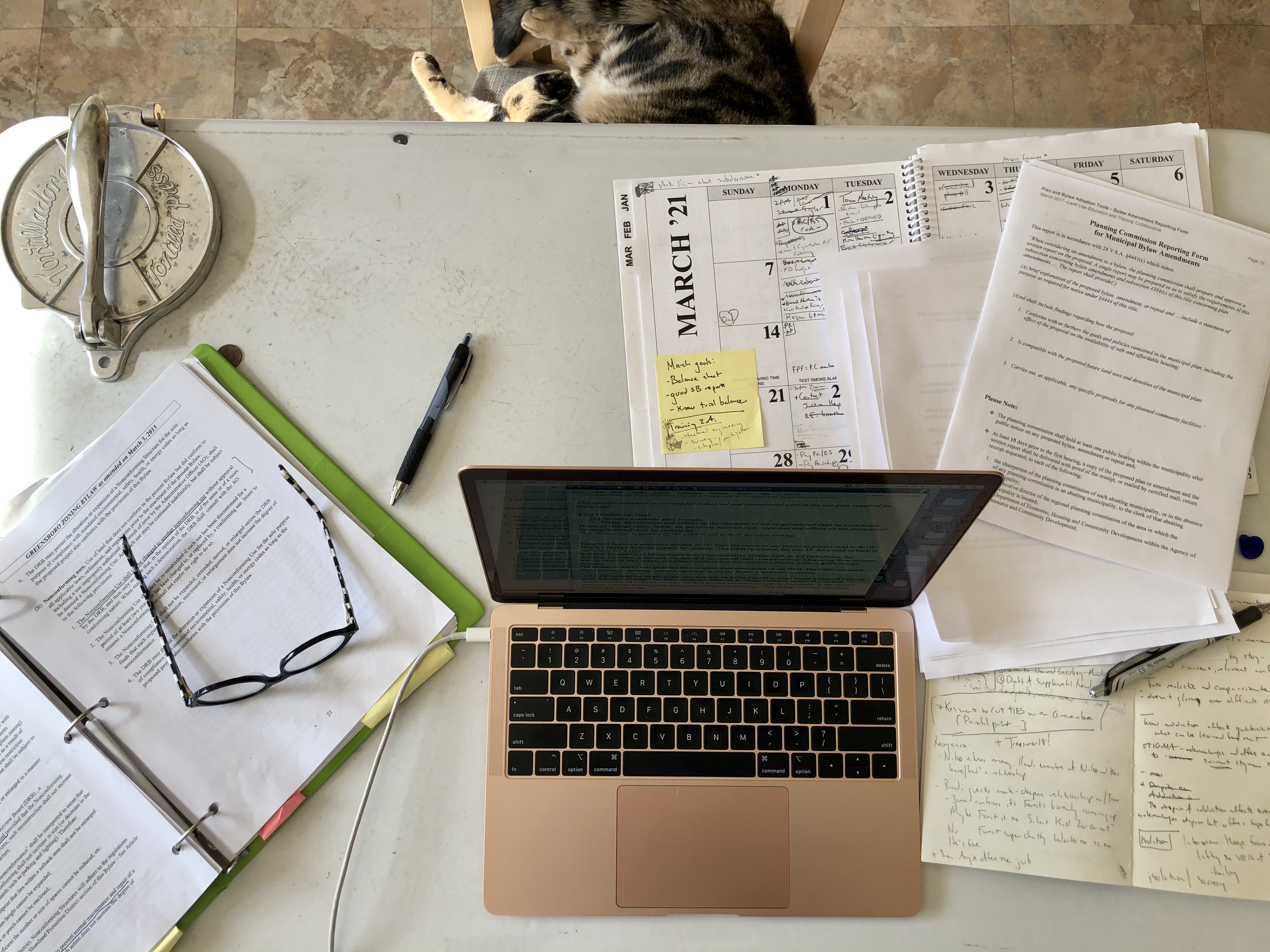
Kitchen office, complete with (working) cat and borrowed tortilla press.



 Stony Soil Vermont