Ferry Boat Captaining

For years, I’ve taken my daughter and her friends camping for a few days on an island in Lake Champlain. We’ve been going so long now that the years and memories have interwoven — the July the raccoons ate most of our food, how I always cook pasta and clams and greens from my garden, the way we always explore every bit of the island.

What’s changed is that the girls themselves have grown from kids to teenagers. This year, less biking and more talking.

In the early night, I lie awake in the dark, listening to the lingering remains of a thunderstorm and the girls tracing through school and soccer, questioning and wondering and thinking their way through the world.

On the way home on the ferry, we admire a sweatshirt the ferry boat captain is wearing. The shirt must have been issued by the Vermont State Parks. The back reads, 2020 We Did It.

We sit on the ferry’s open top. In the cabin, the captain invites in all the little kids on the ferry, surrounding himself with five and six and seven year olds. On the loudspeaker, he says, Lots of future captains with us today. We’re so lucky. All the way back from the island to the mainland, the kids cluster around him. There’s one place between rocks, marked with buoys, so shallow we can see rocks gliding beneath the lake water. He guides us through effortlessly, and in the open water again offers his chair to the children, who take turns. The children are radiant. The captain places his hand on a boy’s head and smiles joyfully.

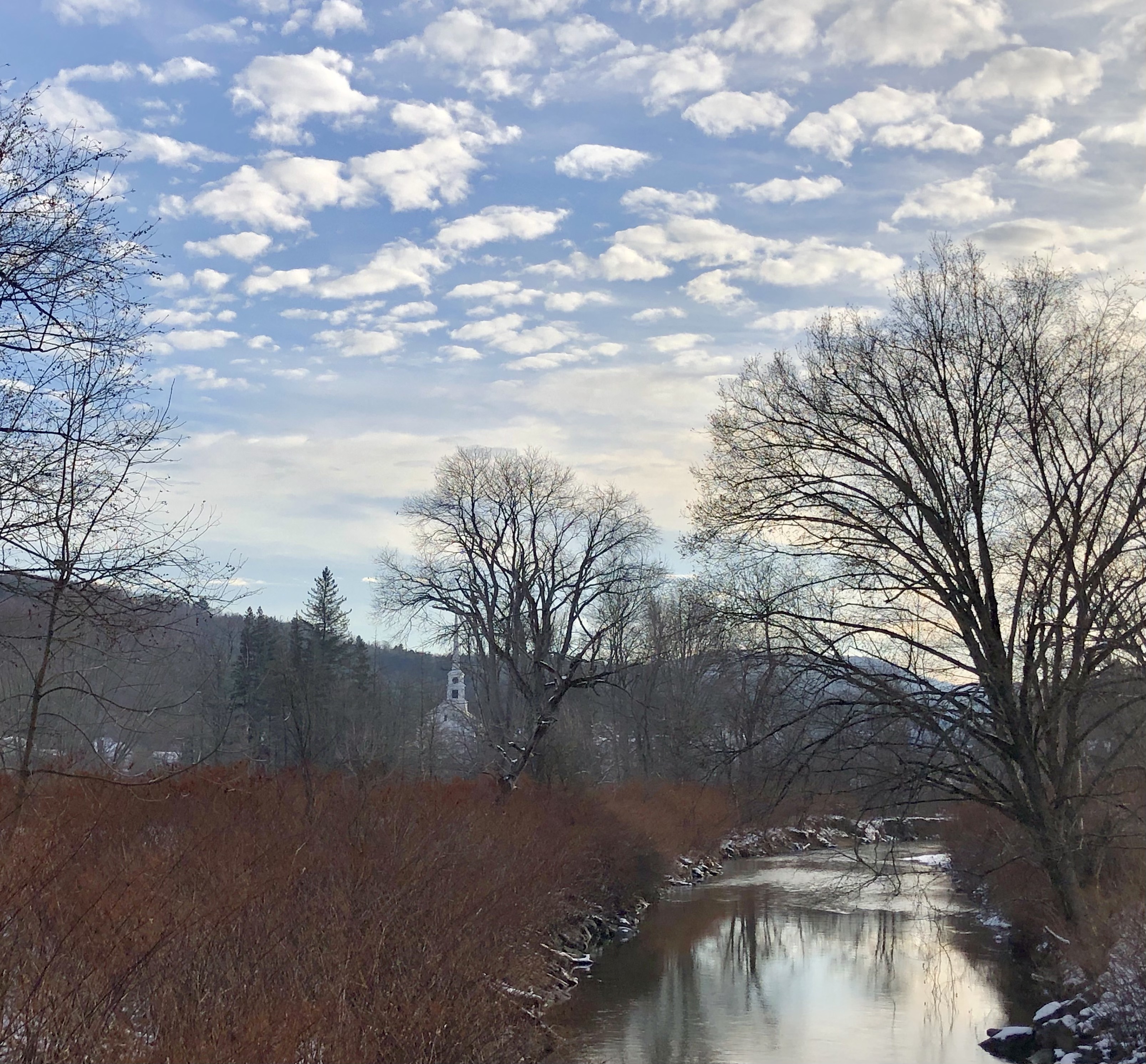
Burton Island, Vermont

Sunday Rescue

I’m reading on the couch Sunday afternoon when my daughter calls from her cell phone.

She’s walking on a nearby trail system and met a woman who lost her dog. The woman gave my daughter her cell phone number, in hopes that my daughter might find her dog.

My daughter says excitedly, I found the dog!

Good going, I say.

The dog, however, keeps rolling around on its back and begging for rubs. The dog won’t walk. What do I do?

Good lord, I think. I close my book.

The afternoon is rapidly heading towards dark. I take the leftover soup from the refrigerator and set it on the woodstove to begin heating. My younger daughter, excited to be doing something, knocks off her homework and offers to drive, nothing that her sister needs assistance.

As we head through the village in the twilight, I say, Hey, look at you. At fifteen, you’re already on your first dog rescue mission.

She asks, You’ve done this before?

Nope….

It’s dark by the time we find the elderly woman, wearing a mask, in her car in the dark by the side of the road, talking on her cell phone with my daughter.

I tell the woman my daughter is in the field, on the other side of the ruins of an old house, marked by maple trees. My youngest goes ahead, and I walk with the woman, lifting strands of electric fence that have been turned off for the season. In a break in the parting clouds, the sunset appears briefly as a dark bruise in the sky, before the night swallows it up. It’s balmy yet, for December; but it is early winter, and I know our house will be warm when we return.

My oldest — who cares not at all for dogs — has remained with the dog. At home, she washes away the scent of dog under her cat’s serious scrutiny.

Her sister says, You kept the dog’s person from getting lost, too…

Lighting the Way

On our evening walk in the dark, we pass by a house where a couch, a love seat, and an ottoman have been sitting in the front yard for nearly two months now. Last night, in the rain, passing by the FREE sign that had fallen on the wet ground, I wondered, What’s the plan here?

These evenings, I often stop by the neighboring house. That small house on Winter Street was built for granite workers around 1900, like the house I bought instead. The Winter Street house was dirty and unkempt, the kitchen not really a kitchen; no one seemed to have cooked in that room for a very long time. The woman who bought that house fixed it up, room by room, but now that house appears to be empty again; I’m hoping she’s found true love and moved elsewhere.

From her free pile, I’ve taken little things — a patterned bowl, a small plate with a fish.

Post-Thanksgiving, I walk with my youngest, who imagines a post-Covid world when she’s ready for college and then wonders about her few high school years remaining. What will that look like?

She knows the future is utterly unknown. Post-holiday, we’re in watch-and-wait, partly to see how the virus surges or not, and partly to see how, collectively, how our behavior will unfold. As always, the kids are at the mercy of adult behavior, for good or for ill.

So, when I hear the governor on the radio yesterday urge Vermonters to light up these long early winter nights, I abandon my usual bah-humbug attitude of not running up the electric bill or burning more fuel.

There’s plenty of winter ahead. The plan might be as simple as day-by-day take a walk in the dark, through the mist and beneath a gauzy moon. Walking across our front yard last night, I remembered where I had planted crocuses and daffodils, that the blue squill will return next spring, that night always passes, too.

“I know how hard this pandemic has been, especially as we make our way through the holidays without the ‘normal’ get-togethers and sense of closeness we all want,” said Governor Scott. “So, in celebration of the coming holiday season, I think it’s time to lift our spirits. Let’s get creative and show the world that Vermonters are here for each other and that even through these dark and difficult times, Vermont Lights the Way…. I hope this effort will spread joy and hope, especially for our kids… there are brighter days ahead.”

Sticky Notes

A week of chaos, a jumble of days.

By yesterday afternoon, my desk was littered with multiple sizes and colors of sticky notes, scrawled in my lousy handwriting. Before I headed home, I stood staring at this mosaic and considered chucking the lot in the recycling bin.

Instead, I decided to let that wait until next week.

Despite all this, we’re headed to the state championships for a soccer game — socially distanced, with masks, in the brilliant sunlight. At the beginning of soccer season, in September, my daughter’s high school team wasn’t even sure they would be able to play a game, but it was enough to practice together. Then they lost the first five games. Now, apparently beating bad odds, they’ve progressed to the state championships.

In this midst of utter adult chaos, what a pleasure to see radiant teen joy. Here’s hoping that joy is a harbinger of better days, all around, for all of us.

High School in the Time of Covid

My daughter’s high school varsity soccer team, the Lady Cats, advanced into the playoffs — local joy against rising Covid rates and the election hurtling along.

I didn’t play sports as a student, the lone wolf who ran long solitary runs — pretty much what I’m doing now, except these are short solitary runs. But to be a kid on a local team who wasn’t expected to do well at all — that’s a big deal.

Friday, I’m home briefly in the middle of the day. My daughter and her friend have finished school for the day. In the living room, they’ve set up this year’s version of high school, each with their notebooks and a school-issued Chromebook, surrounded by piles of my library books, their cleats drying beside the wood stove. The room is sunny and warm, and the girls are intently working at whatever assignment — chemistry or algebra.

I fill my thermos with espresso and ask my daughter’s friend if she’d like a cup. I’m joking, but she happily accepts. I’d love an espresso.

So, in a little china cup painted with blueberries that my daughter once used for milk, I serve this girl an espresso, who thanks me.

Before I head out the door again, I look back at these two. I’m happy to be employed, heading to interesting work, on this sunny autumn day, in my Shire of Vermont. But goodness, I’m grateful for girls and warmth. The whole world matters — disease and political collapse — but this afternoon matters, too.

I open the kitchen door, call I love you, step out into the chilly afternoon, and close the door carefully behind me.

Half Moon

I step around the barn in the twilight and see the half moon shimmering above the barn’s back corner, like a surprise.

I empty the ash bucket and set it on the cement step, waiting for my daughters and our twilight walk, as the dusk shakes down.

A year ago, my oldest was in New Mexico, visiting my parents and hanging out with my brother and his girlfriend. After a wild wind and rain storm, the power went out, and my youngest and I ate take-out by candlelight. Always, at this time of year, as the days perceptibly shorter, I realize how profoundly cold and dark has wound into my life, spread physically and metaphorically into the life I’ve shaped as a woman and a mother.

What’s different this year is the collective darkness of disease as the rates of Covid increase around our little world, of the unraveling political world relentlessly marching along.

And yet — there’s that ancient silent moon.

My daughters are laughing as they walk towards me.

What? I ask.

They look at each other again, and my oldest says, Nothing, Mom, and then they laugh again.

“I am more convinced than ever that we are shards of others.”

— Jenn Shapland, My Autobiography of Carson McCullers

Photo by Molly S.