Creative Chairs

I picked up six free chairs the other day. Amazing, what the back of a Toyota Matrix can hold, when the kids aren’t in. Chairs have been a burr in this household for a number of years, and we’ve cycled through a number of incarnations of castoffs, supplemented with a  great deal of glue. A shocking number have ended up permanently relegated to the basement. But these chairs, I believe, will be here to stay for some time. They’re hard-used, fully broken with the kind of grime around the edge that fits in here, from hands like ours, dirty and calloused and into all kinds of things.

I took the smallest chair, the one the giver (also a writer) preferred, and set it at my desk. The chair’s well-made, well-used, and infinitely appreciated by me. Not to mention, I didn’t have to outlay any cash.

Sweeping under the kitchen table tonight, I remembered being a teenager and wandering through the adult section of the public library. I found all kinds of gems in those stacks, but a particular one was Salinger’s Nine Stories, stories I’ve read over, and over, through so many phases of my life. These chairs reminded me of De Daumier-Smith’s Blue Period, a koan of a story (aren’t these all?) ending with a mystical experience involving a mannikin. At the story’s end, in exasperation perhaps, the main character takes a chair up to his room. The house’s owners are Japanese, and the bedroom lacks a chair. I’m reminded of this story at times, when I can’t seem to get it together to just bring a chair up to a room, to just do an apparently simple thing.

I remind myself: do the simple thing. The harder things are hard enough. Early this morning, while the creamy moon was sailing over the house and the children were still sleeping, I was at my desk with my pages and pages of sentences. I thought, This is hard, but do something harder, write what I’d least expect, and I leaned over the page.

… the letters seemed to write themselves. It may have had something to do with the fact that, before sitting down to write, I’d brought a chair up from downstairs.

–– J. D. Salinger
IMG_0177

Cycle of Seasons, Firewood, Re-Envisioning Your Soul….

Driving home today, last week’s mantel of golden leaves had fallen from Elmore Mountain, leaving only a dull gray and dark evergreen. In Vermont, the seasons change fierce and hard, the fall hammering away summer’s softness, the spring mud swallowing winter’s crystalline beauty.

The last of our winter’s firewood has yet to be stacked, sprawled over the grass. I’m impatient, anxious for the wood to be stacked and drying, my precious heat. My older daughter complains about the ceaselessness of this chore: we cut and split the wood, stack piles, carry armloads into the house, load the stove, shovel the ashes out, and do all this again. And again, and so on….

I point out this year I actually bought firewood.

Whatever, she says, rolling her eyes, exasperated.

As kindly as I can (which might be little), I say, But that’s life.

She’s sixteen; she’s not buying my advice. I can hardly fault my daughter. At sixteen, my own eyes were on the linear horizon, eyeing the freedom of the open road, the sky unbounded. I believed I could remake – or re-envision – my own soul. Perhaps, yet, even with my hands full of firewood and ashes, I still believe I can.

But you can’t get to any… truth by sitting in a field smiling beatifically, avoiding your anger and damage and grief. Your anger and damage and grief are the way to the truth. We don’t have much truth to express unless we have gone into those rooms and closets and woods and abysses that we were told not to go in to. When we have gone in and looked around for a long while, just breathing and finally taking it in – then we will be able to speak in our own voice and to stay in the present moment. And that moment is home.

–– Anne Lamott, Bird By Bird

IMG_0162

Burlington, Vermont

Storm Windows, Fiction

While I was at work yesterday, my daughters washed and latched storm windows on the kitchen windows. They also biked in the season’s first snow, baked a chocolate cream pie from Pie which the younger daughter is reading, argued, played memory games, and spread out a rug in front of the wood stove as an official opening to the wood stove/snow season. Already, the piles of games and books and knitting are growing in uneven piles on that rug.

As my own book nears its publication date, I’m pushed to speak more about how I came to write this book, and why. In my own busy household that mixes children and rural Vermont, what’s increasingly clear to me is that writing is a human activity as essential to our lives as stocking your root cellar or bank account or however you do it for the long, colder season ahead. Our culture emphasizes material gain above pretty much everything else, but, really, at the day’s end, there’s little else of relevance besides stretching your bare toes toward a hot fire, with the children nearby, and the windows buttoned up against the growing dark and cold.

The society to which we belong seems to be dying or is already dead. I don’t mean to sound dramatic, but clearly the dark side is rising. Things could not have been more odd and frightening in the Middle Ages. But the tradition of artists will continue no matter what form the society takes. And this is another reason to write: people need us, to mirror for them and for each other without distortion – not to look around and say, “Look at yourselves, you idiots!,” but to say, “This is who we are.”

Anne Lamott, Bird by Bird

IMG_0119

October/West Woodbury, Vermont

Stellar Fifth Grader

My teenager often ponders her career path these days. She wants a salary (likely because neither of her parents, being self-employed, ever managed that little detail). She wants to love what she does.

My younger daughter listed the various what-I-want-to-be desires she’s cycled through: a pop star, a race car driver, a jeweler in Boston. Then she thought for a moment and said, I’m happy doing what I’m doing now. I’m a really good fifth grader.

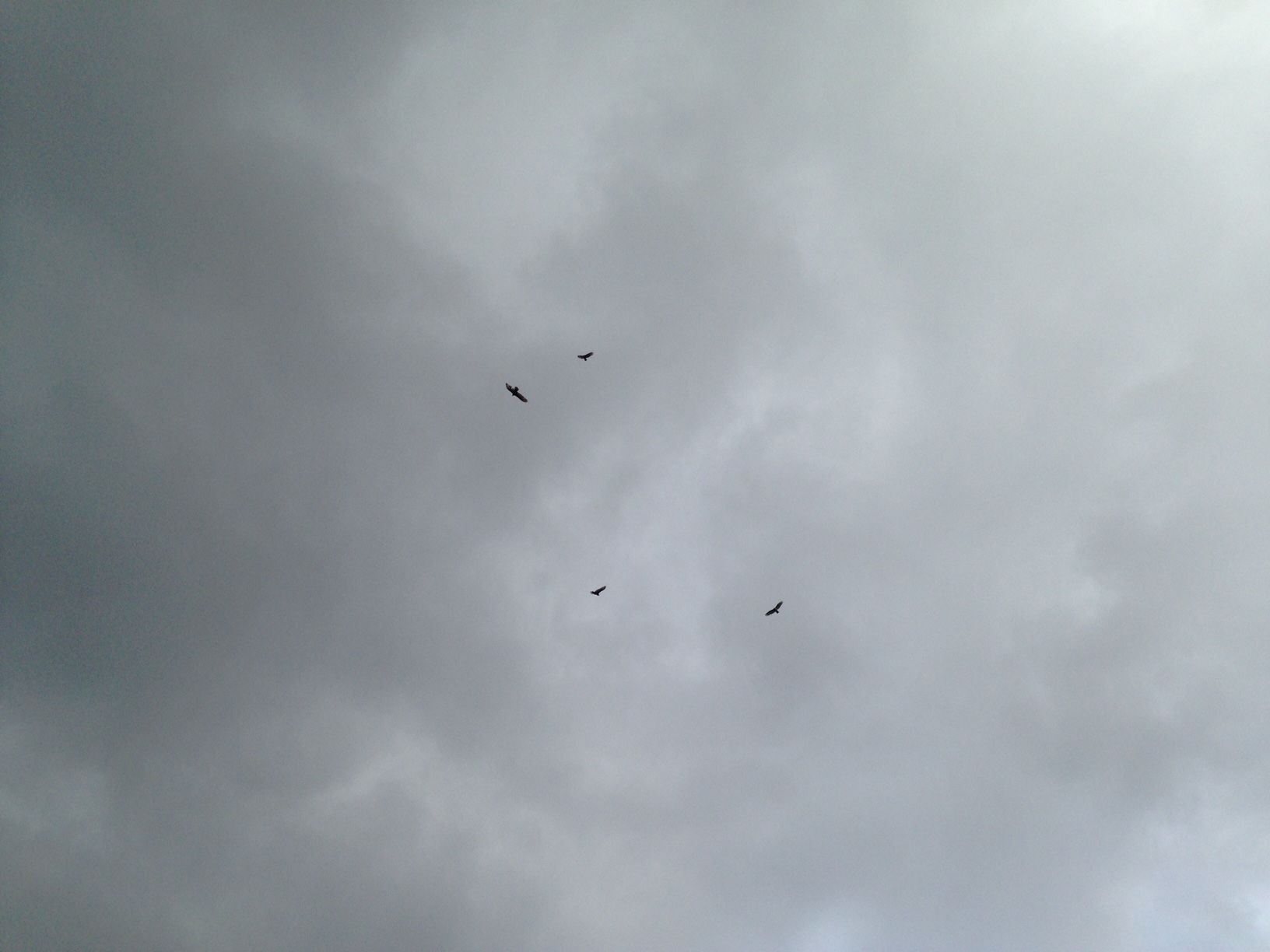
I interrupted their conversation to pull over on the road’s shoulder at the mini-storage, and we stood on a strip of frost-bitten grass staring up at a confluence of turkey vultures, circling around and around in the air currents.

Back in the car, my older daughter in her pragmatic way told her sister, Do fifth grade while you’re there, and then worry about the rest of your life.

If these rescuers (of Jews in WWII) had anything in common… it was self-knowledge. When you know yourself there is little to say. This is worth brooding upon as we consider how we, who know ourselves so poorly and have so much to say about ourselves, will respond to challenges to come.

— Timothy Snyder, Black Earth

IMG_0105

Hardwick, Vermont

Financial Aid Lingo

Tonight, my older daughter and I sat in her high school library listening to a power point presentation on college financial aid – don’t nod off right now! Sitting there, wishing I had a cup of coffee, I glanced at my daughter’s eyes glazing over as she doubtlessly sat thinking of something else entirely. I added up the loan amounts for four years of college (holy cow!) and underlined my note: Don’t miss deadlines.

On our way out, I asked for the presenter’s email address, and she asked me if I had gone to collegeI told her I had, but my dad filled out the forms – and that was in the prehistoric non-digital age. The woman commiserated that my dad had to xerox tax forms.

Driving home, my daughter remarked that no one used the word xerox anymore. Why do you and grandpa keep doing that? The word is copy.

I assured her xerox is definitely a verb. Like a more modern version of mimeograph.

She was silent a moment, driving through the darkness, and then she asked, Mimeograph? What’s that?

… Sometimes, I see parts of myself in my older daughter – an exasperation I had when I was younger at the adult world’s infuriating mediocrity, a why-can’t-you-get-yourselves-together-ness.  At sixteen, on the cusp of stepping into her adult life, the whole great world of love and desire and ambition (and heartbreak, inevitably, although not too much, please) yet to spin out before her. And then sometimes, in that cyclical way time moves, I see my father reflected in me, all those careful files he kept, putting his three kids through college.

At home, I laid the evening’s materials in a folder on my desk. My daughter came into the room and asked with great seriousness, Can we do this?

I smiled at her. Piece of cake, I assured her. Meet deadlines, stay organized, follow the rules, fill out all the forms. 

Forms are the easy part.

When we are loved, we wish the other to recognize our presence, and this is a very important practice. You must do whatever is necessary to be able to do this:  recognize the presence of the person you love….

— Thich Nhat Hanh

Small Pond in Woodbury, Vermont

Small Pond in Woodbury, Vermont

Other Gods

At the dinner table the other night, my older daughter had some questions about the ten commandments. Although she attends a secular public high school, apparently the commandments surfaced in a health class discussion. Transported back to my few elementary school years in Sunday School, I remembered crayoning two suspiciously tombstone-like tablets and a mighty Moses figure. I assured my girls honoring their mother was a key commandment.

But the commandment that stumped her was the second:  Thou shalt have no other god. What the heck could that mean?

We were eating bacon-traded-for-our-syrup from a friend’s pig, an enormous porcine wonder once named Douglass. I had fried the thick fat golden crunchy on the outside, creamy and savory-smoked on the inside. The frost hadn’t yet gotten to my peppers, and with the bacon fat I had sautéed poblanos with my garden onions and garlic and nearly the last of the tomatoes. My younger daughter tore pieces of crusty bread and laid these on our plates.

I suggested: think about what fills your life. What if your life was consumed with the desire to win an Olympic figure skating medal, or insatiably to earn money? Or what if your life was filled with cultivating thousands of acres of commercial corn? Overseeing a small town library? Teaching kindergarten? Or suffused with a quest for something else: gambling, anorexia, heroin? What about Vermeer and his eleven children, the unpaid bakery bill at his death, and the two paintings his wife hocked in exchange for that debt? For better or for worse, isn’t what you fill your life with, and what you pursue, precisely what you kneel before?

There’s an upper window in our kitchen, and at this time of year, sunlight falls down in the late afternoons on our table. Years ago, my parents gave us this table from my girlhood home. The butcher block has held up all these years.

Oh, little girl,
my stringbean,
how do you grow?
You grow this way.

— Anne Sexton

IMG_0083

Montpelier, Vermont