“Like a definition of love…”

Eight summers ago when my daughters and I first moved into this house, we swam in a nearby pond, usually with friends who lived nearby. In those eight summers, the kids grew up and are now swimming in other lakes, other ponds. I kept on. The swimming and conversation was a peaceful way to end jammed and often chaotic working days.

Late last fall, as part of extensive testing after I was diagnosed with lymphoma, I realized I had Giardia, too, proverberial small potatoes compared to cancer and easily treated. This year, I never started swimming. In May, I’d endured a painful surgery with a lengthy incision that needed to heal. That nearby pond was the most likely source of the Giardia.

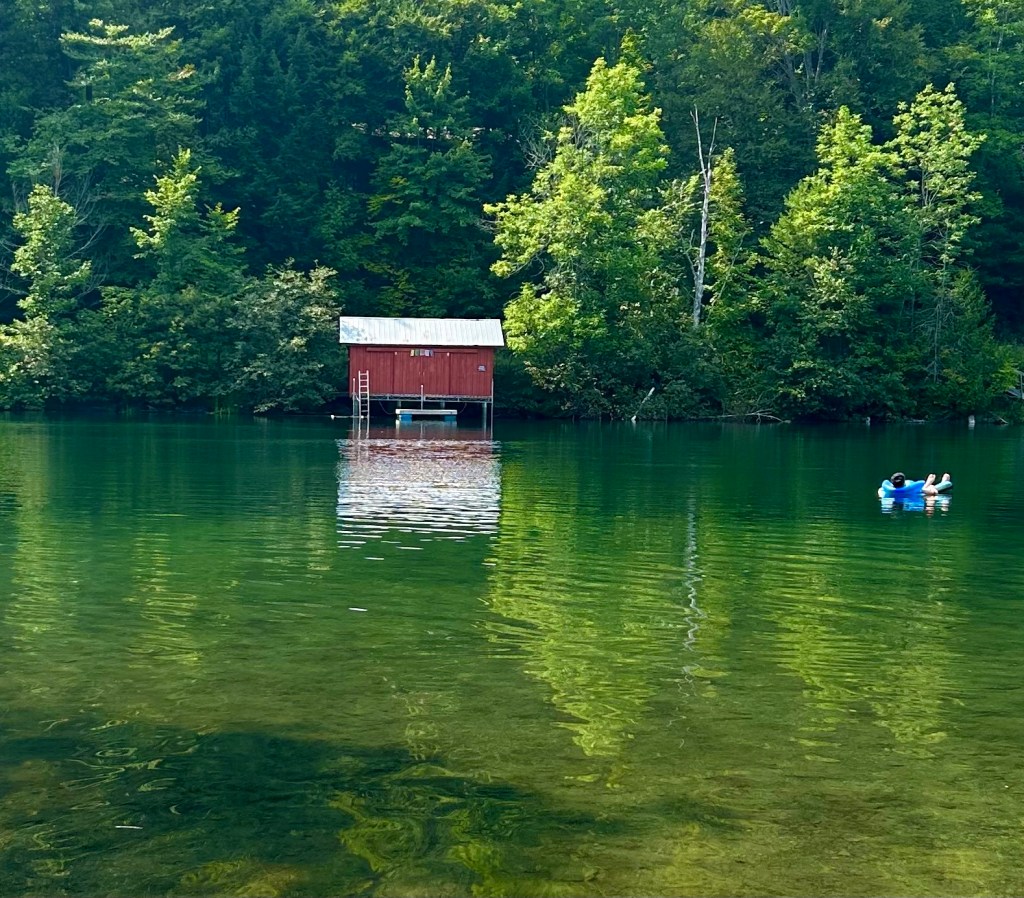
This August, a friend convinced me to swim at #10 Pond, familiar territory between our two houses, another place where my daughters and I swam and kayaked and picnicked. I arrived a few minutes early, opened my book, and the loons cued. This pond has always been one of my favorites: clear water, friendly fellow swimmers, scant motorized boats, little development. The water was cool. Kicking my legs, I felt my incision tug, but it was a sensation, nothing more. Afterwards, we lingered, drying and warming in the sun.

Yesterday, I was in sultry Barre and drove by the pharmacy where I had the go-around with the pharmacist and sharply insisted he fill my dilaudid prescription. I was on my way home from yet another lengthy stay at Dartmouth. We had to wait for the prescription, so my brother and I walked around Barre. It was early spring, hot, and the trees hadn’t yet leafed out. He’d parked on a hill and worried I couldn’t walk back up. I’d been on blood thinners, and the bandage around my IV site was soaked with blood. Don’t open it up! he warned me. It was so dusty and hot, and I was exuberant to be in the world where daffodils were blooming.

So yesterday, on my way home, I stopped at #10 Pond again, swam and read and listened to a nearby conversation between two men who were fishing — and the loons, of course, the loons.

We’ve now crested beyond the high summer. Each August day offers its own potential, for swimming or heartbreak or simply eating ripe peaches. Reader, wherever you are, love at least slices of your lives and places.

I’m about to send off a third novel manuscript to an interested party. In the dark this morning, I woke and began the book I’ll write about cancer and motherhood. Sure, cancer changed my life in small and great ways, but a year later it’s still the same me, rowing my life against the common current, compelled to write something that seems impossible.

And, for historical and record-keeping notes, I’ll add that the full moon, the Sturgeon Moon, rose smoky and red, ineffably beautiful over the cricket chorus.

“Green Apples” by Ruth Stone

In August we carried the old horsehair mattress
To the back porch
And slept with our children in a row.
The wind came up the mountain into the orchard
Telling me something:
Saying something urgent.
I was happy.
The green apples fell on the sloping roof
And rattled down.
The wind was shaking me all night long;
Shaking me in my sleep
Like a definition of love,
Saying, this is the moment,
Here, now.
A real clusterfuck of thinking…

Hurrying from one thing to another, I detour to my favorite swimming pond, under these overcast skies. A woman and a little girl are swimming. There’s no one else around, and the woman and I chat about the fish nibbling our toes. The girl sits on a floatie shaped like a chocolate ice cream cone and looks skeptically at us, as if her mother and I might be making up everything. Maybe, in truth, our toes are bleeding from fish fangs. The child is taking no chances. She leans back on the floatie and stares up at the sky. Her mother gently pushes her from shore.

I swim out.

My head is jammed with the conversation I just had over Pad Thai, three of us women, about writing and Vermont and friendships, about money, of course, always about money, how money winds into decisions we make. These are old conversations, worked out in new ways. As I drift out in the cold water, I keep thinking about all the material I’ve been reading about rivers and history, about farming and logging hands on the land, 100, 200 years ago, how what made sense then (sense? perhaps even seemed downright innovative, bordering darn smart) has piled up over these generations of rivers, now dredged too deep, the roads and the towns built far too near.

Because my mind works in metaphors, I keep thinking how years pile up mistakes, one after another, a real clusterfuck of thinking. There’s no one else around in the water save for me and the mother and girl. They’re both lying on their backs on the ice cream floatie now, circling around, the mother’s heels trailing in the water. All those summer days I spent at the beach with my daughters, with plastic shovels and buckets, with the sleeves of red cups that I used at the farmers’ market back in the days when I sold homemade root beer floats, $2.75 per cup…. The kids are now all (mostly) grownup, as happens. Maybe those years were nothing more than a light way to pass the days, insubstantial as dreams.

I swim out as far as I can bear in the cold water. When I return, the beach is empty. Clouds have pushed down low, and the sand is clammy. On my short walk back, two bikers ask me for directions. Go west, I advise. That’s the way out of here.

Finding a Thread.

On my way home, I stop at Number Ten Pond. The water temperature is at that sweet spot, exactly perfect — and how often do you touch perfect? — and I wade right in. A woman stands in the pond, two children splashing around her. She laughs when the minnows bite her toes.

I swim far. In the pond’s center, I float on my back. With my eyes closed, my mind’s eye turns red, with blood or sunlight, who knows, and I’m no longer sure which way is up or down, water or sky. I’m distant enough from shore that only the loon call reaches me. By the summer’s end, these swims will add up to an invisible chain of experience: of water and weather, of whatever language drifts my way. July here, just a handful of fleeting days.

"Everything Is Made Of Labor"
Farnaz Fatemi

The inchworm’s trajectory:
pulse of impulse. The worm
is tender. It won’t live
long. Its green glows.
It found a place to go.
Arrange us with meaning,
the words plead. Find the thread
through the dark.

Facts Yet Matter.

As one of the things I do to keep my household of daughter and me and two cats churning along, I spend an inordinate amount of time on minutes for a complicated development review board hearing. The writing poses the interesting questions of what to include, what to delete, clarity of the whole, simplicity of sentence. Beneath this, the minutes are a miniature of a town and the push-pull around building and change, of past and present and future, of how multiple stories of people intersect.

A deep appeal for me, writing these minutes, is that the facts matter. I arrange numbers and percentages, how these describe boards and a proposed building beneath a stand of cedars.

What I don’t include is that beyond the cedars the bank drops steeply into the water. The water is particularly clean. I’ve been swimming at the public beach for years, and I know how you can swim far out and look down at the sandy bottom. Flecks of mica glitter in the sunlight. The facts of my own story include an especially warm October day many years ago when a friend and I ventured far out into the lake. We swam among the first of the fallen red leaves. The day was so warm and the water so still.

And a line from Nikita Gill that sums up my tenor of thinking these days….

“We have all taken turns being Red Riding Hood and we have all been the wolf.” 

— Nikita Gill

‘In sorrow, pretend to be fearless.’

In Praise of Coldness

“If you wish to move your reader,”
Chekhov said, “you must write more coldly.”

Herakleitos recommended, “A dry soul is best.”

And so at the center of many great works
is found a preserving dispassion,
like the vanishing point of quattrocentro perspective,
or tiny packets of desiccant enclosed
in a box of new shoes or seeds.

But still the vanishing point
is not the painting,
the silica is not the blossoming plant.

Chekhov, dying, read the timetables of trains.
To what more earthly thing could he have been faithful?—
Scent of rocking distances,
smoke of blue trees out the window,
hampers of bread, pickled cabbage, boiled meat.

Scent of a knowable journey.

Neither a person entirely broken
nor one entirely whole can speak.

In sorrow, pretend to be fearless. In happiness, tremble.

— Jane Hirshfield

July 31. Swim.

The dog is a new thing in our lives. My oldest daughter lives nearby with a sweet and curious dog. Yesterday, we brought the dog into our house to meet our two house cats. One cat remained on the kitchen table in his beloved cardboard box (I know, I know who allows things like this? a cat in a box on the kitchen table not for an hour or a day but for months?), paw crooked over the edge of the box, looking at the dog in the cool disdainful way of felines. Our other cat trembled in the doorway, holding his ground. Curious, cautious, verging on endearing and ridiculous. The dog seemed just happy to be there.

We decided to swim and took a giant floatie shaped like a pineapple that I had bought last year for camping. Jammed in the trunk, the floatie hung over the backseat which bothered the dog, who moved into the passenger seat. My daughters sat in the back under the floatie. I drove and talked to the dog. The wind blew in through the windows, muting my daughters’ voices. So many miles I drove with kids in the back, looking over my hands on the steering wheel. For few miles, I was back in the world of young motherhood.

Despite the heat, the lake wasn’t crowded in the least. A woman walked down the sandy path holding a beer can. She and the group at the far end exclaimed that they hadn’t seen each other in thirty years. My oldest whispered, Thirty years? I answered, What’s thirty years, really, forgetting entirely for a moment my daughter is far younger than thirty.

The drive to the lake was a short one. After swimming, we went up the road to the general store and ate pizza on the deck. We chatted with people we saw all the time, and some we hadn’t seen in years. The dog — good creature — waited patiently.