Mapping, Metaphor, Motherhood.

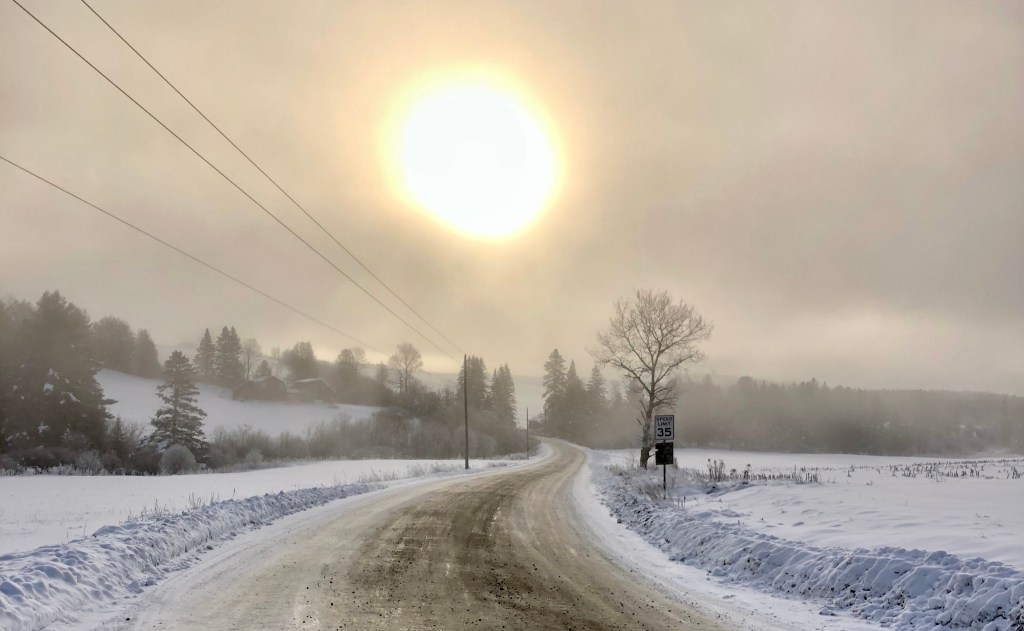
I forget my map on my desk beside my eternal list (write thankyous, double check FAFSA submission, confirm E and J meeting….) and drive over the Canadian border shortly after sunrise. Luminous crimson stripes the clouds. Almost immediately, the land flattens from Vermont’s hard ridges to industrial ag fields, distantly studded with metal silos. Late December, and the terrain is more gray than white. I stop at a gas station and ask a woman who is emptying her car of fast food wrappers for directions. I don’t understand her accent, the slipperiness of French that eluded me all those high school French classes. She wants me to understand, repeating her directions, one hand waving a crumpled bag. I nod thank you, thank you, and turn back to my salt-crusted Subaru, miserable with my lack of agility with language. Aren’t I a writer?

At a crossroads, I have no idea which road to take, and the world opens up abruptly in dizzyingly wideness.

My intention is to drive to Montreal to meet my daughters. I hate driving the dullness of interstate and fear driving into cities, and I’ve made this infinitely worse by losing my map. For years with young children in carseats, I delivered maple syrup around Vermont, navigating by atlas and rivers, the sun and roadsigns, using my tools of snacks and a box of board books. I once pulled over and lifted a handful of pebbles from a roadside so my toddler could dump pebbles from one paper cup to another, satisfying her tired self.

Now: no map, no cell service, in a town whose name (ridiculously) I never learn, I pull a Streetcar Named Desire card ask strangers to point my way out. A teenager shrugs. An old man can’t hear me. Finally, an electrician in a truck gives me directions. We repeat his directions to each other three times, and then I roll out, my heart not full of faith, precisely, but enough warmth of optimism. May this new year bring out the generosity of strangers and of ourselves. Thank you all for your kindness and curiosity for reading.

You should keep on painting no matter how difficult it is, because this is all part of experience, and the more experience you have, the better it is… unless it kills you, and then you know you have gone too far.

— Alice Neel
Soundtrack.

My oldest plays Noah Kahan as the soundtrack to her life, the young man who sings of loving Vermont in all its bareness and glory: I love Vermont, but it’s the season of the sticks

I pull over on the roadside. There’s no one around, not even a crow keeping me company. Solstice season, the precipice of one thing tipping into another, the darkest of the season tipping over into the real winter yet to begin. I am decades into my own love personal affair with Vermont.

Winter is the perfect season for a writer with its shocking beauty, the looming threat of frostbite, the profound metaphor of darkness and light, heat and cold, stillness and the edging-in resurrection of spring. On the deepest level, perhaps, winter reinforces the need for patience.

Noah Kahan sings: So I thought that if I piled something good on all my bad
That I could cancel out the darkness I inherited from dad…

How’s that for a variation of an Eugene O’Neill play?

Curious about this Kahan character? Check out Vermont Public Radio’s story.

Glass. Packages. Blood.

My daughters spent years playing with glass containers. Sure, we also had the usual endless assortment of empty yogurt containers, the odd plastic collection, the paper cups such as the beloved Easter bunny cups (known lovingly as cups-with-bunnies), but we made and sold maple syrup for years.

At one point, wedding favors in leaf or heart bottles was a chunk of our livelihood. I made endless trips to different maple distributors, loading up the back of my station wagon and often around my daughters in carseats with cardboard boxes of glass. That 8oz maple leaf with a gold foil top? Top seller.

I packed and shipped maple syrup in the PO’s flat rate boxes. Those boxes made shipping syrup a viable family endeavor, and I knew all the post offices in my small sphere of travel. Headed to story hour at the library? I swung by the Greensboro post office. Picking up more glass? East Montpelier post office. Need bike parts? Morrisville.

I had a “well, duh,” moment this week at the post office when I weighed a package to my parents. The clerk kindly handed me a flat rate box, tape, and a mailing label. I asked for use of a pen, too, then stripped off my winter coat and hat, and went to repackaging work in the PO corner. I sliced my fingertip on the blade of the knife dispenser and bled on the label and then on my check. All those years, so many bottles filled with sand and pebbles, with colored water and concoctions of leaves and flower blossoms, and I don’t remember a single glass cut on my daughters’ little hands.

I ripped up the check I’d bloodied and wrote another, left-handed and nearly illegible.

Cutting into with the ax,

I was surprised at the scent of.

The winter trees.

— Issa

The Beginning of Genius.

An acquaintance comes into work today to update the town’s website. We talk back and forth, little details here and there, the mechanics of putting the website together and how the pieces of democracy work: minutes and transparency. The public can and does come to Selectboard meetings with requests to move roads and complaints about cowshit spilled over roads. Our conversation tips into philosophical territory. Nearing the end of a challenging week, I’m drinking my 46th cup of coffee that morning and espouse that we’re in end-stage capitalism. Sometimes we behave very badly. Sometimes, not so.

I am not at all a Facebook fan, not a FB reader, but all week I’ve been dipping into the stories people have posted about Ray McNeill. So many stories, some from people I once knew very well. I lived in Brattleboro when I turned 21, completely alone in an apartment over The Shin La, a Korean restaurant still in operation. One night, I closed Céline’s Death on the Installment Plan and went out in the rain. Even then, I was a loner. I didn’t go to public places alone. But that night, the rain fell so hard I ran into Three Dollar Deweys. My friend Debi was there. In those days, she lived with my ex-boyfriend. She came up to me and rubbed my long hair with bar towel. We played darts for hours. The bar lights shone out into the falling rain.

“The beginning of genius is being scared shitless.” 

— Louis-Ferdinand Céline

November.

I must appear half-drowned when I walk into the library, because the librarian asks me just how bad is the weather?

I reach into my jacket and extract a few books, then slip under my sweater the one he hands me. Three-thirty in the afternoon, and a dark rain presses against the windows. The weather reminds me of Ethan Frome, of Walden, of the wildness of Dostoyevsky, the human longing for a hot hearth and candlelight over a bowl of soup.

At home, my cats — self-satisfied as cats are — are pleased they survived the visiting dogs. They’ve regained their places before the wood stove, still slightly disdainful that we’ve allowed in the canines. There’s no one out, the roads nearly deserted, the sky concealed beneath the clouds. A wet wind blows.

At home, I wash the dishes and empty the compost in the bin beneath the apple tree. A cardinal flies into the tree’s thickety branches, a welcome sight.

“There are two ways of spreading light: to be the candle or the mirror that receives it.” 

— Edith Wharton

Snapshot. Vermont Thursday.

In Newport, at the Vermont/Canadian border, a woman in a bubble-gum pink blazer strikes up a conversation with me in a parking lot about the snow falling into Lake Memphremagog. Mid-morning, dense clouds, fat snowflakes disappearing into the gray lake. I’ve never been around the Canadian edges of this lake.

In Newport, I stopped first to visit my new acquaintance Lila Bennett to check out the work she and her colleagues are doing at the Journey to Recovery Community Center. The center is suffused with natural light, alive with plants and colors, and it’s immediately obvious that they’re engaged in that old-fashioned phrase, “the good fight,” work that saves and salvages lives. Lila shows me the stack of my books, too, that the center is giving away for free, to anyone who wants to read it. I thank her profusely.

I’m in Newport, too, to find my way into a state building, up through a reverse rabbit warren into a large and light-filled room where the state’s staff tells Selectboard members and volunteers from Vermont’s tiny Northeast Kingdom towns about the chunks of federal money in the state’s coffers and asks how to get that money to the needy and broken places in our rural communities.

The room is packed. I sit in the back beside a state senator who offers me advice while I knit a sweater cuff. My blue and orange balls of fingerling yarn roll beneath a stranger’s chair.

The snow falls all morning. A woman I knew 25 years ago comes up and reintroduces herself and launches into her enthusiasm for the rail trail. I chat with the Department of Libraries staff member who reads my blog.

Finished, I hurry down to the lake’s boardwalk before I leave, to breathe in some of that cold wet air. Years ago, my little girl lost a flipflop in this lake. I was talking to someone from the farmers market where I worked, and I turned around when my daughter cried out. She had stuck her foot through the railings and lost her shoe. My friend tried to save her shoe with a stick, but the pink- and purple-flowered flipflop bobbed away, headed northward.

I can’t see my future clearly…

The road becomes itself

single stone after single stone

made of limitless possibility,

endless awe.

— Jacqueline Suskin